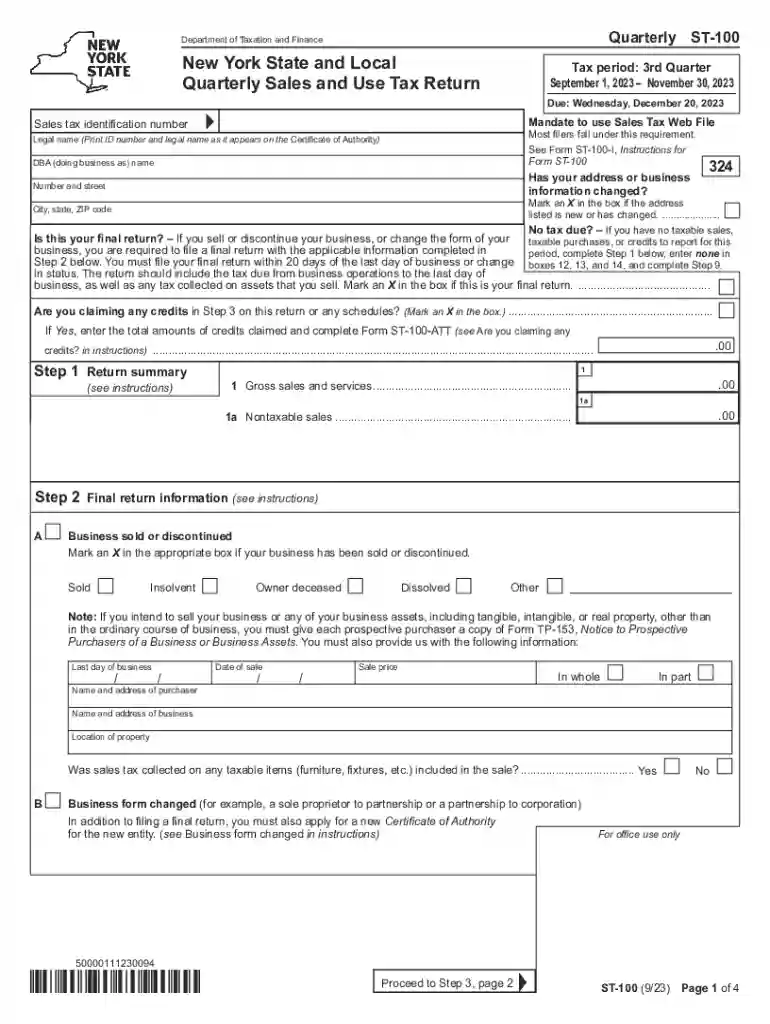
Form ST-100 New York State and Local Quarterly Sales and Use Tax Return Revised 9 23 2026

Get Form
st 100 form Preview on Page 1

Here's how it works

01. Edit your st 100 form online
Type text, add images, blackout confidential details, add comments, highlights and more.

02. Sign it in a few clicks
Draw your signature, type it, upload its image, or use your mobile device as a signature pad.

03. Share your form with others
Send it via email, link, or fax. You can also download it, export it or print it out.

How to use or fill out Form ST-100 New York State and Local Quarterly Sales and Use Tax Return Revised 9 23 with our platform

Form edit decoration
9.5
Ease of Setup
DocHub User Ratings on G2
9.0
Ease of Use
DocHub User Ratings on G2
  1. Click ‘Get Form’ to open it in the editor.
  2. Begin by entering your sales tax identification number and legal name as it appears on your Certificate of Authority. If your address has changed, mark the appropriate box.
  3. In Step 1, summarize your return by entering gross sales and services in the designated fields. If you have no taxable sales, simply enter 'none' in boxes 12, 13, and 14.
  4. If this is a final return due to business discontinuation or change, complete Step 2 with the necessary details about the sale or change of business form.
  5. Proceed to Step 3 to calculate sales and use taxes. Enter totals from any applicable schedules as instructed.
  6. Continue through Steps 4 to 9 for special taxes, credits, and final calculations. Ensure all amounts are accurately entered before signing.

Start using our platform today for free to streamline your form completion process!

See more Form ST-100 New York State and Local Quarterly Sales and Use Tax Return Revised 9 23 versions

We've got more versions of the Form ST-100 New York State and Local Quarterly Sales and Use Tax Return Revised 9 23 form. Select the right Form ST-100 New York State and Local Quarterly Sales and Use Tax Return Revised 9 23 version from the list and start editing it straight away!
Versions Form popularity Fillable & printable
2023 4.8 Satisfied (42 Votes)
2022 4.1 Satisfied (57 Votes)
2021 4.8 Satisfied (45 Votes)
2020 4.2 Satisfied (125 Votes)
2019 4.3 Satisfied (179 Votes)
2018 4.3 Satisfied (109 Votes)
2017 4.2 Satisfied (49 Votes)
2017 3.9 Satisfied (28 Votes)
2016 4.4 Satisfied (431 Votes)
2015 3.9 Satisfied (49 Votes)
2014 4 Satisfied (32 Votes)
2013 4 Satisfied (21 Votes)
2012 4 Satisfied (28 Votes)
2011 4.2 Satisfied (51 Votes)
2000 4 Satisfied (56 Votes)
be ready to get more

Complete this form in 5 minutes or less

Get form

Got questions?

We have answers to the most popular questions from our customers. If you can't find an answer to your question, please contact us.
Contact us
Filing Requirements Residents: The estate of a New York resident must file a New York State estate tax return if the amount of the residents federal gross estate, plus the amount of any includible gifts, exceeds the basic exclusion amount applicable at the date of death.
The personal representative is responsible for filing any final individual income tax return(s) and the estate tax return of the decedent when due. You may need to file Form 56, Notice Concerning Fiduciary Relationship to notify the IRS of the existence of a fiduciary relationship.
An estate tax return (Form 706) must be filed if the gross estate of the decedent (who is a U.S. citizen or resident), increased by the decedents adjusted taxable gifts and specific gift tax exemption, is valued at more than the filing threshold for the year of the decedents death, as shown in the table below.
Residents. The estate of a New York State resident must file a New York State estate tax return if the following exceeds the basic exclusion amount: the amount of the residents federal gross estate, plus. the amount of any includible gifts.
The reporting periods covered by quarterly returns are March 1 through May 31, June 1 through August 31, September 1 through November 30, and December 1 through February 28/29. Quarterly returns are due no later than 20 days after the end of the quarter to which they relate.

People also ask

The exemption threshold represents an estates maximum value before being subject to estate tax. In 2024, New Yorks estate tax exemption threshold was $6.58 million. However, this threshold is adjusted annually for inflation. For the upcoming year, the threshold is set at $7.16 million.
Penalty for late payment If you do not pay your tax when due, we will charge you a penalty in addition to interest. The penalty may be waived if you can show reasonable cause for paying late. The penalty charge is: 0.5% of the unpaid amount for each month (or part of a month) it is not paid, up to a maximum of 25%

Related links