Functional communication profile pdf 2026

Get Form
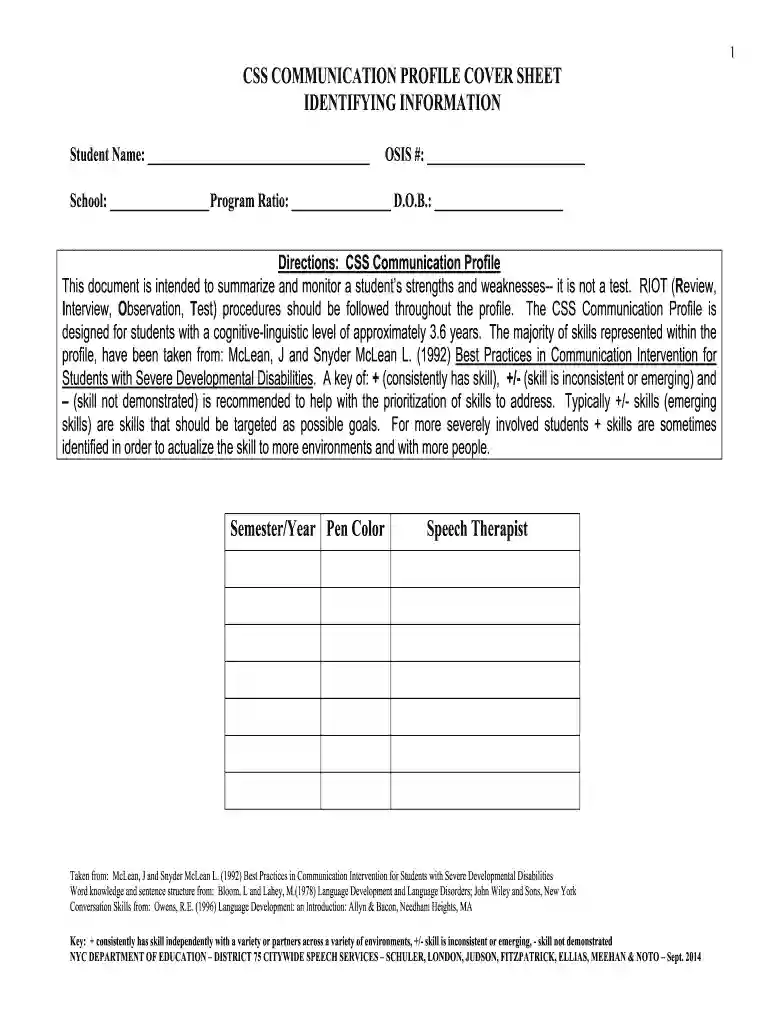
functional communication profile pdf Preview on Page 1

Here's how it works

01. Edit your functional communication profile pdf online
Type text, add images, blackout confidential details, add comments, highlights and more.

02. Sign it in a few clicks
Draw your signature, type it, upload its image, or use your mobile device as a signature pad.

03. Share your form with others
Send functional communication profile pdf free via email, link, or fax. You can also download it, export it or print it out.

Overview of the Functional Communication Profile PDF

The Functional Communication Profile PDF serves as an essential tool for evaluating the communication skills of individuals, particularly those with developmental disabilities. This document outlines the processes for assessing strengths and weaknesses through various methods, including observations, interviews, and testing. By systematically documenting communication capabilities, it establishes a foundation for targeted intervention goals.

Key Components of the Functional Communication Profile

The functional communication profile encompasses several critical components:

  • Sensory/Motor Skills: Assessment of an individual's sensory and motor capabilities, which influence their ability to engage in communication.
  • Forms of Communication: Identification of the different modes used for communication, including verbal, non-verbal, and alternative communication methods such as sign language or communication devices.
  • Communicative Functions: Evaluation of the purposes behind communication, such as requesting, expressing, or asserting.
  • Comprehension Skills: Analysis of how well individuals understand the information conveyed to them, which is essential for effective communication interactions.

Benefits of Using the Functional Communication Profile

Utilizing the functional communication profile provides several benefits:

  • Targeted Goal Setting: By identifying specific areas of strength and weakness, practitioners can design individualized communication goals that are relevant to each person's unique skills and needs.
  • Structured Assessment: The profile outlines a structured approach to evaluating communication abilities, ensuring that practitioners follow a consistent methodology.
  • Data Collection: Gathering data over time allows for tracking progress and making informed decisions about ongoing interventions and supports.

Creating a Functional Communication Profile

To create a functional communication profile, follow these steps:

  1. Gather Background Information: Collect relevant data through interviews with family, caregivers, and professionals who know the individual well.
  2. Conduct Observations: Observe the individual in various settings to see how they communicate across different contexts.
  3. Administer Assessments: Use standardized tools or informal assessments to evaluate communication skills comprehensively.
  4. Analyze Data: Review the collected data to identify strengths and challenges in the individual's communication abilities.
  5. Develop the Profile Document: Compile the findings into the functional communication profile PDF, ensuring it clearly outlines the individual's communication skills and recommendations for support.

Examples and Case Studies

Practical scenarios can illustrate how the functional communication profile is utilized:

  • Case Study 1: A child with autism spectrum disorder demonstrates strengths in using visual supports but struggles with verbal communication. The profile identifies these aspects and suggests interventions focusing on expanding vocabulary and using AAC (Augmentative and Alternative Communication) devices.
  • Case Study 2: An adult with a traumatic brain injury exhibits difficulty in comprehension and directional communication. The profile guides the formulation of tailored strategies that emphasize clearer instructions and visual cues.

Recommended Practices for Use

To maximize the effectiveness of the functional communication profile PDF, consider the following practices:

  • Regular Updates: Continuously update the profile as communication skills evolve over time, ensuring the document reflects the most current assessment of abilities.
  • Involved Team: Engage a multidisciplinary team, including speech-language pathologists, teachers, and family members, in the assessment and profiling process to obtain a holistic view of the individual's communication skills.
  • Culturally Responsive Assessment: Take cultural and linguistic diversity into account when evaluating communication to ensure all assessments are relevant and respectful of the individual's background.

Using the functional communication profile PDF not only aids in comprehension but also supports effective communication interventions tailored to individual needs. The systematic approach outlined within this document emphasizes its importance in the fields of education and healthcare.

See more functional communication profile pdf versions

We've got more versions of the functional communication profile pdf form. Select the right functional communication profile pdf version from the list and start editing it straight away!
Versions Form popularity Fillable & printable
2014 4.8 Satisfied (201 Votes)
2011 4.2 Satisfied (53 Votes)
be ready to get more

Complete this form in 5 minutes or less

Get form

Got questions?

We have answers to the most popular questions from our customers. If you can't find an answer to your question, please contact us.
Contact us
The FCP-R does not have a standardized scoring system. Each assessment area is rated on a subjective decision by the evaluator based on responses in the assessment areas and general impressions. The rating scale ratings are typical, mild, moderate, severe, and profound.
The Functional Communication Measures (FCMs) are a series of 15 disorder-specific seven-point rating scales, ranging from least functional (Level 1) to most functional (Level 7).
What does a functional communication profile assess? The purpose of the Functional Communication Profile is to provide a comprehensive inventory of an individuals communication abilities, their mode of communication (ex: nonverbal, verbal, sign, augmentative), and their degree of independence.
The ASHA FACS helps you to measure the functional communication of adults with speech, language, and cognitive-communication impairments. The measure comprises 43 items across four domains: Social Communication, Communication of Basic Needs, Reading/Writing/Number Concepts, and Daily Planning.
The Functional Communication Profile Revised (FCP-R) allows SLPs and special educators to evaluate and account for some of the unique communication skills in individuals with developmental and acquired delays across a broad age range. It addresses all communication possibilities including oral language expression.

Security and compliance

At DocHub, your data security is our priority. We follow HIPAA, SOC2, GDPR, and other standards, so you can work on your documents with confidence.

Learn more
ccpa2
pci-dss
gdpr-compliance
hipaa
soc-compliance
be ready to get more

Complete this form in 5 minutes or less

Get form

People also ask

These eight tips can help you maximize your communication skills for the success of your organization and your career. Be clear and concise. Prepare ahead of time. Be mindful of nonverbal communication. Watch your tone. Practice active listening. Build your emotional intelligence. Develop a workplace communication strategy.

functional communication profile report template