HELPFUL TIPS FOR PREPARING YOUR APPEAL 2026

Get Form
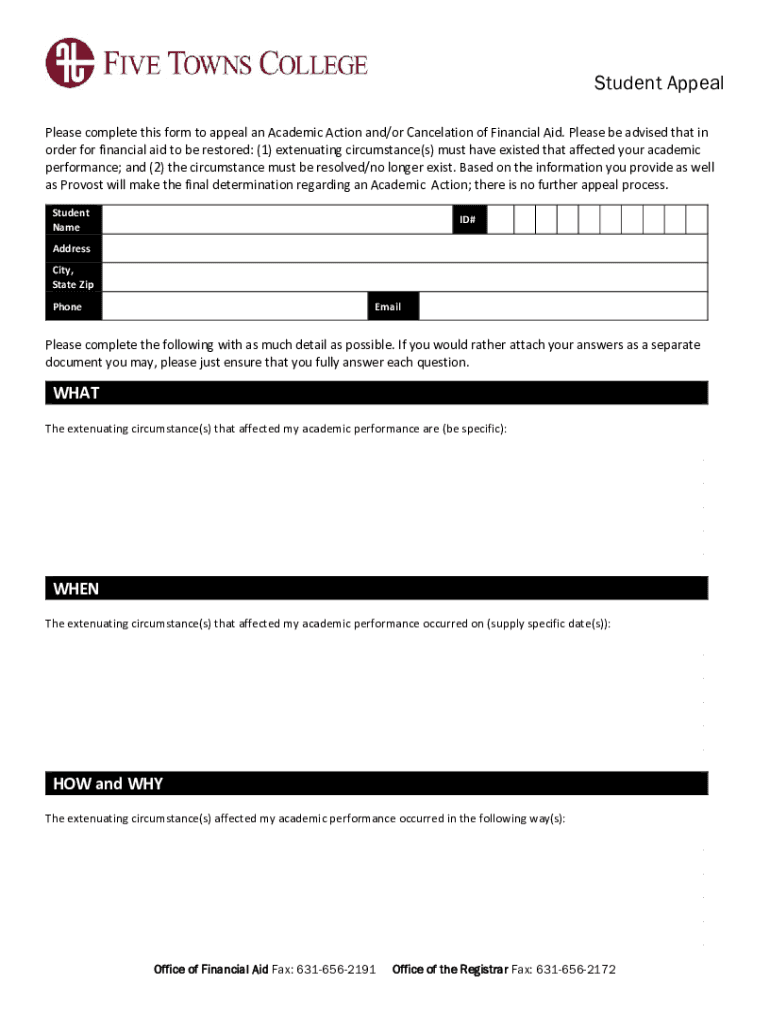
HELPFUL TIPS FOR PREPARING YOUR APPEAL Preview on Page 1

Here's how it works

01. Edit your form online
Type text, add images, blackout confidential details, add comments, highlights and more.
02. Sign it in a few clicks
Draw your signature, type it, upload its image, or use your mobile device as a signature pad.
03. Share your form with others
Send it via email, link, or fax. You can also download it, export it or print it out.

How to use or fill out HELPFUL TIPS FOR PREPARING YOUR APPEAL with DocHub

Form edit decoration
9.5
Ease of Setup
DocHub User Ratings on G2
9.0
Ease of Use
DocHub User Ratings on G2
  1. Click ‘Get Form’ to open the HELPFUL TIPS FOR PREPARING YOUR APPEAL in our editor.
  2. Begin by entering your personal information in the 'Student' section, including your name, ID number, address, phone number, and email. Ensure all details are accurate for effective communication.
  3. In the 'WHAT' section, clearly describe the extenuating circumstances that impacted your academic performance. Use specific examples to provide context.
  4. For the 'WHEN' section, specify the dates when these circumstances occurred. This helps establish a timeline for your appeal.
  5. In the 'HOW and WHY' section, explain how these circumstances affected your academic performance. Be detailed to strengthen your case.
  6. Under 'DOCUMENTATION', list any supporting documents you will attach. If documentation is unavailable, provide a brief explanation.
  7. In the 'RESOLUTION' section, articulate how and why the circumstances have been resolved. Specificity is key here as well.
  8. Outline your 'CORRECTIVE ACTION PLAN', detailing steps you will take to ensure satisfactory academic progress moving forward.
  9. Finally, complete the ATTESTATION section by signing and dating the form to confirm accuracy of information provided.

Start using our platform today to easily fill out and submit your appeal form for free!

See more HELPFUL TIPS FOR PREPARING YOUR APPEAL versions

We've got more versions of the HELPFUL TIPS FOR PREPARING YOUR APPEAL form. Select the right HELPFUL TIPS FOR PREPARING YOUR APPEAL version from the list and start editing it straight away!
Versions Form popularity Fillable & printable
2021 4.8 Satisfied (72 Votes)
be ready to get more

Complete this form in 5 minutes or less

Get form

Got questions?

We have answers to the most popular questions from our customers. If you can't find an answer to your question, please contact us.
Contact us
Content and Tone Opening Statement. The first sentence or two should state the purpose of the letter clearly. Be Factual. Include factual detail but avoid dramatizing the situation. Be Specific. Documentation. Stick to the Point. Do Not Try to Manipulate the Reader. How to Talk About Feelings. Be Brief.
Step 1: File the Notice of Appeal. Step 2: Pay the filing fee. Step 3: Determine if/when additional information must be provided to the appeals court as part of opening your case. Step 4: Order the trial transcripts. Step 5: Confirm that the record has been transferred to the appellate court.
An effective appeal letter should adhere to company policies, be addressed to the appropriate decision-maker, maintain a formal tone, use facts to state your case, express gratitude, be concise, note any relevant attachments, and follow up if required.
One of the most important parts of an appeal is the evidence. If you dont have good evidence, think about how you might be able to get some. The evidence you require depends on the underlying facts and grounds of the appeal but might include any of the following: Medical evidence (e.g. medical report, doctors letter)
As a result, an effective appeal should be brief, logical, and clear. No judge wants to dig through a convoluted trial record to identify key issues in a case. Do the leg work for them and present a clear, logical argument that points to specific support in the trial record.

Security and compliance

At DocHub, your data security is our priority. We follow HIPAA, SOC2, GDPR, and other standards, so you can work on your documents with confidence.

Learn more
ccpa2
pci-dss
gdpr-compliance
hipaa
soc-compliance

People also ask

Successful appeals hinge on demonstrating legal errors, such as: Prejudicial Error: Mistakes in law or procedure that harmed the appellant (e.g., incorrect jury instructions or evidence rulings). No Substantial Evidence: Lack of evidence to support the trial courts decision.
Having strong arguments is the best way to win. So how do you make sure your appeal is as strong as it can get? Well, the data shows you should call in an appellate attorney. Most litigators understand that a trial is predominantly about facts, whereas an appeal is predominantly about law.

Related links