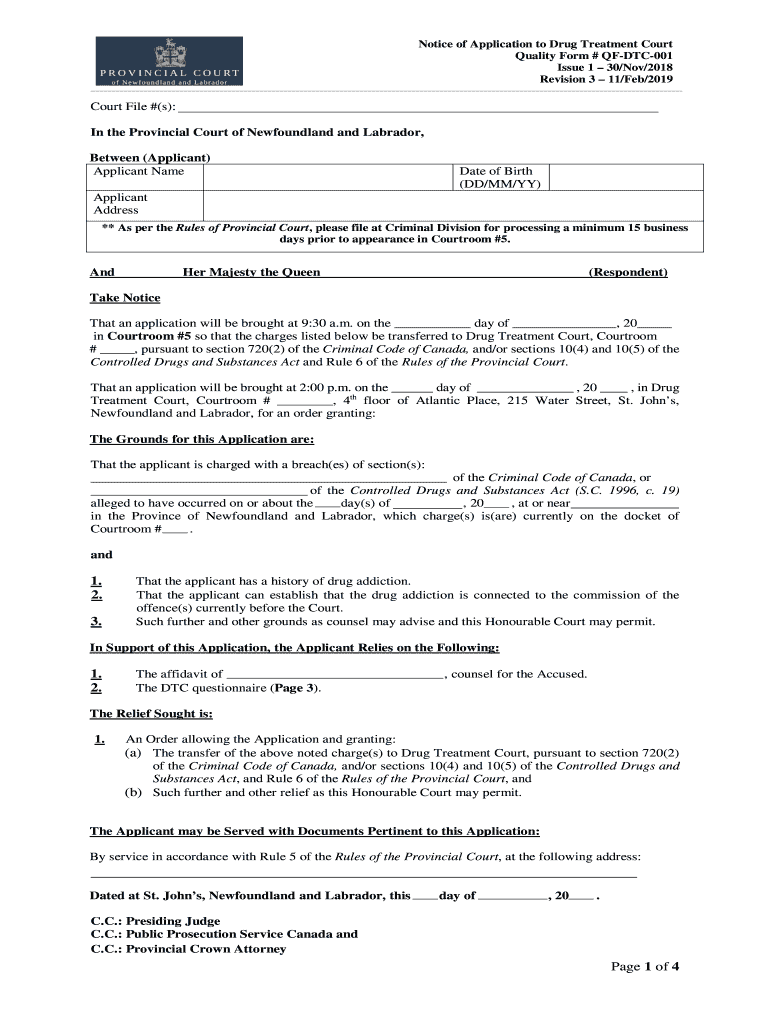
Drug Treatment CourtProvincial Court of Newfoundland and 2026

Get Form
Drug Treatment CourtProvincial Court of Newfoundland and Preview on Page 1

Here's how it works

01. Edit your form online
Type text, add images, blackout confidential details, add comments, highlights and more.
02. Sign it in a few clicks
Draw your signature, type it, upload its image, or use your mobile device as a signature pad.
03. Share your form with others
Send it via email, link, or fax. You can also download it, export it or print it out.

How to use or fill out Drug Treatment Court Provincial Court of Newfoundland and with our platform

Form edit decoration
9.5
Ease of Setup
DocHub User Ratings on G2
9.0
Ease of Use
DocHub User Ratings on G2
  1. Click ‘Get Form’ to open the Drug Treatment Court application in the editor.
  2. Begin by filling in your personal details, including your name, date of birth, and address. Ensure accuracy as this information is crucial for processing your application.
  3. In the 'Current and Outstanding Charges' section, list any charges you currently face. If applicable, indicate whether you are in custody or on bail.
  4. Provide details about your current drug use. Select your drug of choice and describe when you last used it. This information helps assess your eligibility for the Drug Treatment Court.
  5. Complete the consent section for release/access to information for DTC assessment. This allows the DTC team to evaluate your suitability.
  6. Finally, review all entries for accuracy before signing the application. Your lawyer should also sign to validate the submission.

Start using our platform today to streamline your Drug Treatment Court application process for free!

See more Drug Treatment CourtProvincial Court of Newfoundland and versions

We've got more versions of the Drug Treatment CourtProvincial Court of Newfoundland and form. Select the right Drug Treatment CourtProvincial Court of Newfoundland and version from the list and start editing it straight away!
Versions Form popularity Fillable & printable
2019 4.8 Satisfied (86 Votes)
be ready to get more

Complete this form in 5 minutes or less

Get form

Got questions?

We have answers to the most popular questions from our customers. If you can't find an answer to your question, please contact us.
Contact us
Deferred prosecution and postadjudication programs are the two general types of drug courts. Drug courts are specialized court systems that handle cases involving substance-abusing offenders through comprehensive supervision, drug testing, treatment services, and immediate sanctions and incentives.
There are two types of drugs: Legal drugs are known as over-the-counter (OTC) and prescription (Rx) drugs. Alcohol, nicotine, and caffeine are all legal drugs as well.
Drug courts usually employ a multiphased treatment process, generally divided into a stabilization phase, an intensive treatment phase, and a transition phase. The stabilization phase may include a period of AOD detoxification, initial treatment assessment, education, and screening for other needs.
This type of court is primarily for high risk/high need individuals, with a history of difficulty with prior supervision and treatment, who voluntarily agree to participate in DTC including treatment and drug testing.
Provincial courts try most criminal offences, money matters and family matters. In private-law cases involving bdocHub of contract or other claims of harm, the courts apply common-law principles in nine provinces and the territories.

Security and compliance

At DocHub, your data security is our priority. We follow HIPAA, SOC2, GDPR, and other standards, so you can work on your documents with confidence.

Learn more
ccpa2
pci-dss
gdpr-compliance
hipaa
soc-compliance

People also ask

Drugs can be categorised by the way in which they affect our bodies: depressants slow down the function of the central nervous system. hallucinogens affect your senses and change the way you see, hear, taste, smell or feel things. stimulants speed up the function of the central nervous system.
Adult Drug Courts are evidence-based court programs that provide an alternative to traditional criminal justice case adjudication for high-risk/high-need individuals struggling with substance use disorders.
Since their inception in 1989, drug courts programs have expanded from serving just adults, to include juvenile drug treatment courts, DUI/DWI courts, family treatment courts, mental health courts, veterans treatment courts, tribal healing to wellness courts, and others.

Related links