United kingdom building regulations 2026

Get Form
united kingdom building regulations Preview on Page 1

Here's how it works

01. Edit your united kingdom building regulations online
Type text, add images, blackout confidential details, add comments, highlights and more.
02. Sign it in a few clicks
Draw your signature, type it, upload its image, or use your mobile device as a signature pad.
03. Share your form with others
Send it via email, link, or fax. You can also download it, export it or print it out.

How to use or fill out United Kingdom Building Regulations with our platform

Form edit decoration
9.5
Ease of Setup
DocHub User Ratings on G2
9.0
Ease of Use
DocHub User Ratings on G2
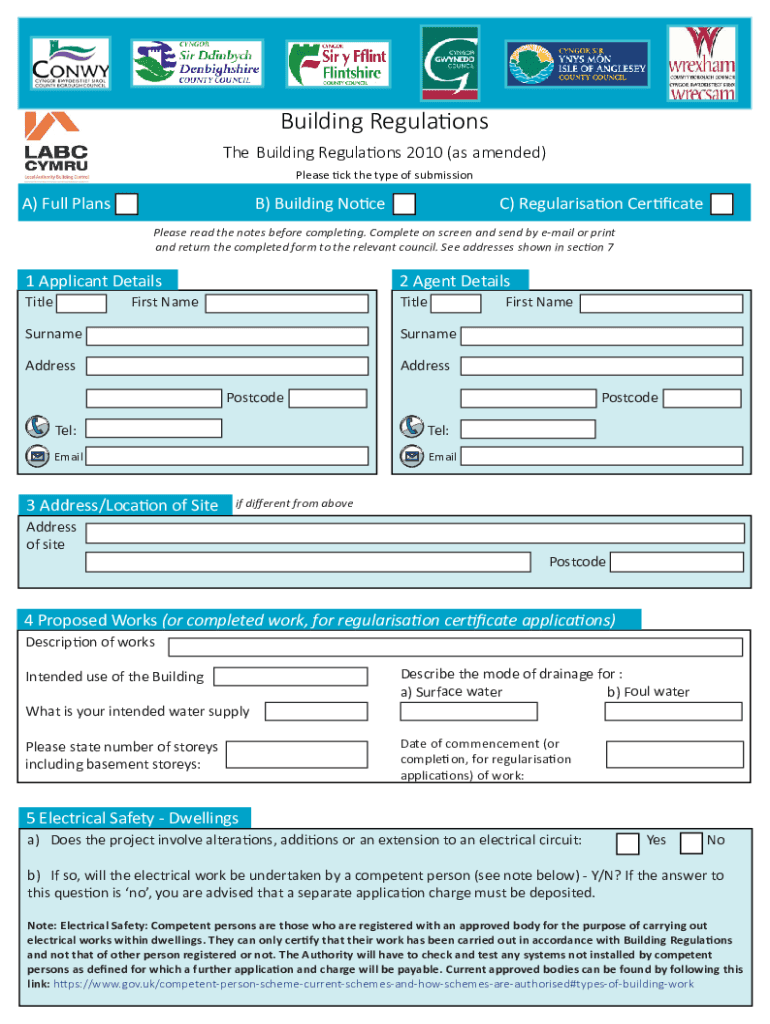
  1. Click ‘Get Form’ to open the United Kingdom Building Regulations document in the editor.
  2. Begin by filling out the 'Applicant Details' section. Enter your title, first name, surname, address, postcode, telephone number, and email address.
  3. If applicable, complete the 'Agent Details' section with the same information as above for your agent.
  4. In the 'Address/Location of Site' section, provide the site address if it differs from your applicant details.
  5. Describe the proposed works in detail under 'Proposed Works'. Include intended use and drainage methods for surface and foul water.
  6. Answer questions regarding electrical safety and confirm if a competent person will undertake any electrical work.
  7. Complete further information sections regarding time extensions, planning permission, and listed building status.
  8. Fill in charges based on the type of work being submitted. Ensure all calculations are accurate before submission.
  9. Finally, review your entries for accuracy and sign the declaration before submitting via email or printing it out for postal submission.

Start using our platform today to streamline your building regulations application process for free!

See more united kingdom building regulations versions

We've got more versions of the united kingdom building regulations form. Select the right united kingdom building regulations version from the list and start editing it straight away!
Versions Form popularity Fillable & printable
2014 4.8 Satisfied (159 Votes)
be ready to get more

Complete this form in 5 minutes or less

Get form

Got questions?

We have answers to the most popular questions from our customers. If you can't find an answer to your question, please contact us.
Contact us
There are currently Eighteen parts (sections) to the building regulations (for England and Wales) and each is lettered as Part A to Part S (however there are no Parts I or N) accompanied by an approved document for that Part X.
Most building work requires approval under the Building Regulations 2010. These detail the minimum level of standards acceptable, in order to ensure health and safety, conservation of fuel and power, and access and facilities for the disabled.
Building Regulations set standards for the design and construction of buildings to ensure the safety and health for people, including those with disabilities in or about those buildings and to help conserve fuel and power.
UK regulators in context According to the National Audit Office (NAO), there are around 90 regulators in the UK. 1 The UKs regulators cover a wide range of policy areas, including but not limited to financial services, utilities, communications, transport, education, healthcare and the environment.
There are 4444 UK Public General Acts, but not all are in force as this includes repealed legislation, such as these two 2019 Acts and these two from 1803 (the earliest on record).

Security and compliance

At DocHub, your data security is our priority. We follow HIPAA, SOC2, GDPR, and other standards, so you can work on your documents with confidence.

Learn more
ccpa2
pci-dss
gdpr-compliance
hipaa
soc-compliance

People also ask

Building control bodies and professionals must follow mandatory codes and standards for building control. Read the latest versions of all documents on GOV.UK: Building control bodies: professional codes and standards.

Related links