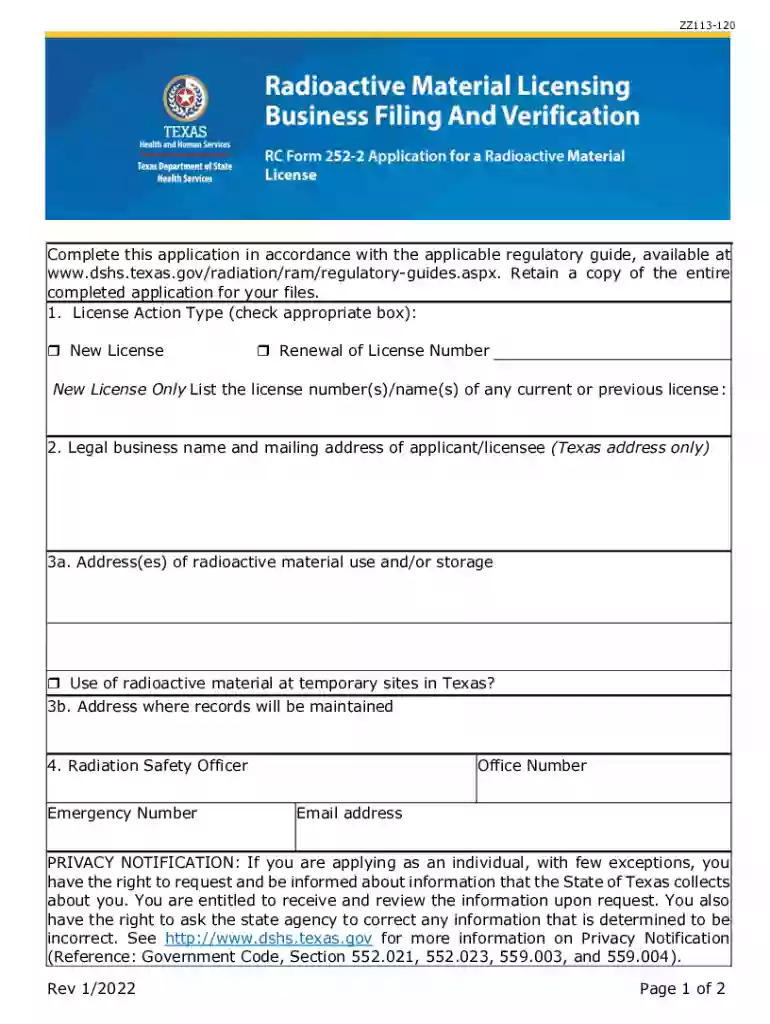
RC Form 252-2 Application for a Radioactive Material 2026

Get Form
form 252 2 Preview on Page 1

Here's how it works

01. Edit your form 252 2 online
Type text, add images, blackout confidential details, add comments, highlights and more.

02. Sign it in a few clicks
Draw your signature, type it, upload its image, or use your mobile device as a signature pad.

03. Share your form with others
Send it via email, link, or fax. You can also download it, export it or print it out.

How to use or fill out RC Form 252-2 Application for a Radioactive Material

Form edit decoration
9.5
Ease of Setup
DocHub User Ratings on G2
9.0
Ease of Use
DocHub User Ratings on G2
  1. Click ‘Get Form’ to open it in the editor.
  2. Begin by selecting the appropriate License Action Type. Check either 'New License' or 'Renewal of License Number' as applicable.
  3. Enter the legal business name and mailing address of the applicant/licensee, ensuring it is a Texas address.
  4. Provide the address(es) where radioactive material will be used and/or stored. If applicable, indicate if there will be temporary sites in Texas.
  5. Fill in the contact details for the Radiation Safety Officer, including emergency and office numbers, as well as an email address.
  6. For items 5 through 10, prepare separate attachments with detailed information regarding radioactive materials requested, responsible individuals, training programs, facilities, radiation protection programs, and waste management.
  7. Complete the certification section by signing and dating the application to confirm that all information is accurate.

Start using our platform today to fill out your RC Form 252-2 Application for a Radioactive Material easily and for free!

See more RC Form 252-2 Application for a Radioactive Material versions

We've got more versions of the RC Form 252-2 Application for a Radioactive Material form. Select the right RC Form 252-2 Application for a Radioactive Material version from the list and start editing it straight away!
Versions Form popularity Fillable & printable
2022 4.8 Satisfied (69 Votes)
2008 4 Satisfied (56 Votes)
be ready to get more

Complete this form in 5 minutes or less

Get form

Got questions?

We have answers to the most popular questions from our customers. If you can't find an answer to your question, please contact us.
Contact us
Category II facilities are licensed to possess SNM of moderate strategic significance as defined in 10 CFR 70.4 and 73.2. These facilities include HALEU fuel cycle facilities (e.g., uranium enrichment plants and fuel fabrication facilities), non-power reactors, and medical isotope facilities.
Process for New Licenses A company that wishes to obtain a license to use nuclear materials must submit an application to NRC. This application must demonstrate how the use of these materials will meet the safety requirements in NRC regulations found in 10 CFR Parts 19-21 and 30-39.
A RADIOACTIVE WHITE-I label means practi- cally no radiation outside the package, while a RADIOACTIVE YELLOW-II label means some ra- diation outside the package. The RADIOACTIVE YELLOW-III label is for higher radiation levels than RADIOACTIVE I and II.
In the Example of Yellow Radioactive II Label above. Radioactive II: means low radiation levels
Special form (A1) radionuclides are usually encapsulated sources which would only pose an external radiation hazard, not a contamination hazard, if the package was ruptured. Normal form (A2) radionuclides are usually not securely encapsulated and could yield docHub contamination if the package was ruptured.

Security and compliance

At DocHub, your data security is our priority. We follow HIPAA, SOC2, GDPR, and other standards, so you can work on your documents with confidence.

Learn more
ccpa2
pci-dss
gdpr-compliance
hipaa
soc-compliance

People also ask

Category 2 sources, if not safely or securely managed, could cause permanent injury to a person who handled them or was otherwise in contact with them for a short time (minutes to hours).
Category 2. As defined by the IAEA, an amount of radioactive material which, if not safely managed or securely protected, could cause permanent injury to a person who handled it, or were otherwise in contact with it for a short time (minutes or hours).
All shipments of radioactive material must be packaged and transported according to strict federal regulations. Markings on containers and vehicles explain the contents of each package using standard terms, codes and internationally recognized symbols.

Related links