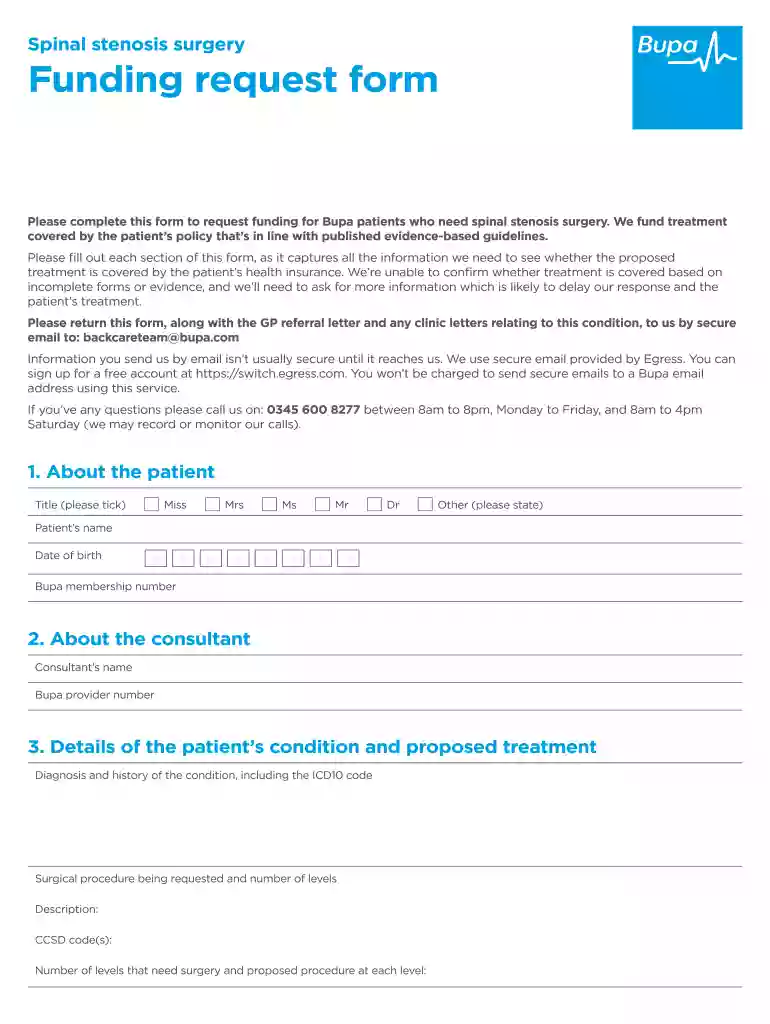
Spinal Stenosis Request Form 2026

Get Form
Spinal Stenosis Request Form Preview on Page 1

Here's how it works

01. Edit your form online
Type text, add images, blackout confidential details, add comments, highlights and more.

02. Sign it in a few clicks
Draw your signature, type it, upload its image, or use your mobile device as a signature pad.

03. Share your form with others
Send it via email, link, or fax. You can also download it, export it or print it out.

How to use or fill out Spinal Stenosis Request Form with our platform

Form edit decoration
9.5
Ease of Setup
DocHub User Ratings on G2
9.0
Ease of Use
DocHub User Ratings on G2
  1. Click ‘Get Form’ to open the Spinal Stenosis Request Form in the editor.
  2. Begin by filling out the 'About the patient' section. Select the appropriate title and enter the patient's name, date of birth, and Bupa membership number.
  3. Next, move to the 'About the consultant' section. Input the consultant's name and Bupa provider number.
  4. In the 'Details of the patient’s condition and proposed treatment' section, provide a detailed diagnosis including ICD10 code, surgical procedure requested, CCSD codes, and any relevant imaging test details.
  5. Complete the 'Declaration' section by confirming that you have permission to share clinical information. Enter your name, date, and General Medical Council number.

Start using our platform today for free to streamline your form completion process!

See more Spinal Stenosis Request Form versions

We've got more versions of the Spinal Stenosis Request Form form. Select the right Spinal Stenosis Request Form version from the list and start editing it straight away!
Versions Form popularity Fillable & printable
2019 4.9 Satisfied (41 Votes)
be ready to get more

Complete this form in 5 minutes or less

Get form

Got questions?

We have answers to the most popular questions from our customers. If you can't find an answer to your question, please contact us.
Contact us

Microsoft Word doesn’t have signing tools to generate legitimate electronic signatures and enforceable documents. Luckily, DocHub is an online eSignature-compliant editor that supports various document formats, such as .doc files. Sign in to your account and add the Word edition of your Spinal Stenosis Request Form from your device and cloud, or URL - our editor will automatically turn it into an editable PDF. Make all required alterations in your form and click Sign to generate your own legally-binding electronic signature. There are four signing methods from which to choose.

If you edit your Spinal Stenosis Request Form with DocHub, you merely need a steady internet connection and virtually any browser installed on your device. No need to set up any third-party applications or study guides. Simply open a tab with DocHub, drag and drop your file, and modify it immediately.

Nonsteroidal anti-inflammatory drugscommonly called NSAIDsrelieve pain by reducing inflammation of nerve roots and spine joints, thereby creating more space in the spinal canal. Types of NSAIDs include ibuprofen, aspirin, and naproxen.
Nonsurgical Treatments You may be encouraged to try slowly progressive aerobic activity, such as swimming or using exercise bicycles. In addition, your physical therapist or health care provider may recommend home exercises. A brace to provide some support and help you regain mobility.
New Treatments for Epilepsy What should I expect from my spinal stenosis treatment? Are there conservative treatments available that combine pain-relieving drugs and physical therapy? What happens if the first treatments dont work? What are some alternatives for spinal stenosis treatment?

Security and compliance

At DocHub, your data security is our priority. We follow HIPAA, SOC2, GDPR, and other standards, so you can work on your documents with confidence.

Learn more
ccpa2
pci-dss
gdpr-compliance
hipaa
soc-compliance

People also ask

Laminectomy is a surgery that doctors perform to treat spinal stenosis by removing the bony spurs and the bone walls of the vertebrae.
If you have any of these symptoms, you need to get medical attention right away: Loss of bowel or bladder control. Severe or increasing numbness between your legs, inner thighs, and back of the legs. Severe pain and weakness that spreads into one or both legs. This makes it hard to walk or get out of a chair.
Hear this out loud PauseCold and hot compresses, exercises to maintain joint flexibility and range of motion, and low-level laser treatments (LLLT), have been helpful in providing relief to patients living with stenosis. Some patients report finding relief with the use of a CBD tincture oil and/or through meditation.
Weill Cornell Medicine Pain Management offers a new technology to treat spinal stenosis and minimize the painful symptoms. Vertiflex superion is a device that is implanted into the area of the spine causing pain and relieves pressure on the affected nerves.
Your provider and other health professionals will help you manage your pain and keep you as active as possible. Your provider may refer you for physical therapy. You may also see a chiropractor, a massage therapist, and someone who performs acupuncture. Cold packs and heat therapy may help your pain during flare-ups.

Related links