California 4-H Policies - California 4-H Youth Development 2026

Get Form
California 4-H Policies - California 4-H Youth Development Preview on Page 1

Here's how it works

01. Edit your form online
Type text, add images, blackout confidential details, add comments, highlights and more.
02. Sign it in a few clicks
Draw your signature, type it, upload its image, or use your mobile device as a signature pad.
03. Share your form with others
Send it via email, link, or fax. You can also download it, export it or print it out.

How to use or fill out California 4-H Policies - California 4-H Youth Development with our platform

Form edit decoration
9.5
Ease of Setup
DocHub User Ratings on G2
9.0
Ease of Use
DocHub User Ratings on G2
  1. Click ‘Get Form’ to open the California 4-H Policies document in the editor.
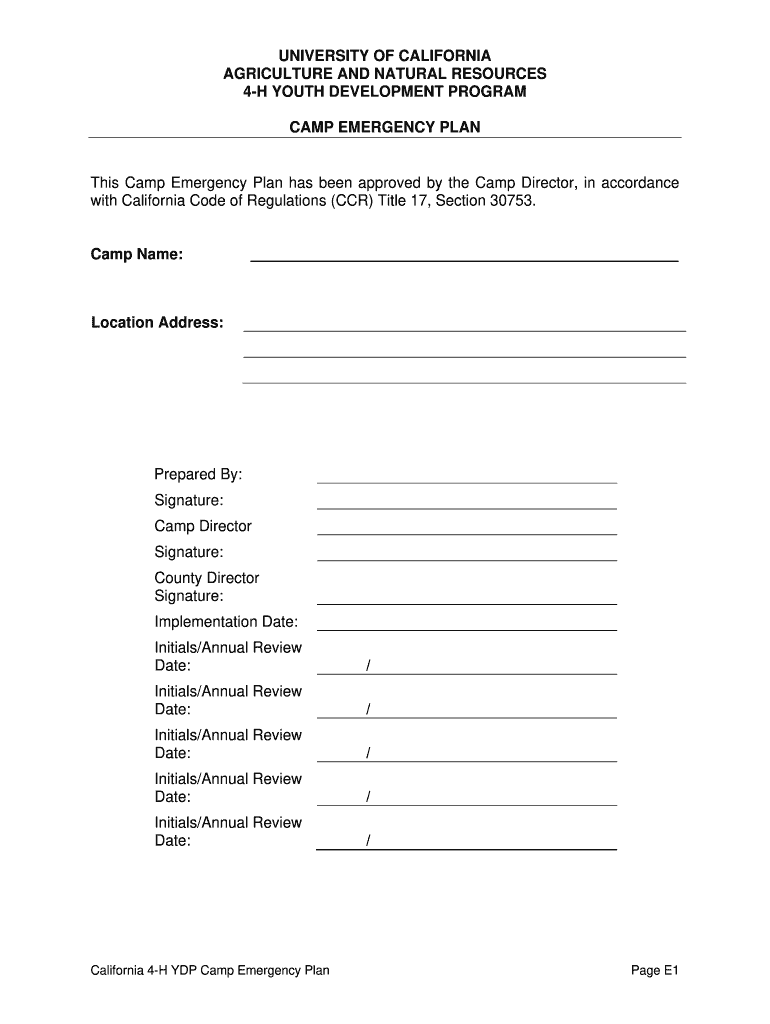
  2. Begin by filling in the 'Camp Name' and 'Location Address' fields at the top of the form. Ensure that this information is accurate as it is crucial for emergency identification.
  3. In the 'Prepared By' section, provide your name and signature, followed by signatures from both the Camp Director and County Director. This validates the emergency plan.
  4. Proceed to Section I, where you will outline specific procedures for various emergency situations. Use bullet points to clearly list each type of emergency and corresponding procedures.
  5. Continue through Sections II to VI, filling in details about camp personnel, emergency response assignments, and communication protocols. Make sure all contact numbers are current.
  6. Review all sections for completeness and accuracy before saving your changes. Utilize our platform's features to highlight any areas needing attention or further detail.

Start editing your California 4-H Policies document today for free on our platform!

be ready to get more

Complete this form in 5 minutes or less

Get form

Got questions?

We have answers to the most popular questions from our customers. If you can't find an answer to your question, please contact us.
Contact us
4‑H programs are grounded in the belief that kids learn best by doing. Kids and teens complete hands-on projects in areas like science, health, agriculture and civic engagement, in a positive environment where they receive guidance from adult mentors and are encouraged to take on proactive leadership roles.
4-H focuses on developing youth potential. 4-H believes that all young people, as members of families and communities, and citizens of a global society, should have the opportunity to reach their full potential. 4-H builds a culturally competent workforce engaging adults and youth from diverse backgrounds.
Youth are eligible to participate in 4-H if they meet the following criteria: A. Primary 4-H Members. Primary members must be 5 years old by December 31st of the program year. B. Junior, Intermediate and Senior 4-H Members. C. Home Schooled Members. D. Special Needs Members. E. Members as Adult Volunteers.
4-H focuses on developing healthy lifestyles, both physically and emotionally, by teaching youth to manage feelings, build self-esteem, and build character. Youth learn to use their Head, Heart, Hands, and Health to better their club, community, country, and world. For additional information about Global 4H visit here.
While things have changed in the last 100 years and 4-H has evolved with the times. The program still involves teaching children how to grow fruits and vegetables and care for livestock, particularly in Californias farming communities, but has expanded to include public speaking, cooking, art, and rocketry.

Security and compliance

At DocHub, your data security is our priority. We follow HIPAA, SOC2, GDPR, and other standards, so you can work on your documents with confidence.

Learn more
ccpa2
pci-dss
gdpr-compliance
hipaa
soc-compliance

People also ask

Head, Heart, Hands, and Health are the four Hs in 4‑H, and they are the four values members work on through fun and engaging programs.
4-H is a youth development program where adult volunteers provide positive, hands-on, fun and educational opportunities with youth age 5 to 19. This can take place in many different settings such as project clubs, community clubs, after school programs, camps, workshop or events.

Related links