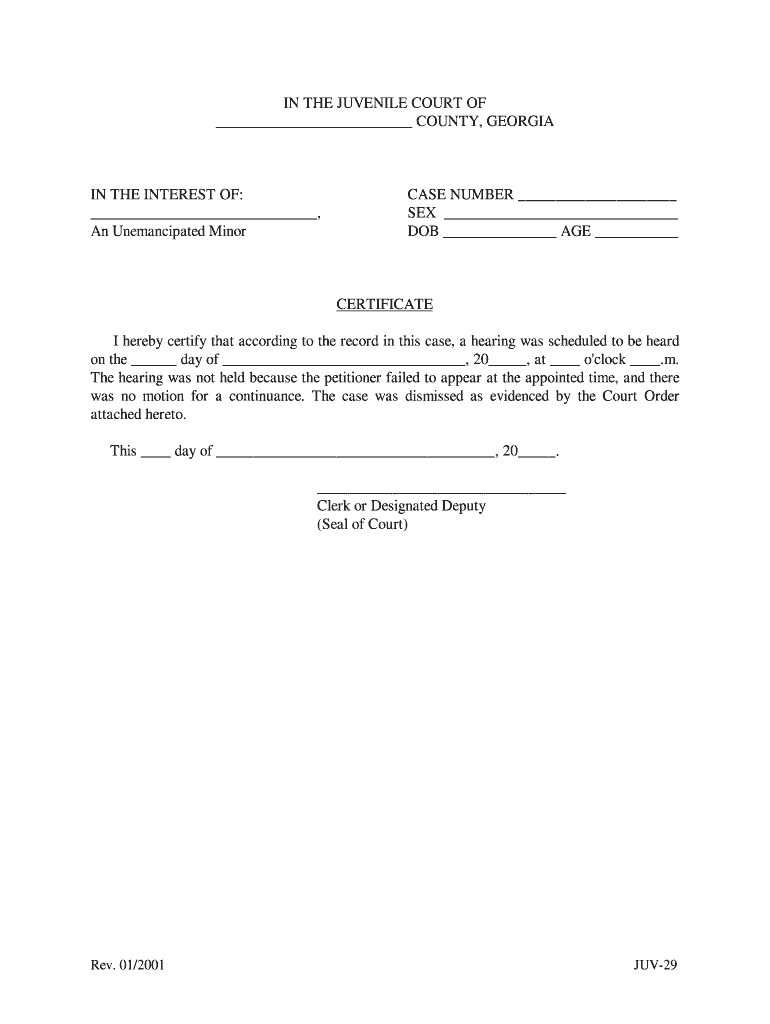
JUV-29 2026

Get Form
JUV-29 Preview on Page 1

Here's how it works

01. Edit your form online
Type text, add images, blackout confidential details, add comments, highlights and more.
02. Sign it in a few clicks
Draw your signature, type it, upload its image, or use your mobile device as a signature pad.
03. Share your form with others
Send it via email, link, or fax. You can also download it, export it or print it out.

How to use or fill out JUV-29 with DocHub

Form edit decoration
9.5
Ease of Setup
DocHub User Ratings on G2
9.0
Ease of Use
DocHub User Ratings on G2
  1. Click ‘Get Form’ to open the JUV-29 in our editor.
  2. Begin by entering the county name at the top of the form, ensuring it matches the jurisdiction of your case.
  3. Fill in the minor's name in the designated field, followed by their case number, sex, date of birth (DOB), and age. Accuracy is crucial here for proper identification.
  4. In the certificate section, specify the date of the scheduled hearing and time. This information is essential for record-keeping.
  5. Indicate that the hearing was not held due to the petitioner's absence and confirm that there was no motion for a continuance.
  6. Finally, sign and date where indicated as Clerk or Designated Deputy, ensuring you include any necessary court seals if applicable.

Start using our platform today to fill out your JUV-29 form online for free!

See more JUV-29 versions

We've got more versions of the JUV-29 form. Select the right JUV-29 version from the list and start editing it straight away!
Versions Form popularity Fillable & printable
2001 4.8 Satisfied (283 Votes)
be ready to get more

Complete this form in 5 minutes or less

Get form

Got questions?

We have answers to the most popular questions from our customers. If you can't find an answer to your question, please contact us.
Contact us
Motion for a Judgment of Acquittal. (a) Before Submission to the Jury. After the government closes its evidence or after the close of all the evidence, the court on the defendants motion must enter a judgment of acquittal of any offense for which the evidence is insufficient to sustain a conviction.
Juvenile Rule 29(A) Scheduling the hearing If the prosecuting attorney does not file a notice of intent to pursue a serious youthful offender sentence before the twenty-day time period lapses, the ordinary juvenile time frames again become operative.
Under Rules 29(c) and 45(b), a post-trial motion for acquittal must be made or an extension requested within 14 days after the jurys verdict or the discharge of a jury that failed to reach a verdict.
The law states that 29 is the magic number of times a consumer must be exposed to a product before becoming a buyer. The law of 29, an unwritten rule, is the basis for drip marketingan approach that necessitates communicating with consumers steadily through a constant stream of marketing material.
This Rule 29(a) governs amicus filings during a courts initial consideration of a case on the merits. (2) When Permitted. The United States or its officer or agency or a state may file an amicus brief without the consent of the parties or leave of court.

Security and compliance

At DocHub, your data security is our priority. We follow HIPAA, SOC2, GDPR, and other standards, so you can work on your documents with confidence.

Learn more
ccpa2
pci-dss
gdpr-compliance
hipaa
soc-compliance

People also ask

Rule 29 motions are infrequently granted because they require the court to find that the prosecutions evidence is insufficient for any reasonable jury to convict.
Currently, Rule 29(c) requires the defendant to move for a judgment of acquittal within seven days of the guilty verdict, or after the court discharges the jury, whichever occurs later, or some other time set by the court in an order issued within that same seven-day period.
Rule 29 permits the parties by stipulation to modify any of the procedures provided by the discovery rules. Any stipulation varying the discovery procedures may be superseded by court order. It is expected that the court will intervene to overrule a stipulation only under extraordinary circumstances.

Related links