Small claims satisfaction of judgement 2026

Get Form
small claims satisfaction of judgement Preview on Page 1

Here's how it works

01. Edit your small claims satisfaction of judgement online
Type text, add images, blackout confidential details, add comments, highlights and more.
02. Sign it in a few clicks
Draw your signature, type it, upload its image, or use your mobile device as a signature pad.
03. Share your form with others
Send it via email, link, or fax. You can also download it, export it or print it out.

How to use or fill out small claims satisfaction of judgement with our platform

Form edit decoration
9.5
Ease of Setup
DocHub User Ratings on G2
9.0
Ease of Use
DocHub User Ratings on G2
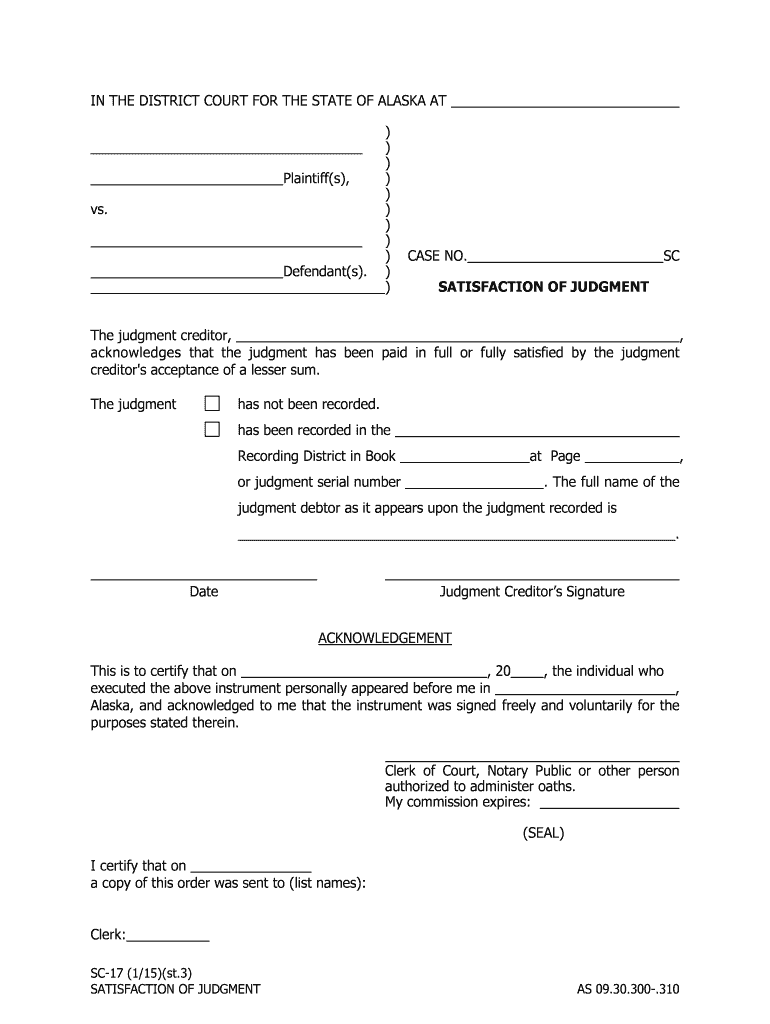
  1. Click ‘Get Form’ to open the small claims satisfaction of judgment in the editor.
  2. Begin by entering the case number at the top of the form. This is essential for identifying your specific case.
  3. In the section labeled 'The judgment creditor,' input the full name of the creditor who is acknowledging that the judgment has been satisfied.
  4. Indicate whether the judgment has been recorded by checking the appropriate box and providing details such as Book, Page, or serial number if applicable.
  5. Fill in the full name of the judgment debtor as it appears on any recorded documents to ensure accuracy.
  6. Date your acknowledgment and provide your signature as the judgment creditor, confirming that all information is correct.
  7. Complete the acknowledgment section by filling in details about when and where you signed this document, along with a notary's information if required.

Start using our platform today to easily complete your small claims satisfaction of judgment for free!

See more small claims satisfaction of judgement versions

We've got more versions of the small claims satisfaction of judgement form. Select the right small claims satisfaction of judgement version from the list and start editing it straight away!
Versions Form popularity Fillable & printable
2015 4.8 Satisfied (62 Votes)
be ready to get more

Complete this form in 5 minutes or less

Get form

Got questions?

We have answers to the most popular questions from our customers. If you can't find an answer to your question, please contact us.
Contact us
Once a judgment is paid, either in full or in an amount the judgment creditor agrees to accept as full payment, the judgment creditor must immediately file an Acknowledgement of Satisfaction of Judgment (EJ-100) with the court (California Code of Civil Procedure (CCP) 724.030).
Satisfied judgments make it easier to get loans. They still hurt your credit score under the FICO formulas used for home loans, car loans, and credit card applications.
When you are fully paid, you must fill out and file an Acknowledgment of Satisfaction of Judgment form. This is like a receipt for payment. The person who owed you money can use it to remove everything from their record that shows they owe you money.
Pay the judgment creditor in full and have them sign an Acknowledgment of Satisfaction Of Judgment (see below section What To Do After The Judgment Is Paid). Take the Satisfaction to the court where the case was filed. File the Satisfaction with the clerk and request that the warrant be recalled.
How Do I Go About Negotiating A Settlement After A Judgment Has Been Issued Against Me? Step One: Figure out who you need to pay. Step Two: Once you have figured out whom you need to talk to, call that person and find out your balance. Step Three: Attempt to negotiate with the creditor to pay a lower balance.

Security and compliance

At DocHub, your data security is our priority. We follow HIPAA, SOC2, GDPR, and other standards, so you can work on your documents with confidence.

Learn more
ccpa2
pci-dss
gdpr-compliance
hipaa
soc-compliance

People also ask

This study answers two fundamental questions about small claims courts: (1) Who usually wins? (2) Do victors collect their judgments? The rate of victory for plaintiffs who file claims and appear in court is eighty-five percent. Of winning plaintiffs, fifty-five percent never collect any part of their judgments.

Related links