Alaska p 310 claim against form search 2026

Get Form
alaska p 310 claim against form search Preview on Page 1

Here's how it works

01. Edit your alaska p 310 claim against form search online
Type text, add images, blackout confidential details, add comments, highlights and more.

02. Sign it in a few clicks
Draw your signature, type it, upload its image, or use your mobile device as a signature pad.

03. Share your form with others
Send it via email, link, or fax. You can also download it, export it or print it out.

How to use or fill out alaska p 310 claim against form search with our platform

Form edit decoration
9.5
Ease of Setup
DocHub User Ratings on G2
9.0
Ease of Use
DocHub User Ratings on G2
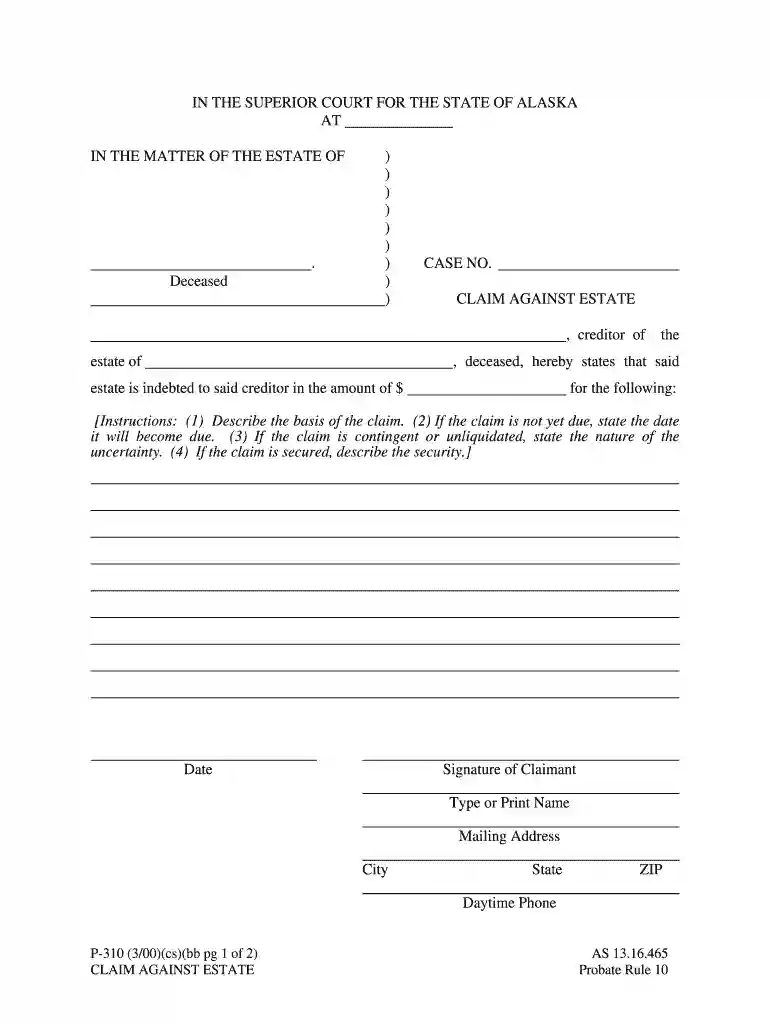
  1. Click ‘Get Form’ to open the alaska p 310 claim against form in the editor.
  2. Begin by entering the name of the deceased and their estate information in the designated fields. This establishes the context for your claim.
  3. In the section regarding the amount owed, clearly state the dollar amount that you believe is due. Be precise to avoid any confusion.
  4. Describe the basis of your claim in detail. This could include services rendered, loans made, or any other relevant information that supports your claim.
  5. If applicable, indicate if your claim is not yet due by specifying the date it will become due. If it is contingent or unliquidated, provide details about this uncertainty.
  6. For secured claims, describe any security associated with your claim to ensure clarity on what collateral exists.
  7. Finally, sign and date the form. Ensure that your name is printed clearly along with your mailing address and daytime phone number for contact purposes.

Start using our platform today to fill out your alaska p 310 claim against form easily and for free!

See more alaska p 310 claim against form search versions

We've got more versions of the alaska p 310 claim against form search form. Select the right alaska p 310 claim against form search version from the list and start editing it straight away!
Versions Form popularity Fillable & printable
2000 4.8 Satisfied (113 Votes)
be ready to get more

Complete this form in 5 minutes or less

Get form

Got questions?

We have answers to the most popular questions from our customers. If you can't find an answer to your question, please contact us.
Contact us
A: In California, common non-probate assets can include: Retirement accounts, like 401(k)s and IRAs. Life insurance policies with specific beneficiaries. Jointly owned properties that come with rights of survivorship.
Alaska state criminal records are, for the most part, accessible to the public online for free via the state courts CourtView portal. A user can search for a criminal court record by case number, name of the defendant, or ticket/citation number from this portal.
Here are the California System 1 property exemptions: The Homestead Exemption protects up to $600,000 in your principal residence, which could be a home, boat, condo, or even a planned development. The Motor Vehicle Exemption protects up to $3,625 of equity in your car or other vehicle.
Exempt property is any property that creditors cannot seize and sell in order to satisfy debt during chapter 7 or chapter 13 bankruptcy. The type of property exempted differs from state to state but often includes clothes, home furnishings, retirement plans, and small amounts of equity in a house and car.
Alaska Rules of Court | Supreme Court Orders The Anchorage Law Library has a historical collection of the Alaska Rules of Court. The official publisher of the Alaska Rules of Court is Tower Publishing. Their toll-free number is 1-800-969-8693. The rules are published annually in October.

Security and compliance

At DocHub, your data security is our priority. We follow HIPAA, SOC2, GDPR, and other standards, so you can work on your documents with confidence.

Learn more
ccpa2
pci-dss
gdpr-compliance
hipaa
soc-compliance

People also ask

There are some exceptions where a grant of Probate may not be needed by the executors. This might include where any assets were held jointly with other people (so something called the right of survivorship) applied to the assets and they passed automatically to the surviving joint owner and irrespective of any will.

Related links