Third Party-At Risk Youth Verification Form 2026

Get Form
Third Party-At Risk Youth Verification Form Preview on Page 1

Here's how it works

01. Edit your form online
Type text, add images, blackout confidential details, add comments, highlights and more.

02. Sign it in a few clicks
Draw your signature, type it, upload its image, or use your mobile device as a signature pad.

03. Share your form with others
Send it via email, link, or fax. You can also download it, export it or print it out.

How to use or fill out Third Party-At Risk Youth Verification Form with DocHub

Form edit decoration
9.5
Ease of Setup
DocHub User Ratings on G2
9.0
Ease of Use
DocHub User Ratings on G2
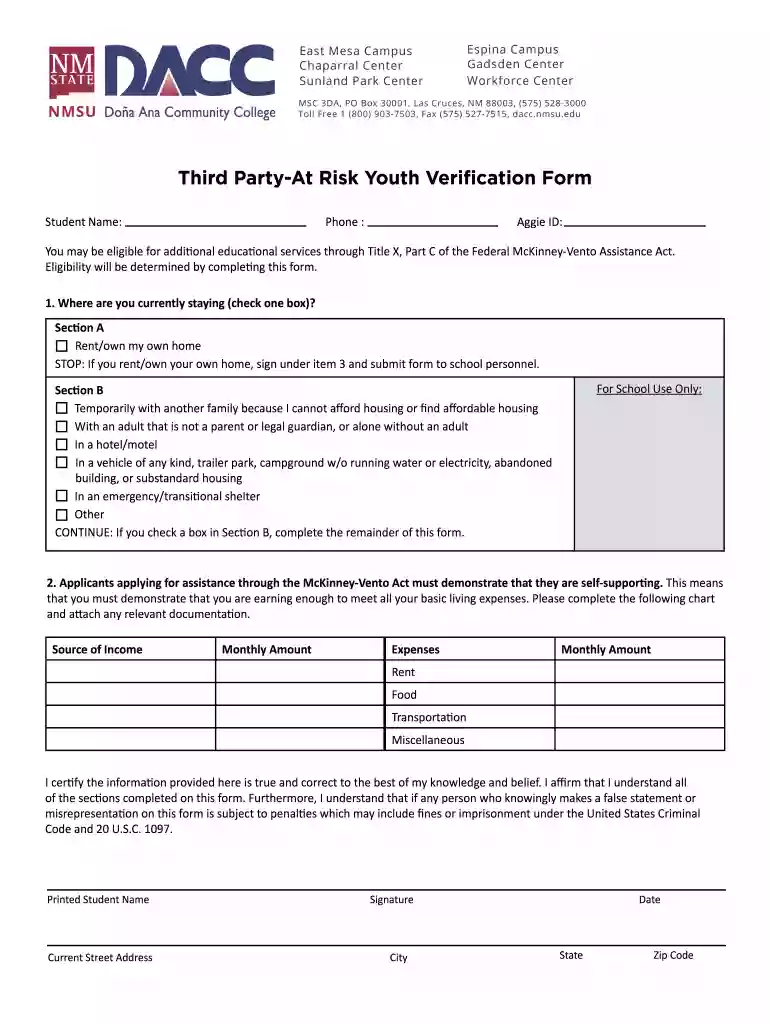
  1. Click ‘Get Form’ to open the Third Party-At Risk Youth Verification Form in our editor.
  2. Begin by entering the Student Name, Phone, and Aggie ID at the top of the form. Ensure all information is accurate for proper processing.
  3. In Section A, check the appropriate box regarding your current living situation. If you own or rent your home, sign under item 3 and submit the form. If you are temporarily staying elsewhere, continue filling out the form.
  4. Complete Section B by providing details about your income and expenses. Fill in the chart with your sources of income and monthly amounts alongside your monthly expenses for rent, food, transportation, and miscellaneous costs.
  5. Certify that all information provided is true by signing at the bottom of the form. Include your printed name, current address, city, state, zip code, and date.
  6. If applicable, have a Local Liaison or Director complete their section to verify your living situation. They should check one of the options provided and include their contact information.

Start using our platform today to easily fill out and submit your Third Party-At Risk Youth Verification Form for free!

See more Third Party-At Risk Youth Verification Form versions

We've got more versions of the Third Party-At Risk Youth Verification Form form. Select the right Third Party-At Risk Youth Verification Form version from the list and start editing it straight away!
Versions Form popularity Fillable & printable
2019 4.8 Satisfied (34 Votes)
be ready to get more

Complete this form in 5 minutes or less

Get form

Got questions?

We have answers to the most popular questions from our customers. If you can't find an answer to your question, please contact us.
Contact us
Federal law (the McKinney-Vento Act) requires school district homeless liaisons to inform unaccompanied homeless youth of their status as independent students for financial aid (the Free Application for Federal Student Aid, or FAFSA) and help them obtain verification of that status.
You can go to a school counselor, college counselor, or TRIO professional (Upward Bound, Talent Search, Student Support Services) and request a letter verifying your status as unhoused or homeless if they push you to verify that status (usually the first time you claim it.)
At-risk of homelessness is when a students housing may cease to be fixed, regular and adequate, such as a student who is being evicted.
Instead, these students can attest that they are experiencing homelessness without a parent by providing a determination letter from an authorized party, completing a documented interview, or providing a written statement to the financial aid administrator.
When you get to the FAFSA, youll get to this question that says: At any time on or after July 1, 2024, was the student unaccompanied and either (1) homeless or (2) self-supporting and at risk of being homeless?

Security and compliance

At DocHub, your data security is our priority. We follow HIPAA, SOC2, GDPR, and other standards, so you can work on your documents with confidence.

Learn more
ccpa2
pci-dss
gdpr-compliance
hipaa
soc-compliance
be ready to get more

Complete this form in 5 minutes or less

Get form

People also ask

You may be homeless if you are living in shelters, parks, motels or cars, or temporarily living with other people because you have nowhere else to go. Unaccompanied means you are not living in the physical custody of your parent or guardian.

Related links