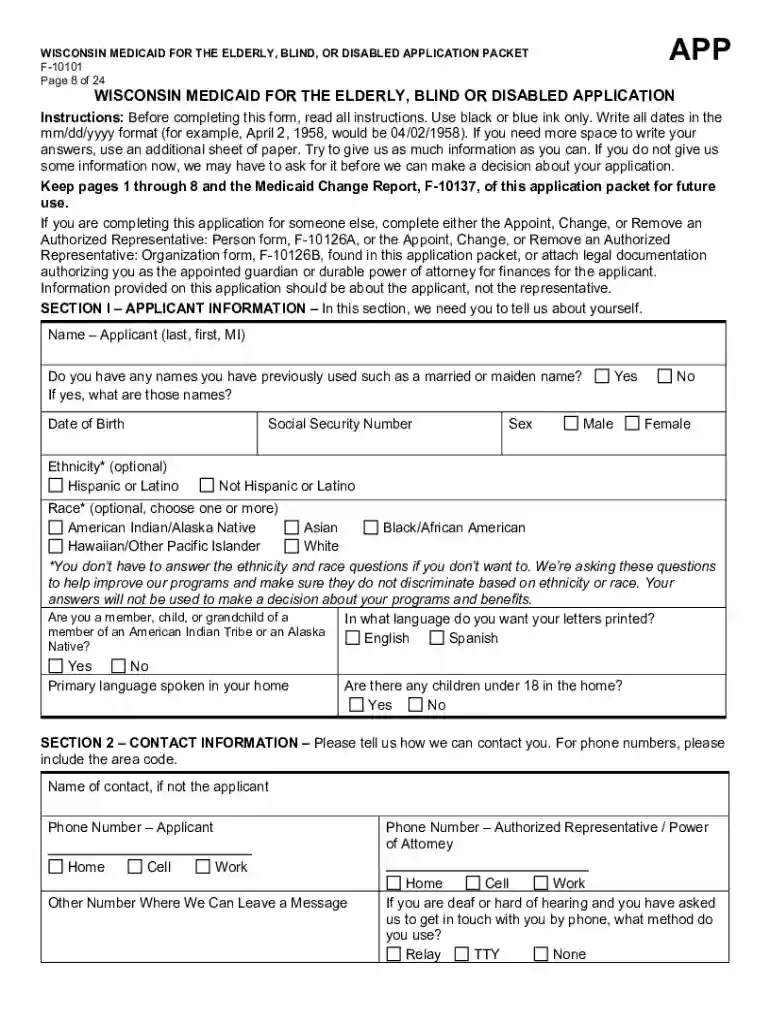
Medicaid for the Elderly, Blind, or Disabled Application 2026

Get Form
Medicaid for the Elderly, Blind, or Disabled Application Preview on Page 1

Here's how it works

01. Edit your form online
Type text, add images, blackout confidential details, add comments, highlights and more.

02. Sign it in a few clicks
Draw your signature, type it, upload its image, or use your mobile device as a signature pad.

03. Share your form with others
Send it via email, link, or fax. You can also download it, export it or print it out.

How to use or fill out Medicaid for the Elderly, Blind, or Disabled Application with DocHub

Form edit decoration
9.5
Ease of Setup
DocHub User Ratings on G2
9.0
Ease of Use
DocHub User Ratings on G2
  1. Click ‘Get Form’ to open the Medicaid for the Elderly, Blind, or Disabled Application in our platform.
  2. Begin by reading the Important Information section thoroughly. This will provide essential context about eligibility and required documentation.
  3. Fill out Section I with your personal information. Ensure you include your name, date of birth, and Social Security Number accurately.
  4. Proceed to Section II to provide your contact information. Include phone numbers and email addresses where you can be reached.
  5. In Section III, answer questions regarding your living situation and any children under 18 in your household. This helps determine eligibility.
  6. Continue through each section of the application, ensuring all fields are completed clearly. Use blue or black ink if filling out a paper version.
  7. Once completed, review your application using our editor's features to ensure accuracy before submitting it online or via mail.

Start using our platform today to streamline your Medicaid application process for free!

See more Medicaid for the Elderly, Blind, or Disabled Application versions

We've got more versions of the Medicaid for the Elderly, Blind, or Disabled Application form. Select the right Medicaid for the Elderly, Blind, or Disabled Application version from the list and start editing it straight away!
Versions Form popularity Fillable & printable
2023 4.7 Satisfied (39 Votes)
2017 4.8 Satisfied (30 Votes)
2013 4.9 Satisfied (32 Votes)
2010 4 Satisfied (22 Votes)
be ready to get more

Complete this form in 5 minutes or less

Get form

Got questions?

We have answers to the most popular questions from our customers. If you can't find an answer to your question, please contact us.
Contact us
Aged, blind, and disabled (ABD) Medicaid provides coverage for a broad range of health services, including doctors visits, hospital care, and medical equipment if: You are 65+, blind, or have a disability. And, you meet the financial eligibility requirements.
Aged, blind, and disabled (ABD) Medicaid provides coverage for a broad range of health services, including doctors visits, hospital care, and medical equipment if: You are 65+, blind, or have a disability.
ABD Medicaid in Georgia serves persons who are 65 years of age or older, legally blind and/or totally disabled.
Their disabilities may include physical impairments and injuries, intellectual and developmental disabilities, mental and behavioral health disorders and other conditions.
Medicaid is for certain individuals and families with low incomes and resources. Eligibility and benefits vary considerably from State to State. Medicare insurance is available for people age 65 or older, younger people with disabilities and people with End Stage Renal Disease.

Security and compliance

At DocHub, your data security is our priority. We follow HIPAA, SOC2, GDPR, and other standards, so you can work on your documents with confidence.

Learn more
ccpa2
pci-dss
gdpr-compliance
hipaa
soc-compliance
be ready to get more

Complete this form in 5 minutes or less

Get form

People also ask

To participate in Medicaid, federal law requires states to cover certain groups of individuals. Low-income families, qualified pregnant women and children, and individuals receiving Supplemental Security Income (SSI) are examples of mandatory eligibility groups.
States are required by federal law to approve or deny Medicaid applications within 45 days, or 90 days for applications that require a disability determination.
There are four types of Medicaid delivery systems: State-operated fee-for-service (FFS) Primary care case management (PCCM) Comprehensive risk-based managed care (MCO model) Limited-benefit plans.

Related links