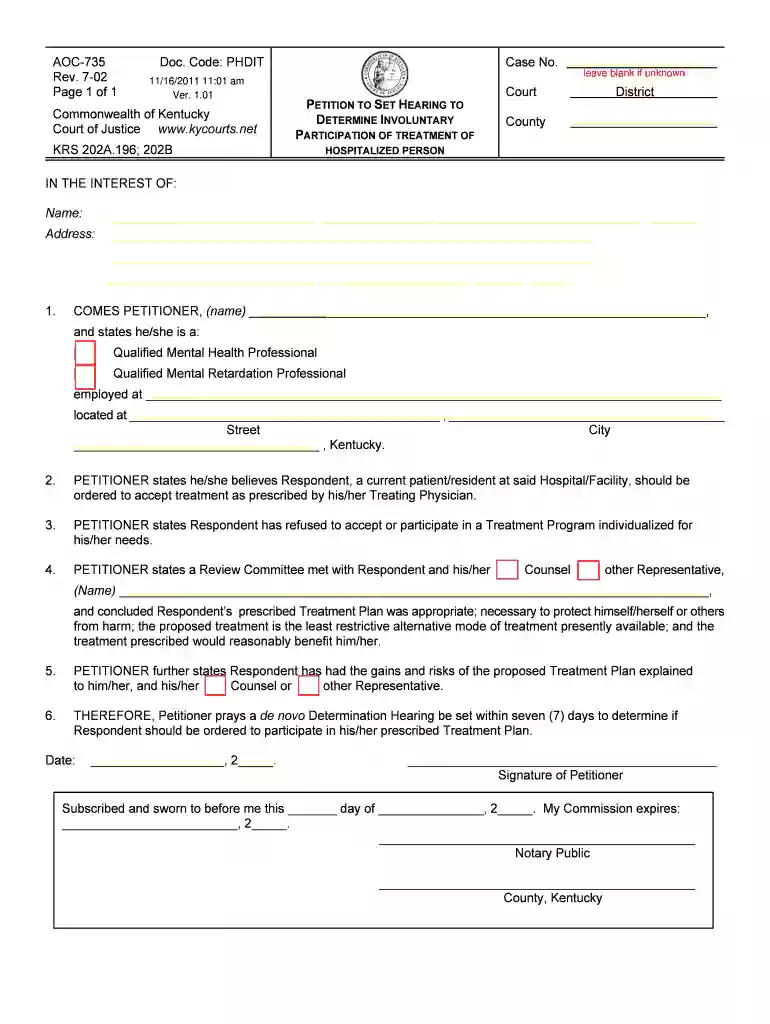
Ky involuntary form 2026

Get Form
ky involuntary form Preview on Page 1

Here's how it works

01. Edit your ky involuntary form online
Type text, add images, blackout confidential details, add comments, highlights and more.

02. Sign it in a few clicks
Draw your signature, type it, upload its image, or use your mobile device as a signature pad.

03. Share your form with others
Send it via email, link, or fax. You can also download it, export it or print it out.

How to use or fill out ky involuntary form with our platform

Form edit decoration
9.5
Ease of Setup
DocHub User Ratings on G2
9.0
Ease of Use
DocHub User Ratings on G2
  1. Click ‘Get Form’ to open the ky involuntary form in the editor.
  2. Begin by entering the Case Number, Court, District, and County at the top of the form. If unknown, you may leave it blank.
  3. In the section labeled 'HOSPITALIZED PERSON', fill in the Name and Address of the individual for whom you are petitioning.
  4. Identify yourself as either a Qualified Mental Health Professional or a Qualified Mental Retardation Professional by checking the appropriate box and providing your employment details.
  5. Clearly state your belief regarding the Respondent's need for treatment and their refusal to participate in a Treatment Program.
  6. Document any meetings with a Review Committee and include details about their conclusions regarding the Respondent’s Treatment Plan.
  7. Finally, sign and date the form at the bottom. Ensure that it is notarized as required before submission.

Start using our platform today to easily complete your ky involuntary form online for free!

See more ky involuntary form versions

We've got more versions of the ky involuntary form form. Select the right ky involuntary form version from the list and start editing it straight away!
Versions Form popularity Fillable & printable
2011 4.8 Satisfied (101 Votes)
be ready to get more

Complete this form in 5 minutes or less

Get form

Got questions?

We have answers to the most popular questions from our customers. If you can't find an answer to your question, please contact us.
Contact us
Involuntary treatment is typically applied under the following conditions: The individual has a severe mental illness. They are assessed as being at docHub risk of harming themselves or others. No less restrictive treatment options are available.
Types of Involuntary Commitment You may be familiar with terms such as pink slipping, 5150, or 72-hour hold. These are all terms for involuntary commitment that vary by state. Three main types of involuntary commitment exist: emergency detention, observational institutionalization, and extended commitment.
A single member LLC whose single member is an individual, estate, trust, or general partnership must file a Kentucky Single Member LLC Individually Owned Income and LLET Return (Form 725) or a Kentucky Single Member LLC Individually Owned LLET Return (Form 725-EZ) to report and pay any LLET that is due.
The Baker Act, also known as 5150 or 302 in other parts of the country, was enacted in 1971 to assist individuals who are actively suicidal, homicidal, or experiencing severe psychotic symptoms.
The reason a person would be brought to a psychiatric hospital and admitted involuntarily is generally consistent across state lines (although wording may vary) the person who initiated the process believes the patient is at risk of harming themselves, harming others or is gravely disabled and unable to take care of

Security and compliance

At DocHub, your data security is our priority. We follow HIPAA, SOC2, GDPR, and other standards, so you can work on your documents with confidence.

Learn more
ccpa2
pci-dss
gdpr-compliance
hipaa
soc-compliance

People also ask

Proof of Zero Income Form (PAFS-702)
A petition for involuntary hospitalization must be filed by a family member or other concerned individual in the District Court of the county where the person to be hospitalized lives or is present at the time of filing.
It is sometimes also called courtordered treatment, involuntary commitment, or even being probated. This treatment can be in a hospital (inpatient treatment) or in the community (outpatient treatment).

Related links