




Here's how it works

01. Edit your consent treatment agreement online
Type text, add images, blackout confidential details, add comments, highlights and more.

02. Sign it in a few clicks
Draw your signature, type it, upload its image, or use your mobile device as a signature pad.

03. Share your form with others
Send it via email, link, or fax. You can also download it, export it or print it out.
How to use or fill out Consent for Treatment and Payment Agreement Consent Form

- Click ‘Get Form’ to open it in the editor.
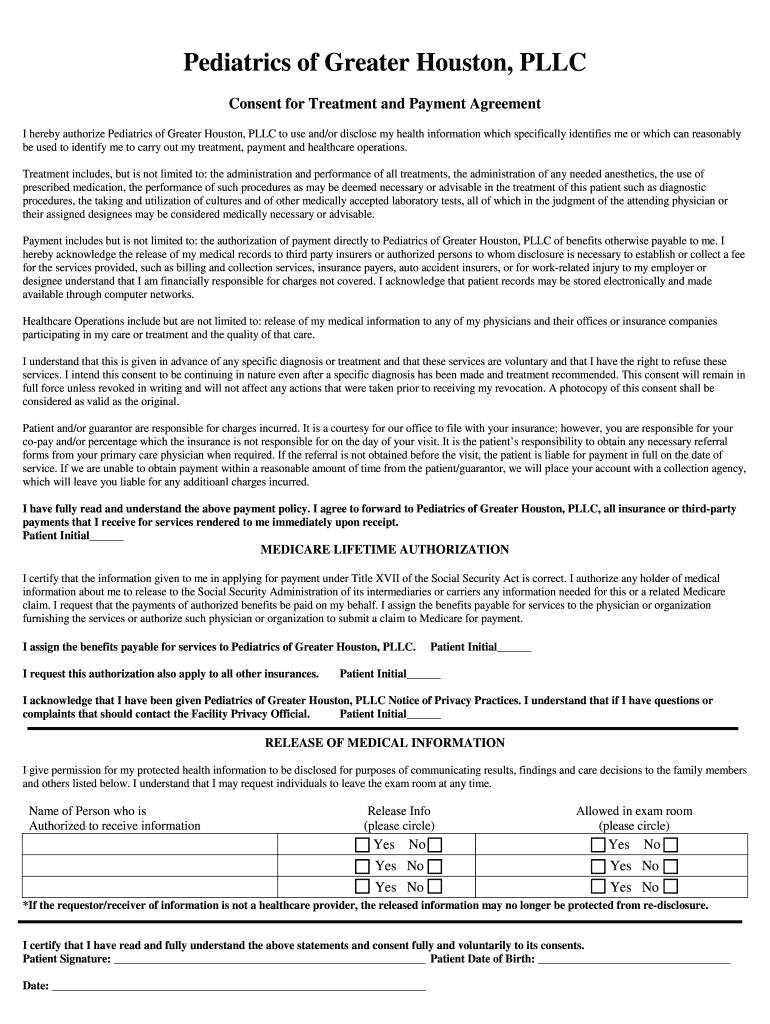
- Begin by entering your personal information at the top of the form, including your name and date of birth. This ensures that your consent is accurately associated with your medical records.
- In the treatment section, review the details provided about what treatments you are consenting to. You may need to initial next to this section to indicate your understanding and agreement.
- Proceed to the payment section where you will authorize payments directly to Pediatrics of Greater Houston, PLLC. Ensure you read through the financial responsibilities outlined before signing.
- For Medicare Lifetime Authorization, fill in any required information and initial as needed. This confirms your understanding of how Medicare claims will be handled.
- In the Release of Medical Information section, list any individuals authorized to receive your health information. Circle 'Yes' or 'No' for their presence during exams as applicable.
- Finally, sign and date the form at the bottom. Make sure all initials and signatures are completed before submitting.
Start using our platform today for free to complete your Consent for Treatment and Payment Agreement Consent Form effortlessly!
Fill out Consent for Treatment and Payment Agreement Consent Form online
It's free
It's free
Got questions?
We have answers to the most popular questions from our customers. If you can't find an answer to your question, please contact us.
Contact us
What are the 5 requirements for informed consent?
The entire informed consent process involves giving a subject adequate information concerning the study, providing adequate opportunity for the subject to consider all options, responding to the subjects questions, ensuring that the subject has comprehended this information, obtaining the subjects voluntary agreement
What are the three types of consent forms?
The three types are: Implied consent. Your provider explains why they recommend a procedure. They explain what happens during the procedure. Verbal consent. An example of verbal consent is when you agree to have tests or procedures. Written consent. Written informed consent applies when you accept a risk.
What are the 5 elements of consent?
Obtaining informed consent in medicine is a process that should include describing the proposed intervention, emphasizing the patients role in decision-making, discussing alternatives to the proposed intervention, discussing the risks and benefits of the proposed intervention, and eliciting the patients preference,
What are the three requirements of a consent form?
To be valid, consent must be voluntary, informed, specific, current, and given by a person with capacity. Unless otherwise indicated, consent can be express or implied, written or verbal.
What are the 5 requirements of consent?
Consent must be freely given, informed, specific, unambiguous, and verifiable.
Security and compliance
At DocHub, your data security is our priority. We follow HIPAA, SOC2, GDPR, and other standards, so you can work on your documents with confidence.
Learn more


People also ask
What are the 5 steps of consent?
This means you and whoever you are with should be over the legal age of consent and not under the influence of drugs or alcohol and not asleep or unconscious. Consent should never be assumed it should be a clear, ongoing continuous process in every new or repeated sexual encounter.
What is signed consent for treatment?
Informed consent is more than merely a signature on a document; it is a communication process between the clinician and the patient. This process ensures that the patient is fully informed about the nature of the procedure or intervention, the potential risks and benefits, and the alternative treatments available.


