


Md standpipe 2026

Get Form
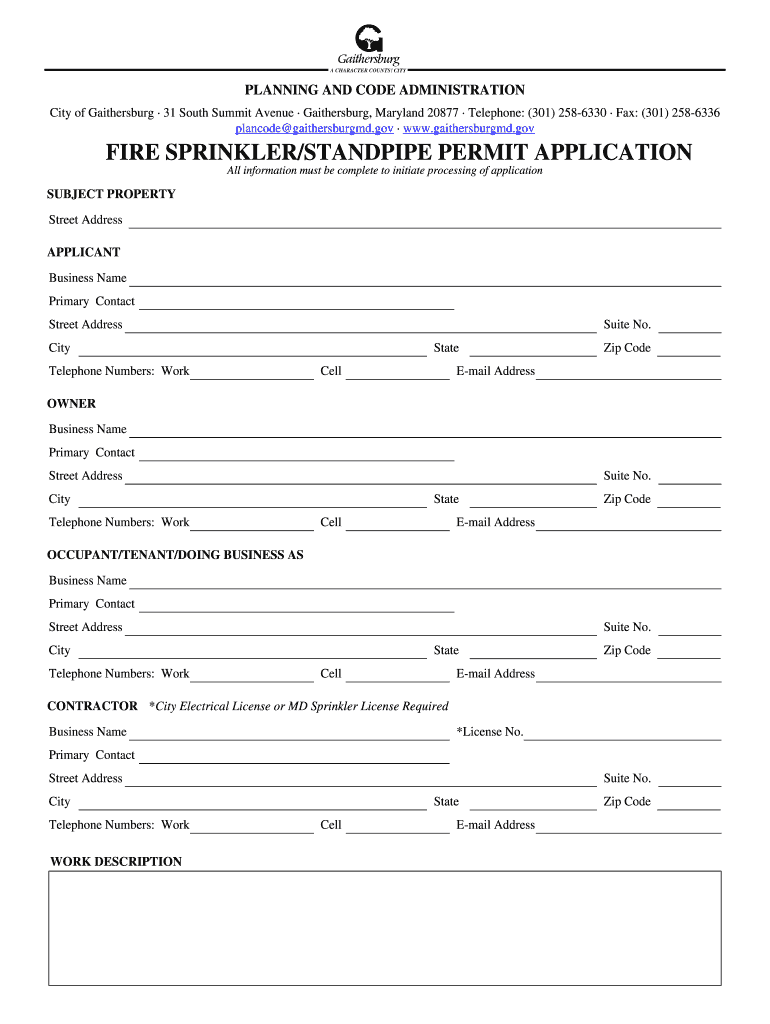
gaithersburg md fire permit application Preview on Page 1

Here's how it works

01. Edit your gaithersburg md fire permit application online
Type text, add images, blackout confidential details, add comments, highlights and more.

02. Sign it in a few clicks
Draw your signature, type it, upload its image, or use your mobile device as a signature pad.

03. Share your form with others
Send md standpipe via email, link, or fax. You can also download it, export it or print it out.

How to use or fill out md standpipe with our platform

Form edit decoration
9.5
Ease of Setup
DocHub User Ratings on G2
9.0
Ease of Use
DocHub User Ratings on G2
  1. Click ‘Get Form’ to open the md standpipe application in the editor.
  2. Begin by filling out the SUBJECT PROPERTY section. Enter the street address of the property where the standpipe will be installed.
  3. In the APPLICANT section, provide your business name and primary contact details, including telephone numbers and email address.
  4. Complete the OWNER section with similar information about the property owner, ensuring all fields are filled accurately.
  5. If applicable, fill in the OCCUPANT/TENANT/DOING BUSINESS AS section with relevant details about any tenants or occupants.
  6. In the CONTRACTOR section, include your contractor's business name and license number. Ensure that you have a valid City Electrical License or MD Sprinkler License.
  7. Describe your WORK DESCRIPTION clearly, detailing what work will be done regarding the standpipe installation or alteration.
  8. Select your PERMIT TYPE by checking either Commercial or Residential options. Then indicate if it’s a New System Installation or an Alteration of an Existing System.
  9. Fill in additional fields such as the number of sprinkler heads, fire pumps, and standpipe risers as required.
  10. Finally, ensure you sign and date the application before submitting it for processing.

Start using our platform today to streamline your md standpipe application process for free!

be ready to get more

Complete this form in 5 minutes or less

Get form

Got questions?

We have answers to the most popular questions from our customers. If you can't find an answer to your question, please contact us.
Contact us
For automatic standpipes, there must be a minimum 100 pounds per square inch (psi) at the outlet of the hydraulically most remote 21/2-inch hose connection and a minimum 65 psi at the outlet of the hydraulically most remote 11/2-inch hose connection.
Wet standpipe systems contain water at all times. Manual Wet Standpipe System - A standpipe system that contains water, but requires additional water to be pumped into the system via a fire department connection (FDC), often by a fire truck.
A Class I system is typically required in buildings that have more than three stories above or below grade because of the time and difficulty involved in laying hose from fire apparatus directly to remote floors. For these reasons, Class I standpipes are the required system in high-rise buildings.
While they are not fail-safe, standpipes provide a level of redundancy in the event that the main water supply to the buildings sprinkler system fails as can happen in an explosion. They also offer a lot of advantages for fighting a fire because they eliminate the need to carry a heavy wet hose up a stairwell.
They are typically 2 to 4 inches wide and rise several feet above the floor. Note that standpipe often refers to a wide variety of mechanisms but this article refers to standpipes found in basements.

Security and compliance

At DocHub, your data security is our priority. We follow HIPAA, SOC2, GDPR, and other standards, so you can work on your documents with confidence.

Learn more

People also ask

All standpipes are fitted with a backflow prevention device in the form of a BS6282 double check valve. Water from a standpipe should not be consumed or used in food preparation. All fire hydrants in public streets and highways are our responsibility.
A standpipe is a system of pipe that delivers a water supply for hose connections and automatic sprinklers in combined systems. Standpipe systems are typically installed vertically from floor to floor but are considered horizontal when two or more hose connections are installed on a single level.

city sprinkler application form