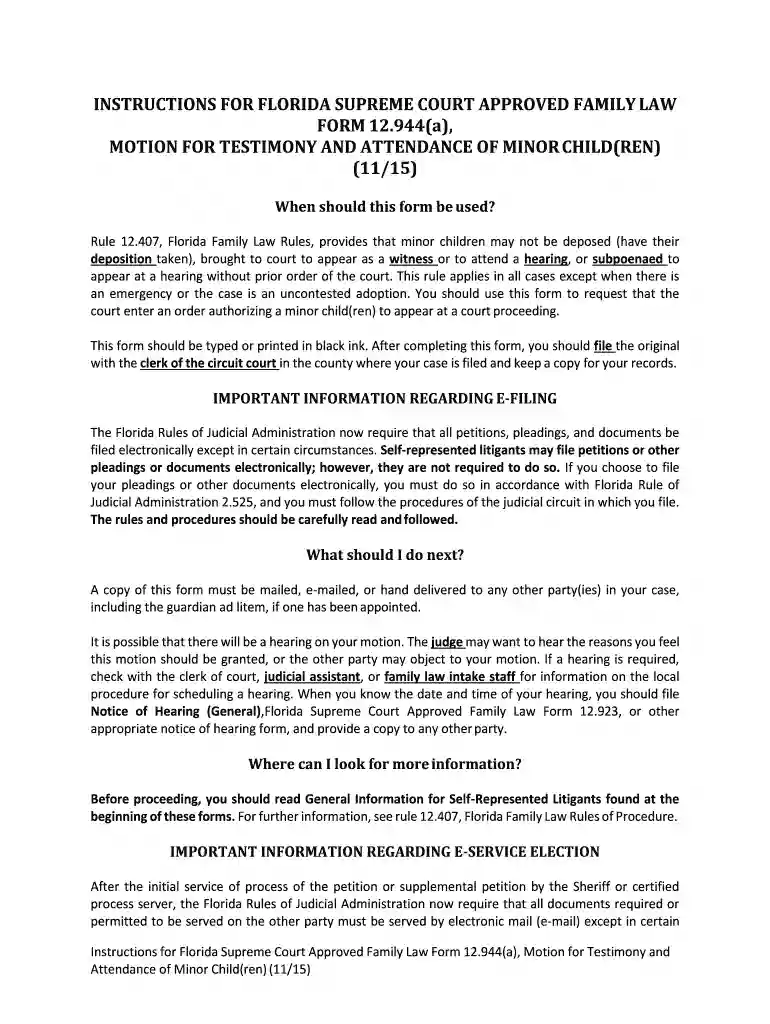
Motion testimony child 2026

Get Form
testimony florida Preview on Page 1

Here's how it works

01. Edit your testimony florida online
Type text, add images, blackout confidential details, add comments, highlights and more.

02. Sign it in a few clicks
Draw your signature, type it, upload its image, or use your mobile device as a signature pad.

03. Share your form with others
Send motion minor child via email, link, or fax. You can also download it, export it or print it out.

How to use or fill out motion testimony child with our platform

Form edit decoration
9.5
Ease of Setup
DocHub User Ratings on G2
9.0
Ease of Use
DocHub User Ratings on G2
  1. Click ‘Get Form’ to open the motion testimony child document in the editor.
  2. Begin by entering the case information at the top of the form, including the judicial circuit and county. Ensure that you accurately fill in your case number and division.
  3. In the 'Petitioner' and 'Respondent' sections, clearly state your name and that of the other party involved in the case.
  4. List the names, birth dates, and ages of all minor children for whom you are requesting testimony or attendance. This is crucial for clarity.
  5. Select all applicable actions regarding the minor children by checking the corresponding boxes. Provide specific details such as dates and locations for each action requested.
  6. In the final section, explain why you believe this motion should be granted. Be concise yet thorough in your reasoning.
  7. Review your entries for accuracy before saving or printing. Once completed, file it electronically with your local court as per e-filing guidelines.

Start using our platform today to streamline your document editing and filing process for free!

See more motion testimony child versions

We've got more versions of the motion testimony child form. Select the right motion testimony child version from the list and start editing it straight away!
Versions Form popularity Fillable & printable
2015 4.2 Satisfied (37 Votes)
2015 4.9 Satisfied (202 Votes)
be ready to get more

Complete this form in 5 minutes or less

Get form

Got questions?

We have answers to the most popular questions from our customers. If you can't find an answer to your question, please contact us.
Contact us
Childs Maturity Most states do not have a limit on the age of a child that can be allowed to testify in court, California does. If a child is 14 years or older and wishes to address the court, the child shall be allowed to.
Hearsay is not admissible in evidence unless it is specifically allowed by an exception in the rules of evidence or another statute.
The Process: The motion hearing begins when one party files a motion, requesting the court decide on a legal issue. After filing, a court hearing date is set, and both sides prepare their arguments. At the hearing, attorneys present their positions using oral arguments, evidence, and sometimes witness testimony.
Childrens accuracy was approximately 30% correct for low-confidence decisions, and accuracy increased monotonically with confidence, up to 86% correct for high-confidence decisions.
Most states do not have a limit on the age of a child that can be allowed to testify in court, California does. If a child is 14 years or older and wishes to address the court, the child shall be allowed to.

Security and compliance

At DocHub, your data security is our priority. We follow HIPAA, SOC2, GDPR, and other standards, so you can work on your documents with confidence.

Learn more
ccpa2
pci-dss
gdpr-compliance
hipaa
soc-compliance

People also ask

Residual Exception:The residual exception allows for hearsay statements that dont neatly fit into other exceptions but are considered trustworthy. If the childs statement has circumstantial guarantees of trustworthiness and is vital to the case, a judge may admit it under this catch-all exception.
In the United States, there is no minimum age for a child to testify as a witness in court. The only requirements are: The child must have personal knowledge of matter that is relevant to the proceeding; The child must be capable of expressing that knowledge; and.

motion testimony and