




01. Edit your navy fitrep fillable pdf online
Type text, add images, blackout confidential details, add comments, highlights and more.

Type text, add images, blackout confidential details, add comments, highlights and more.

Draw your signature, type it, upload its image, or use your mobile device as a signature pad.

Send navy fitrep form via email, link, or fax. You can also download it, export it or print it out.
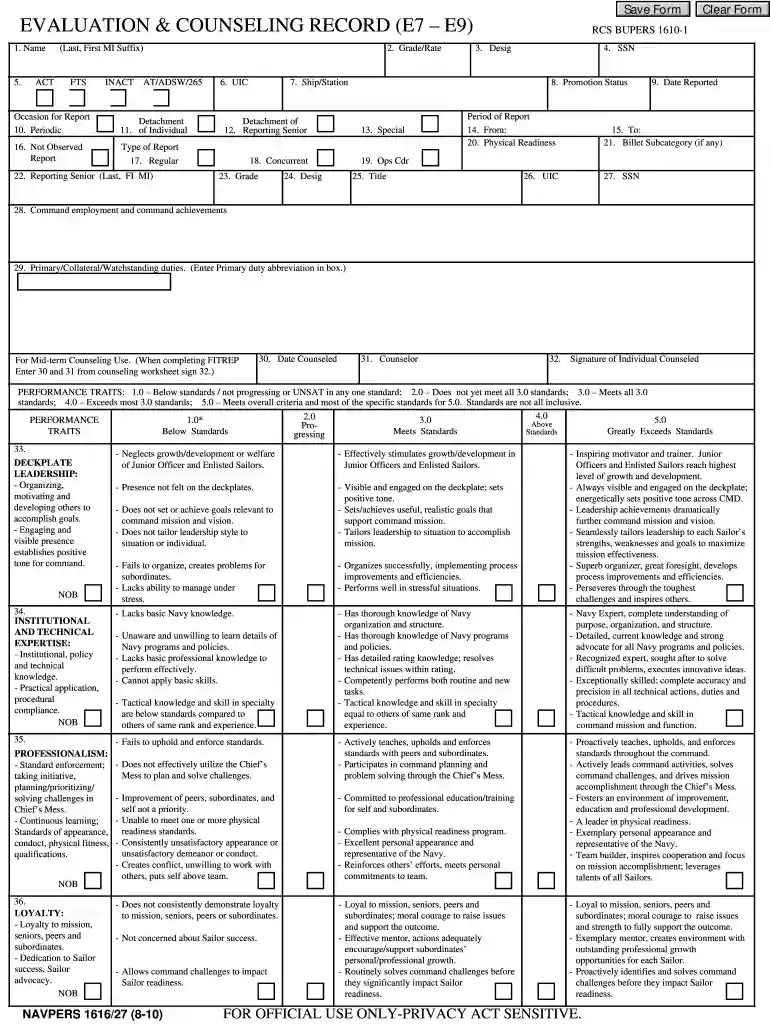
NAVPERS 1616/27 is a document used within the United States Navy for submitting fitness reports, commonly referred to as fitreps. This form plays a crucial role in evaluating the performance of naval personnel, specifically for the ranks of E7 to E9, and is integral for ensuring that evaluations accurately reflect an individual's contributions to their command and overall naval operations.
Each section of the NAVPERS 1616/27 form is vital for providing an accurate portrayal of a service member's performance. Below are the most critical blocks:
Personal Information
This block requires basic details about the reporting member and the evaluators, including names, ranks, social security numbers, and periods of reporting. Accurate completion ensures that the report remains linked to the correct personnel, preventing confusion or errors during evaluations.
Performance Traits
This section enumerates essential traits, including leadership qualities, accountability, and technical proficiency. Evaluators rate individuals on a scale, ensuring performance is quantified, which facilitates objective comparisons among peers. Comprehensive input here can highlight a member’s strengths and opportunities for growth.
Recommendations for Promotion
This block offers evaluators a chance to advise on potential promotions based on the individual’s performance. Providing cogent reasoning can greatly influence a member’s career trajectory, emphasizing the importance of detailed and supported recommendations.
Counseling Dates
Important for tracking an individual's developmental progress, counselors must record dates when discussions concerning performance were conducted. This transparency acknowledges ongoing performance management, showing that feedback is provided regularly, reinforcing accountability.
Summary of Duties
In this block, the reporting member's primary responsibilities and accomplishments during the reporting period are detailed. Highlighting major duties showcases contributions to the command and captures the essence of the member's roles, allowing evaluators and selecting officials to understand the context of performance ratings better.
Filling out the NAVPERS 1616/27 involves several critical steps:
Gather Required Information
Collect personal and command details necessary for accurate completion. Verify that names and ranks are current and match with official records.
Assess Performance Traits
Reflect on the service member's qualities and achievements during the reporting period. Provide specific examples that substantiate evaluations in personal traits to deliver a more robust review.
Detail Counseling Activities
Ensure counseling sessions are documented with accurate dates. This reinforces that the individual has received constructive feedback throughout the evaluation period.
Recommendation Compilation
Clearly articulate promotion recommendations. Use specific examples of achievements and leadership qualities that support the recommendations.
Review and Submit
Before finalizing the report, conduct a thorough review to correct any discrepancies or errors. Ensure that all necessary blocks have been accurately filled out to comply with Navy standards before submission to the appropriate commanding officer.
The NAVPERS 1616/27 form is not merely a formal requirement; it significantly impacts the evaluations and advancement potential of naval personnel. When completed effectively, it facilitates the promotion board's assessment process, making the case for a service member's qualifications and readiness for increased responsibility. Comprehensive fitreps contribute directly to career development and can provide a competitive advantage during promotion selections.
Confidentiality
It is essential for the reporting officer to maintain confidentiality and integrity while completing the evaluation. All feedback, ratings, and comments should reflect the service member's performance honestly.
Adherence to Deadlines
Timely submission of the NAVPERS 1616/27 is vital. Late submissions can hinder promotions and evaluations and may reflect negatively on both the evaluator and the evaluated.
Regular Feedback
Establishing a routine feedback process can enhance the accuracy of the traits assessed. Regular check-ins can help both the reporting officer and service member develop better insights into performance and areas for improvement.
In conclusion, the NAVPERS 1616/27 is a pivotal tool in the career development of E7 to E9 personnel within the U.S. Navy. Each block within the form serves a distinct purpose, providing an organized framework for presenting achievements, performance, and potential for advancement. Understanding its nuances ensures that naval personnel receive fair and constructive evaluations, ultimately fostering career progression and development within the Navy.
We've got more versions of the navy fitrep fillable pdf form. Select the right navy fitrep fillable pdf version from the list and start editing it straight away!
At DocHub, your data security is our priority. We follow HIPAA, SOC2, GDPR, and other standards, so you can work on your documents with confidence.
Apr 30, 2026 NAVPERS 1616/27: Evaluation and Counseling Record (E7 - E9) This. Navy form used to evaluate senior enlisted personnel (E7 - E9).
27,mynavyhr.navy.mil/career-management/boards/active-duty-officer/06-line/fy NAVPERS/NAVPERS 1336-3Rev 10-2024Final.pdf,MyNavy HR ReferencesRead more


