What Property Tax Deduction Can You Claim for 2020-2026

Get Form
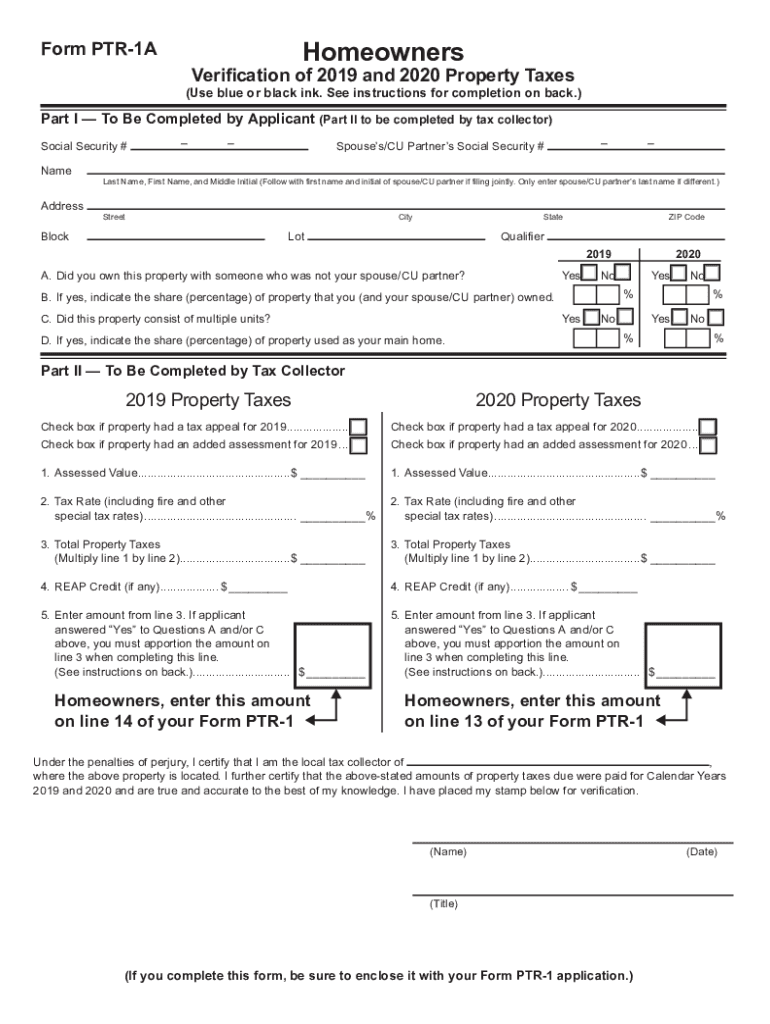
ptr 1a form Preview on Page 1

Here's how it works

01. Edit your ptr 1a form online
Type text, add images, blackout confidential details, add comments, highlights and more.
02. Sign it in a few clicks
Draw your signature, type it, upload its image, or use your mobile device as a signature pad.
03. Share your form with others
Send ptr1a form via email, link, or fax. You can also download it, export it or print it out.

How to use or fill out What Property Tax Deduction Can You Claim for 2020

Form edit decoration
9.5
Ease of Setup
DocHub User Ratings on G2
9.0
Ease of Use
DocHub User Ratings on G2
  1. Click ‘Get Form’ to open it in the editor.
  2. Begin with Part I by entering your Social Security number. If married or in a civil union, include your spouse’s number as well.
  3. Fill in your name and address accurately. Ensure to include your spouse’s name if filing jointly.
  4. Provide the block and lot numbers of your property, along with any applicable qualifier.
  5. Answer questions regarding multiple ownership and occupancy percentages. Be precise about ownership shares if applicable.
  6. In Part II, the tax collector will fill out property tax details for 2019 and 2020. Ensure all amounts are accurate before submission.
  7. Complete the certification section at the end of the form, signing and dating it appropriately.

Start using our platform today to easily complete your property tax deduction form for free!

See more What Property Tax Deduction Can You Claim for 2020 versions

We've got more versions of the What Property Tax Deduction Can You Claim for 2020 form. Select the right What Property Tax Deduction Can You Claim for 2020 version from the list and start editing it straight away!
Versions Form popularity Fillable & printable
2021 4.5 Satisfied (29 Votes)
2019 4.7 Satisfied (31 Votes)
2016 4.8 Satisfied (47 Votes)
2009 4.5 Satisfied (61 Votes)
2005 4 Satisfied (34 Votes)
be ready to get more

Complete this form in 5 minutes or less

Get form

Got questions?

We have answers to the most popular questions from our customers. If you can't find an answer to your question, please contact us.
Contact us
If you itemize, you can deduct these expenses: Bad debts. Canceled debt on home. Capital losses. Donations to charity. Gains from sale of your home. Gambling losses. Home mortgage interest. Income, sales, real estate and personal property taxes.
The total amount of deductible state and local income taxes, including property taxes, is limited to $10,000 for 2024. This amount increases to $40,000 for tax years 2025 through 2028 but is subject to reduction depending on your income level.
The most common itemized deductions are those for state and local taxes, mortgage interest, charitable contributions, and medical and dental expenses.
Personal Expenses that Are No Longer Deductible. Specifically, the TCJA suspended for 2018 through 2025 a large group of deductions lumped together in a category called miscellaneous itemized deductions that were deductible to the extent they exceeded 2% of a taxpayers adjusted gross income.
For federal purposes, your total itemized deduction for state and local taxes paid in 2020 is limited to a combined amount not to exceed $10,000 ($5,000 if married filing separate). In addition, you can no longer deduct foreign taxes you paid on real estate.

Security and compliance

At DocHub, your data security is our priority. We follow HIPAA, SOC2, GDPR, and other standards, so you can work on your documents with confidence.

Learn more
ccpa2
pci-dss
gdpr-compliance
hipaa
soc-compliance

People also ask

You can claim prior years property tax in the tax year you paid them. For example, if you paid your 2022 property taxes in 2024, claim them on your 2024 taxes. However, you cant include any late fees, interest, or penaltiesjust the tax itself.
The $6,000 senior deduction is per eligible individual (or $12,000 total for a married couple where both spouses qualify). Deduction phases out for taxpayers with modified adjusted gross income over $75,000 ($150,000 for joint filers).

Related links