
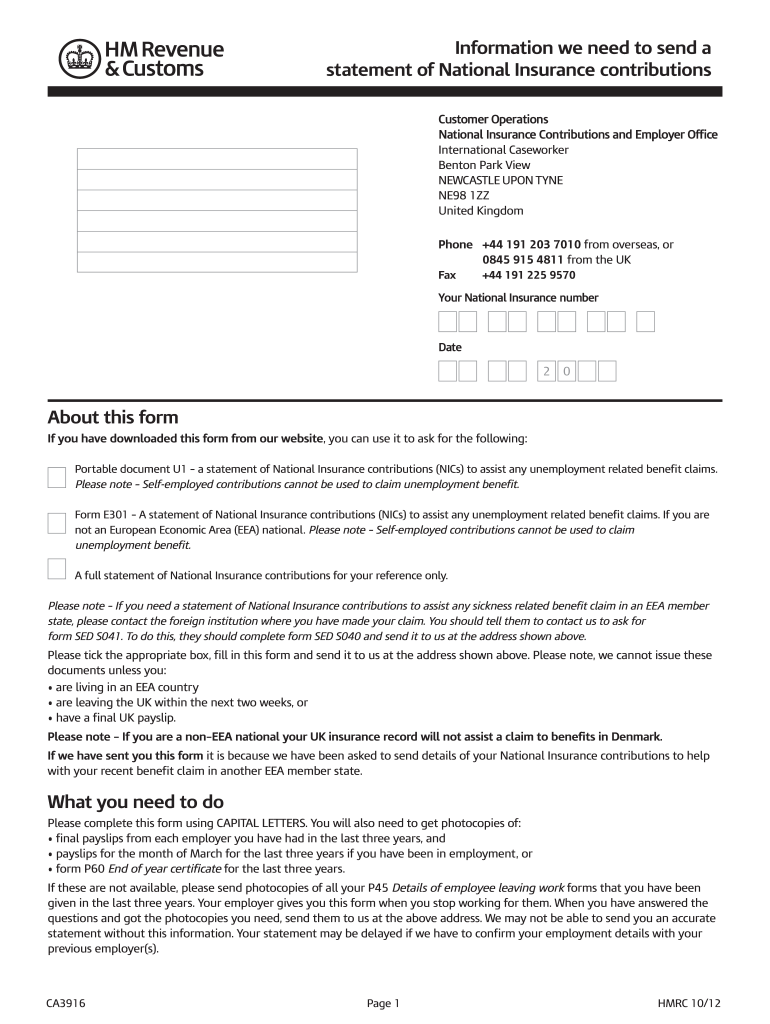







Definition and Meaning of the U1 Form UK
The U1 form, also referred to as the CA3916 in some contexts, is an important document within the United Kingdom that certifies an individual's National Insurance contributions while they were employed abroad within the European Economic Area (EEA). This form is primarily used when individuals wish to claim unemployment benefits or other entitlements after returning to the UK.
The essence of the U1 form lies in its role as proof of contributions. It allows the UK authorities to assess an individual's eligibility for benefits based on the work history accrued abroad, ensuring that contributions made overseas are recognized. This is particularly significant for those who may not have a continuous work history within the UK and rely on their contributions from other EEA countries to qualify for financial support.
How to Obtain the U1 Form UK
To successfully acquire the U1 form, several steps can be followed depending on your current situation and location:
-
Identify the Issuing Authority: For UK residents or former residents who worked in another EEA country, the U1 form is typically requested from the country in which contributions were made. This is usually the social security institution or equivalent body.
-
Complete the Administrative Process: Most countries require you to fill out a request form or provide specific information, such as your personal details and employment history.
-
Submit Required Documentation: You may need to submit additional documents, such as proof of identity, previous payslips, or employment contracts to support your request.
-
Follow Up on Your Application: After submission, keep track of your request through the institution's customer service. Processing times may vary, but you should inquire about expected turnaround times to set your expectations appropriately.
-
Accessing the Form Online: Some countries may offer the option to request the U1 form online. It is beneficial to check the specific country’s social security website to understand their procedures.
Upon completion of these steps, the U1 form will be sent directly to you, either electronically or via post.
Steps to Complete the U1 Form UK
Completing the U1 form correctly is crucial for ensuring that your benefits claims are processed efficiently. Follow these detailed steps to avoid common pitfalls:
-
Gather Required Information: Collect all pertinent personal information, including your National Insurance number, employment history, and contact details.
-
Fill in Personal Details: Enter your name, address, and identification number. Ensure that all information is accurate and up to date.
-
Detail Your Employment History: Include all positions held in the last few years. Be specific about the dates of employment and the nature of your contributions.
-
Provide Supporting Documentation: Attach any necessary documents, such as proof of previous employment (e.g., contracts or pay slips) that verify your contributions in the relevant country.
-
Review and Submit: Double-check all entries for accuracy and completeness. Ensure you have signed where necessary and submit the form to the appropriate authority as instructed.
-
Track Submission Status: Keep records of your submission and monitor any communication from the authority to follow up on the status of your request.
By adhering to these steps, you can fill out the U1 form confidently and correctly.
Legal Use of the U1 Form UK
The U1 form holds significant legal authority and should be used with an understanding of its implications within the context of entitlement claims. Here are the key aspects of its legal use:
-
Proof of Contributions: The U1 form serves as an official record of your National Insurance contributions made while working in another EEA country, which is essential for validating claims for unemployment benefits in the UK.
-
Adhering to the ES Regulations: The use of the U1 form is rooted in European Social Security regulations, which mandate that contributions made across borders within the EEA must be recognized. This means your rights to specific benefits are protected even if your contributions were made outside the UK.
-
Legally Binding Document: Once issued, the U1 form is considered a legally binding document that can be used to contest decisions made by UK benefit authorities. If a claim for benefits is denied, possessing the U1 form can support your case during appeals.
-
Compliance Requirements: Individuals must ensure they complete the U1 form correctly and submit it within specified time frames to maintain compliance with legal expectations set by both the UK and the issuing country.
Understanding these legalities surrounding the U1 form is essential for effectively navigating the benefits system.
Key Elements of the U1 Form UK
The U1 form comprises several crucial elements that must be understood for proper use. The following breakdown highlights its main components:
-
Personal Identification Information: This includes your full name, address, National Insurance number, and other identifying information to confirm your identity.
-
Employment History Section: An accurate record of previous employment history is vital. This section typically requires employers' names, addresses, job titles, and the dates of employment.
-
Contributions Summary: This summarizes your National Insurance contributions, showing periods and amounts of contributions made while working abroad.
-
Signatory and Verification Fields: The form usually requires a signature to validate the information provided and may include fields for authorities to verify the details.
-
Instructions for Submission: Clear instructions on how to submit the form and what documentation to include, which may vary depending on the issuing country.
Having a thorough understanding of these key elements helps in accurately completing and submitting the form, ensuring your benefits claims can be processed without issues.




