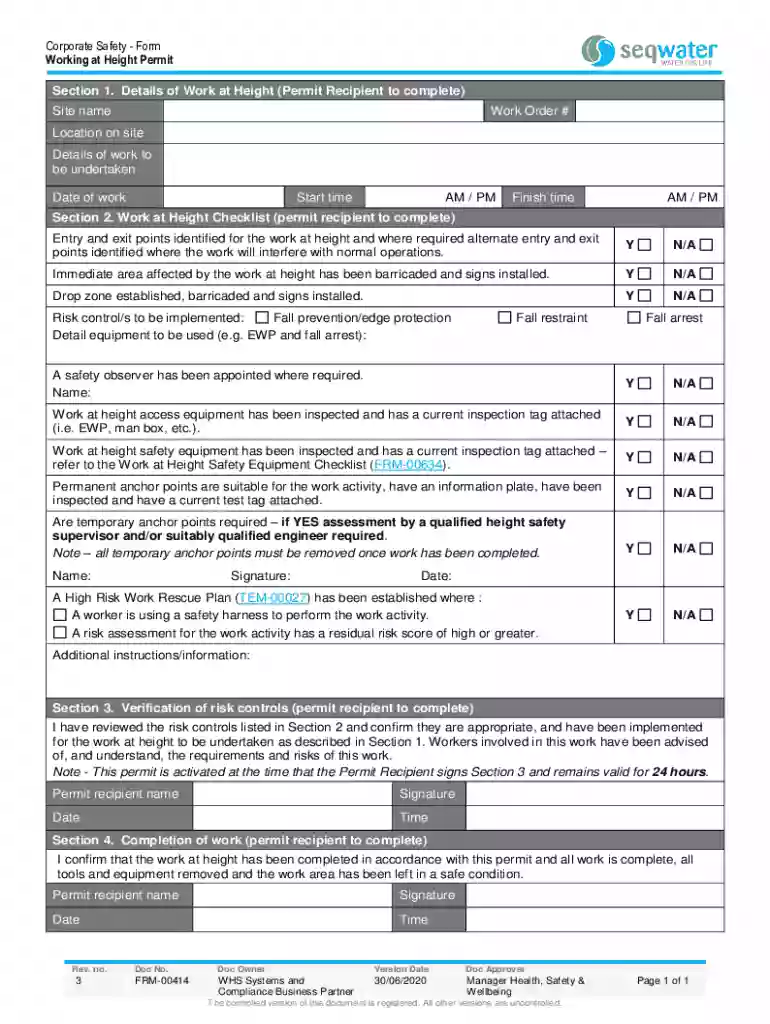
Corporate Safety - Work at Height Permit Form 2026

Get Form
work at height permit word format Preview on Page 1

Here's how it works

01. Edit your work at height permit word format online
Type text, add images, blackout confidential details, add comments, highlights and more.

02. Sign it in a few clicks
Draw your signature, type it, upload its image, or use your mobile device as a signature pad.

03. Share your form with others
Send working at height permit template via email, link, or fax. You can also download it, export it or print it out.

Definition and Importance of the Work at Height Permit

The Corporate Safety Work at Height Permit form is a crucial document designed to manage and mitigate the risks associated with tasks performed at elevated positions. It serves as a formal request and approval mechanism for any work that takes place above a specified height, ensuring that safety protocols are adhered to, thereby protecting workers from potential hazards and ensuring compliance with safety regulations.

Purpose of the Work at Height Permit

  • Risk Management: The permit acts as a preventative measure, ensuring that all safety checks and risk assessments are conducted prior to beginning work at height. This proactive approach minimizes accidents and injuries.
  • Legal Compliance: A properly completed permit is in line with Occupational Safety and Health Administration (OSHA) regulations, which mandate certain safety standards for work performed at height. Violating these regulations could lead to penalties for employers.
  • Documentation: This form provides a recorded history of safety measures taken, which is essential for audits and inspections by regulatory bodies.

Key Components of the Work at Height Permit

The Corporate Safety Work at Height Permit form consists of several critical sections that outline the necessary information relevant to the safety of the operation.

Work Details Section

  • Nature of Work: This section requires a clear description of the task being performed at height, whether it involves construction, maintenance, or any other activity.
  • Location and Duration: It should specify the exact location where the work will be carried out and the expected duration of the activity.

Safety Checklist

  • Pre-Operational Safety Checks: A checklist must be completed to ensure that all safety measures are evaluated before work begins. This includes checking weather conditions, safety gear, and any necessary equipment.
  • Required Safety Equipment: The permit must indicate the required personal protective equipment (PPE), such as helmets, harnesses, and fall arrest systems, tailored to the specific tasks being performed.

Risk Control Verification

  • Identifying Hazards: The form should detail potential risks associated with the task at height, such as falling objects, insufficient guardrails, or unstable ladders.
  • Control Measures: This includes outlining how identified risks will be managed, for instance, through proper training of workers, clear communication, and supervision.

Steps to Complete the Work at Height Permit

Completing the Corporate Safety Work at Height Permit involves several steps to ensure that all areas are adequately covered.

  1. Initiate the Permit: The worker or supervisor initiates the process by filling out the necessary details about the work description and location.
  2. Conduct a Safety Assessment: Prior to submission, a thorough safety assessment using the checklist is conducted to evaluate any potential risks and required safety measures.
  3. Obtain Necessary Signatures: The form must be signed by supervisory personnel who authorize the work, ensuring that a responsible individual is accountable for safety oversight.
  4. Distribute Copies: Once signed, copies of the permit should be distributed to all relevant parties, including those performing the work and safety personnel overseeing the operation.

Examples of Work at Height Permit Use Cases

Throughout various industries, the Corporate Safety Work at Height Permit has multiple applications, reinforcing its necessity.

  • Construction Projects: Contractors use the permit when workers need to perform roofing, scaffolding, or other tasks requiring elevation.
  • Maintenance Operations: Facilities may require the permit for tasks such as changing light bulbs, cleaning gutters, or repairing overhead systems.
  • Event Setup: Companies setting up stages or equipment at significant heights for concerts and festivals utilize the permit to ensure safety compliance.

Legal Compliance and Best Practices

To maintain legality and safety within operations, adhering to established guidelines related to the Work at Height Permit is essential.

  • OSHA Regulations: All operations must comply with OSHA standards, which detail requirements for fall protection and training.
  • Regular Training: Workers should receive ongoing training related to safety procedures and the use of the permit, ensuring that they understand their responsibilities.
  • Review and Revise: The form and its procedures should be periodically reviewed and revised to reflect any changes in regulations or internal safety policies.

By integrating these elements into your operations, you can foster a secure environment for employees working at heights while aligning with regulatory standards.

See more Corporate Safety - Work at Height Permit Form versions

We've got more versions of the Corporate Safety - Work at Height Permit Form form. Select the right Corporate Safety - Work at Height Permit Form version from the list and start editing it straight away!
Versions Form popularity Fillable & printable
2020 4.2 Satisfied (45 Votes)
2012 4.9 Satisfied (40 Votes)
be ready to get more

Complete this form in 5 minutes or less

Get form

Got questions?

We have answers to the most popular questions from our customers. If you can't find an answer to your question, please contact us.
Contact us

Microsoft Word doesn’t have signing tools to create legitimate eSignatures and enforceable forms. Fortunately, DocHub is an online eSignature-compliant editor that works with various file formats, including .doc files. Log in to your account and add the Word version of your working at heights permit template from your device and cloud, or URL - our editor will automatically transform it into an editable PDF. Make all necessary changes in your form and click Sign to create your own legally-binding eSignature. There are four signing methods from which to choose.

You can easily fill out, modify, and even eSign your working at height permit to work example using DocHub. Create a new account and begin your free trial. After that, you may add the file with the form and simply make all the necessary edits. No need to print on paper or use a third-party application to sign it, as you can place your electronic signature on your document quicker through DocHub.

Hot Work. Hot Work Permits are used when the work may involve potential fire hazards, sources of ignition, combustible and/or flammable materials. Examples of hot work include: welding, cutting, grinding, flame cutting, drilling, soldering, brazing, torch-applied roofing, etc.
The permit is issued in Triplicate. The original (green in colour) and 2nd copy (white in colour) will be for the Permittee/ Receiver.
A safe work permit (also known as a permit to work) is a document that includes a description of the work to be performed, the hazards involved, the precautions to take, the required authorizations, and other elements. It is a written record authorizing a specific work at a specific location, and for a specific time.

Security and compliance

At DocHub, your data security is our priority. We follow HIPAA, SOC2, GDPR, and other standards, so you can work on your documents with confidence.

Learn more
ccpa2
pci-dss
gdpr-compliance
hipaa
soc-compliance

People also ask

There are seven main types of work permits: Hot Work Permits, Cold Work Permits, Confined Spaces Work Permits, Chemical Work Permits, Height Work Permit, and Excavation Permit.
The level is set by the Occupational Safety and Health Administration (OSHA) and varies depending on the type of work being done. ing to the OSHA, height is decided as 1.8 meters. So if the work or the job is to perform is at 1.8-meter height from the ground level then a height work permit is required.
A permit-to-work system is a safety document having instructions for safe execution of certain types of works which are potentially hazardous.
A safe work permit (also known as a permit to work) is a document that includes a description of the work to be performed, the hazards involved, the precautions to take, the required authorizations, and other elements. It is a written record authorizing a specific work at a specific location, and for a specific time.
Authorization and control: The PTW system provides a formalized process for authorizing high-risk activities and ensuring they are carried out under controlled conditions. This helps to prevent unauthorized work and ensure that the work is carried out in a controlled and safe manner.

work at height permit template