Behavior Incident Reporting Form - IVCC 2026

Get Form
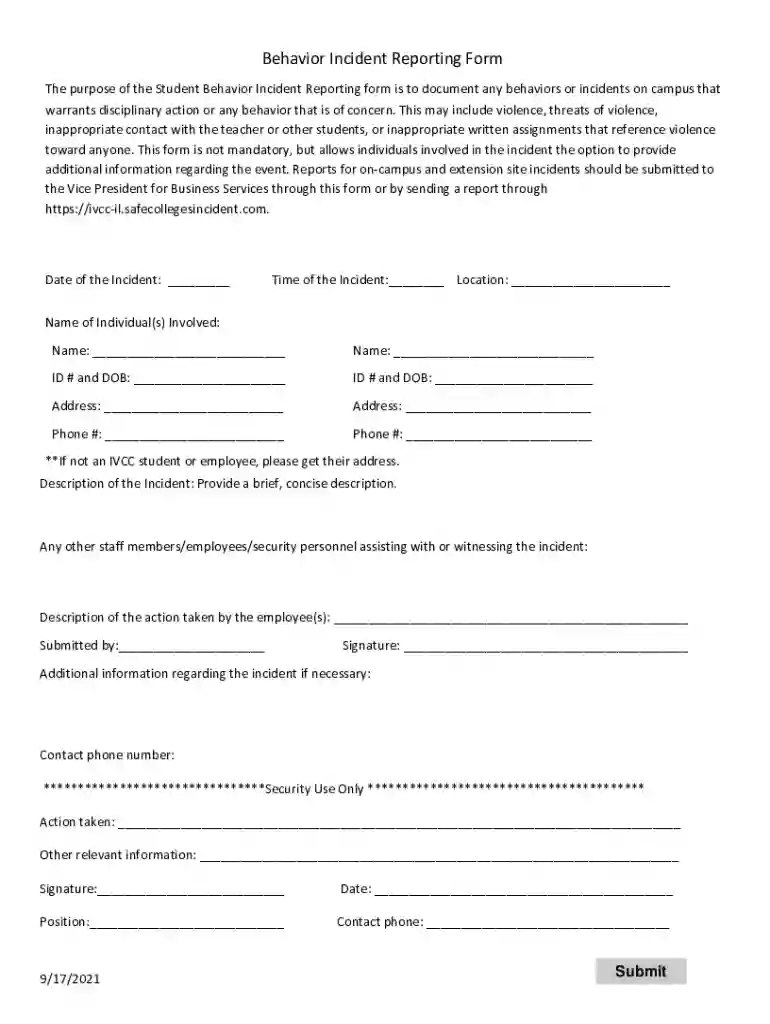
Behavior Incident Reporting Form - IVCC Preview on Page 1

Here's how it works

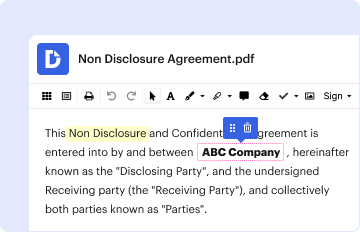
01. Edit your form online
Type text, add images, blackout confidential details, add comments, highlights and more.

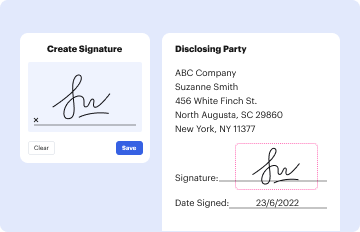
02. Sign it in a few clicks
Draw your signature, type it, upload its image, or use your mobile device as a signature pad.
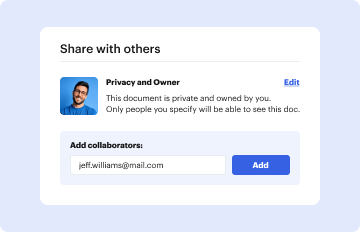
03. Share your form with others
Send it via email, link, or fax. You can also download it, export it or print it out.

How to use or fill out Behavior Incident Reporting Form - IVCC with DocHub

Form edit decoration
9.5
Ease of Setup
DocHub User Ratings on G2
9.0
Ease of Use
DocHub User Ratings on G2
  1. Click ‘Get Form’ to open the Behavior Incident Reporting Form in our editor.
  2. Begin by entering the 'Date of the Incident' and 'Time of the Incident' in the designated fields. This information is crucial for accurate documentation.
  3. Fill in the 'Location' where the incident occurred, ensuring it is specific to aid in any follow-up actions.
  4. Provide the names of all individuals involved in the incident. Include their ID numbers and dates of birth for identification purposes.
  5. Complete the address and phone number fields for each individual involved, including non-IVCC individuals if applicable.
  6. In the 'Description of the Incident' section, write a brief yet comprehensive account of what transpired during the incident.
  7. Document any staff members or security personnel who witnessed or assisted with the incident in the provided space.
  8. Describe any actions taken by employees regarding the incident, ensuring clarity for future reference.
  9. Finally, sign and submit your report using our platform's submission features to ensure it reaches the Vice President for Business Services efficiently.

Start filling out your Behavior Incident Reporting Form today on our platform for free!

See more Behavior Incident Reporting Form - IVCC versions

We've got more versions of the Behavior Incident Reporting Form - IVCC form. Select the right Behavior Incident Reporting Form - IVCC version from the list and start editing it straight away!
Versions Form popularity Fillable & printable
2023 4.8 Satisfied (120 Votes)
2021 4.8 Satisfied (53 Votes)
2019 4.5 Satisfied (34 Votes)
2012 4.5 Satisfied (47 Votes)
be ready to get more

Complete this form in 5 minutes or less

Get form

Got questions?

We have answers to the most popular questions from our customers. If you can't find an answer to your question, please contact us.
Contact us
Use the following checklist to ensure you have provided a comprehensive report: A - About the Person - any known information about the individual. B - Behavior/Basis - what has been observed/ the reason for referral. C - Context - the setting(s) for the behavior(s) D - Details - any other relevant information.
What to Include in an Incident Report General information. Setting or environment. Affected people. Injuries and the severity. Witnesses. Administered treatment. Property and equipment damages. Events.
A general staff incident report generally includes: Persons name and contact details. Incident Time, date, and site. Pertinent details about what happened. Kind of injury or damage. Name of witnesses. Safety measures taken Suggestions for prevention.
Typically, a licensed professional, such as a nurse or nurse practitioner, who was part of or witnessed the event completes the form. However, nonlicensed clinicians should report events and provide information as needed for the report.
Tips for Documenting Incidents Write about the facts: the who, what, where, when, and how. Include the impact of the behavior. Describe any attempts to intervene, discuss, or mitigate the issue and how the person responded to that.

Security and compliance

At DocHub, your data security is our priority. We follow HIPAA, SOC2, GDPR, and other standards, so you can work on your documents with confidence.

Learn more

People also ask

One of the most widely used methods for this is the A-B-C (Antecedent-Behaviour-Consequence) Incident Report. These reports help caregivers, educators, disability support staff, therapists, and behavioural specialists understand patterns of behaviour, identify triggers, and develop effective support strategies.

Related links