




01. Edit your atoms vs ions worksheet online
Type text, add images, blackout confidential details, add comments, highlights and more.

Type text, add images, blackout confidential details, add comments, highlights and more.

Draw your signature, type it, upload its image, or use your mobile device as a signature pad.

Send atoms vs ions worksheet answers via email, link, or fax. You can also download it, export it or print it out.
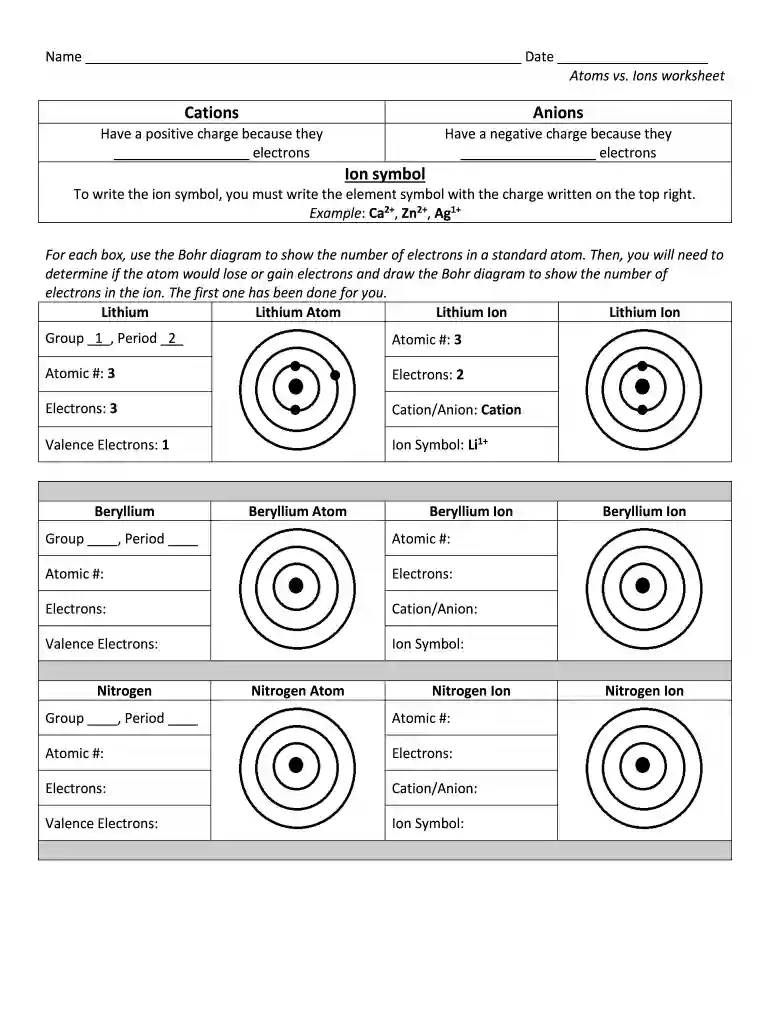
The "atoms vs ions worksheet" is an educational tool designed primarily for students in chemistry to understand the distinctions between atoms and ions, specifically focusing on cations and anions. The worksheet often includes sections where learners can document various elements, their atomic numbers, electron configurations, and the symbols associated with their ionic forms.
Understanding these concepts helps students grasp how atoms interact in chemical reactions and form compounds.
To effectively utilize the atoms vs ions worksheet, follow these structured steps:
Furthermore, it is beneficial to complement the worksheet with Bohr diagrams to visualize how electrons are lost or gained.
Acquiring the atoms vs ions worksheet can be accomplished through various methods:
This accessibility allows learners to have the necessary resources at hand for their studies.
Completing the atoms vs ions worksheet requires attention to detail and a solid understanding of atomic structure. Here are key steps to follow:
The structured approach enhances comprehension and retention of the material.
Familiarity with key terms related to the atoms vs ions worksheet is essential for mastering the concepts involved. Some important terms include:
Understanding these terms supports a deeper comprehension of atomic and ionic behaviors in chemical contexts.
Practical application of the atoms vs ions worksheet can be illustrated through varied examples:
Such examples reinforce the worksheet's purpose, providing concrete instances of how ions form from atoms.
Essential components of the atoms vs ions worksheet contribute to its effectiveness in teaching students about atomic structure and ionic formation:
When each element is thoughtfully integrated, the worksheet becomes a powerful educational tool, fostering academic achievement in chemistry.
We've got more versions of the atoms vs ions worksheet form. Select the right atoms vs ions worksheet version from the list and start editing it straight away!
| Versions | Form popularity | Fillable & printable |
|---|---|---|
| 2017 | 4.9 Satisfied (39 Votes) |
Electronic signatures are an excellent alternative to traditional signing, as they save time, effort, and money people spend on printing, scanning, and paper delivery. You can eSign your atoms vs ions worksheet answer key using a reliable and powerful online document processing tool like DocHub. It complies with major eSignature regulations (ESIGN and UETA), so all documents approved there are legally binding and have the same validity as manually signed ones.
With DocHub, there are several convenient ways to edit your atoms vs ions worksheet answers pdf online. You can drag and drop the form and modify it directly at the DocHub website or use our browser extension to fill out your form right away. On top of that, you can modify your PDF on your phone, as DocHub is compatible with all the available mobile platforms.
At DocHub, your data security is our priority. We follow HIPAA, SOC2, GDPR, and other standards, so you can work on your documents with confidence.
Indicate what has to happen in the atom for the ion to form. Then indicate # of protons (p+), # of electrons (e-), and how ion charge arises. Element. Atomic.Read more
Polyatomic Ions and Ionic Nomenclature. How Are Ions Made From Neutral Atoms. Page 2. Worksheet. How are ions made from neutral atoms worksheet is a crucial
Each is represented by a separate worksheet in this Excel file. As studies were gathered and reviewed, they were broadly categorized based on the general typeRead more


