
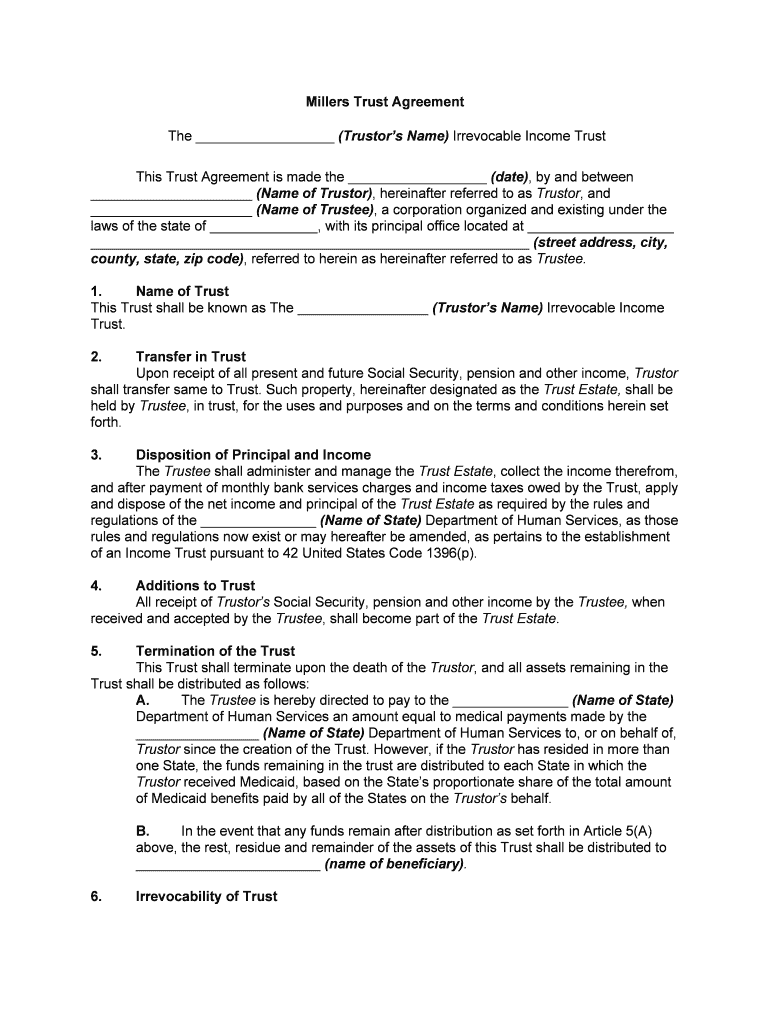



Qualified Income Miller Trust 2026

Get Form
florida qualified income trust template Preview on Page 1

Here's how it works

01. Edit your florida qualified income trust template online
Type text, add images, blackout confidential details, add comments, highlights and more.

02. Sign it in a few clicks
Draw your signature, type it, upload its image, or use your mobile device as a signature pad.

03. Share your form with others
Send qualified income trust texas pdf via email, link, or fax. You can also download it, export it or print it out.

How to use or fill out Qualified Income Miller Trust with our platform

Form edit decoration
9.5
Ease of Setup
DocHub User Ratings on G2
9.0
Ease of Use
DocHub User Ratings on G2
  1. Click ‘Get Form’ to open the Qualified Income Miller Trust in the editor.
  2. Begin by entering the Trustor’s Name and the date of the agreement in the designated fields at the top of the form.
  3. In the 'Name of Trust' section, specify how you want to refer to this Irrevocable Income Trust.
  4. For 'Transfer in Trust', indicate all sources of income that will be transferred into the trust, ensuring clarity on what constitutes the Trust Estate.
  5. Fill out the 'Disposition of Principal and Income' section by detailing how income will be managed and distributed according to state regulations.
  6. Complete sections regarding Additions to Trust and Termination of the Trust, specifying any beneficiaries and conditions for termination.
  7. Review all entries for accuracy before finalizing your document. Utilize our platform's editing tools for any necessary adjustments.

Start using our platform today to easily complete your Qualified Income Miller Trust form online for free!

See more Qualified Income Miller Trust versions

We've got more versions of the Qualified Income Miller Trust form. Select the right Qualified Income Miller Trust version from the list and start editing it straight away!
Versions Form popularity Fillable & printable
2020 4.6 Satisfied (49 Votes)
be ready to get more

Complete this form in 5 minutes or less

Get form

Got questions?

We have answers to the most popular questions from our customers. If you can't find an answer to your question, please contact us.
Contact us
The QIT serves one purpose to create a legal pathway to Medicaid eligibility for applicants who have too much income to qualify for assistance but insufficient funds to pay for needed care.
The Miller trust can pay the Medicaid recipient a small personal needs allowance, and the trust can also be used to pay the recipients spouse a monthly allowance. Any additional money is used to pay the recipients share of his or her cost of care.
However, there are drawbacks as well. A Miller Trust is irrevocable once it is in place it cannot be changed or redone. In addition, some states require that all of the beneficiarys income go through the Miller Trust and that it can only pay out certain expenses, which limits access to your own money.
QBI is the net amount of qualified items of income, gain, deduction, and loss from any qualified trade or business, including income from partnerships, S corporations, sole proprietorships, and certain trusts.
A Miller Trust helps people qualify for Medicaid long-term care benefits in income-cap states. These states enforce strict monthly income limits for Medicaid eligibility, and applicants who exceed that limit by even a few dollars may be denied coverage.

Security and compliance

At DocHub, your data security is our priority. We follow HIPAA, SOC2, GDPR, and other standards, so you can work on your documents with confidence.

Learn more
ccpa2
pci-dss
gdpr-compliance
hipaa
soc-compliance

People also ask

A qualified income trust (QIT), also known as a Miller Trust, is an irrevocable trust specially designed to legally divert an individual or married couples income into a trust resulting in the income being excluded for purposes of determining eligibility for nursing home (institutional) Medicaid and 1915(c) home
If you retitle the name of qualified retirement accounts (401(k)s, 403(b)s, IRAs and qualified annuities) into the name of a revocable living trust, the transfer will be treated as a complete withdrawal of the funds from the account and 100% of the value will be subject to income tax in the year of the transfer.

Related links

