Au 196 10 2026

Get Form
au 196 10 Preview on Page 1

Here's how it works

01. Edit your form online
Type text, add images, blackout confidential details, add comments, highlights and more.

02. Sign it in a few clicks
Draw your signature, type it, upload its image, or use your mobile device as a signature pad.

03. Share your form with others
Send it via email, link, or fax. You can also download it, export it or print it out.

How to use or fill out au 196 10 with our platform

Form edit decoration
9.5
Ease of Setup
DocHub User Ratings on G2
9.0
Ease of Use
DocHub User Ratings on G2
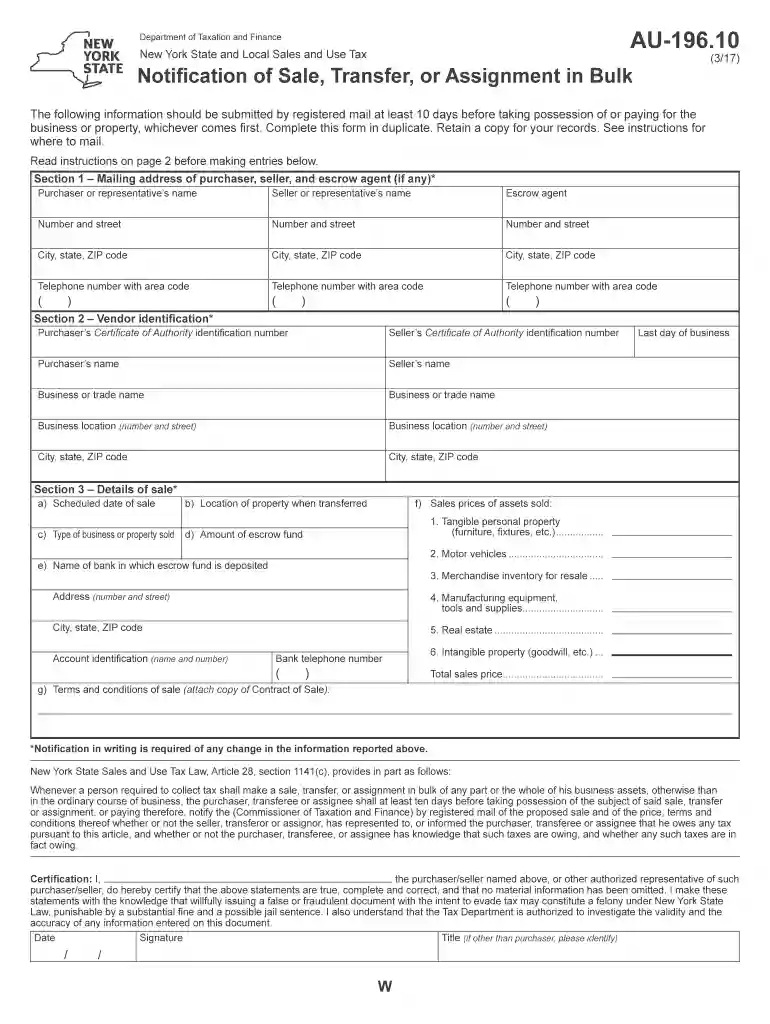
  1. Click ‘Get Form’ to open the AU-196.10 in the editor.
  2. In Section 1, enter the mailing addresses for the purchaser, seller, and escrow agent. Ensure accuracy as this information is crucial for communication.
  3. Proceed to Section 2 and input the Vendor identification numbers for both purchaser and seller. If not applicable, indicate 'none'. Include their business names and locations.
  4. In Section 3, provide details of the sale. Start with the scheduled date of sale and location of property when transferred. Specify the type of business or property sold.
  5. List all sales prices for assets sold in Section 3f, ensuring you include tangible personal property, motor vehicles, merchandise inventory, manufacturing equipment, real estate, and intangible assets.
  6. Finally, review all entries for accuracy before signing at the bottom of the form. Retain a copy for your records.

Start filling out your AU-196.10 form online for free today!

See more au 196 10 versions

We've got more versions of the au 196 10 form. Select the right au 196 10 version from the list and start editing it straight away!
Versions Form popularity Fillable & printable
2017 4.8 Satisfied (40 Votes)
2010 4.1 Satisfied (50 Votes)
be ready to get more

Complete this form in 5 minutes or less

Get form

Got questions?

We have answers to the most popular questions from our customers. If you can't find an answer to your question, please contact us.
Contact us
Bulk Sales Tangible property such as inventory or materials; Real property (land, buildings etc.); and. Intangible assets, such as goodwill.
While most states have repealed their bulk sales statutes, in some states across the U.S., such as California, Delaware, Illinois, New Jersey and Pennsylvania, the practice of bulk sales compliance remains alive and well.
Exemptions from Californias Bulk Sales Law A bulk sale in California is exempt from the Uniform Commercial Code if the net value of the assets is either less than $10,000 or more than $5,000,000 on the date of purchase.
A purchaser in a bulk sale transaction is also responsible for paying the sales tax due on any tangible personal property purchased or acquired. The tax due may be paid to the seller to be remitted with the sellers final return, or it may be paid directly to the Tax Department.
According to Californias Bulk Sales Act, the buyer of a Bulk Sale is required to post official notice at least 12 days prior to the sale/purchase for any potential creditors review. This notice must include: A statement verifying that a bulk sale is taking place.

Security and compliance

At DocHub, your data security is our priority. We follow HIPAA, SOC2, GDPR, and other standards, so you can work on your documents with confidence.

Learn more
ccpa2
pci-dss
gdpr-compliance
hipaa
soc-compliance
be ready to get more

Complete this form in 5 minutes or less

Get form

People also ask

In Colorado, bulk sales require sellers to notify all known creditors and relevant authorities at least 10 days before transferring substantial business inventory outside ordinary operations. Notifications must include detailed asset descriptions and creditor information, submitted to the Secretary of State.

Related links