Type text, add images, blackout confidential details, add comments, highlights and more.
02. Sign it in a few clicks
Draw your signature, type it, upload its image, or use your mobile device as a signature pad.
03. Share your form with others
Send it via email, link, or fax. You can also download it, export it or print it out.
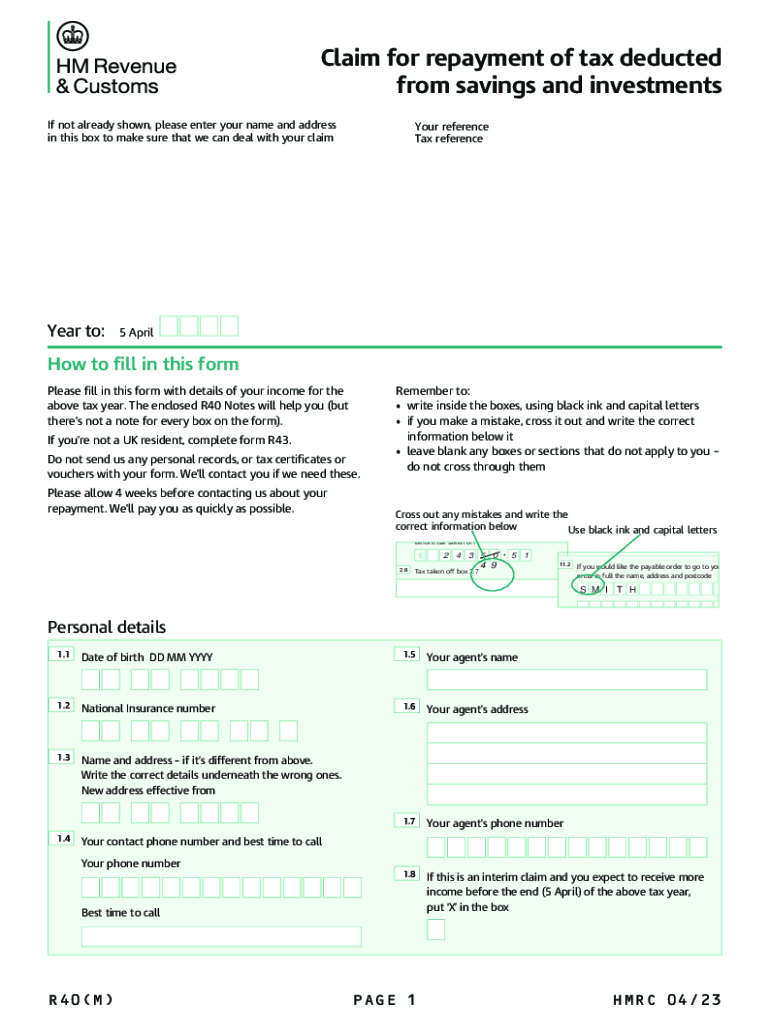
How to use or fill out R40 - Claim for repayment of tax deducted from savings
Ease of Setup
DocHub User Ratings on G2
Ease of Use
DocHub User Ratings on G2
Click ‘Get Form’ to open it in the editor.
Begin by entering your personal details, including your name and address, in the designated boxes. Ensure you use black ink and capital letters for clarity.
Fill in the year for which you are claiming repayment and provide your tax reference number. This information is crucial for processing your claim.
Complete each section regarding your income, pensions, and any other relevant financial details. Refer to the enclosed R40 Notes for guidance on specific boxes.
If applicable, indicate if this is an interim claim by marking the appropriate box. Remember to leave blank any sections that do not apply to you.
Review all entries carefully. If you make a mistake, cross it out neatly and write the correct information below.
Sign and date the form at the end, ensuring that all provided information is accurate before submission.
Start using our platform today to fill out your R40 form easily and for free!
Fill out R40 - Claim for repayment of tax deducted from savings online It's free
See more R40 - Claim for repayment of tax deducted from savings versions
We've got more versions of the R40 - Claim for repayment of tax deducted from savings form. Select the right R40 - Claim for repayment of tax deducted from savings version from the list and start editing it straight away!
R40 claim for repayment of tax deducted from savings onlineR40 Notes PDFR40 claim for repayment of tax deducted from savings 2022What is an R40R43 formWhat is PPI taxR40 claim for repayment of tax deducted from savings formHMRC tax refund claim status
Security and compliance
At DocHub, your data security is our priority. We follow HIPAA, SOC2, GDPR, and other standards, so you can work on your documents with confidence.
Insulation Tax Credit How to Claim the Federal Tax Credits Strategies to Maximize Your Federal Tax Savings Claim the credits using the IRS Form 5695 .Read more
by SC Thompson Jr 2000 Cited by 2 I believe that South Africa should carefully craft tax incentives to promote both savings and investment, and I set out a broad outline of aRead more
Cookie consent notice
This site uses cookies to enhance site navigation and personalize your experience.
By using this site you agree to our use of cookies as described in our Privacy Notice.
You can modify your selections by visiting our Cookie and Advertising Notice.