




01. Edit your form online
Type text, add images, blackout confidential details, add comments, highlights and more.

Type text, add images, blackout confidential details, add comments, highlights and more.

Draw your signature, type it, upload its image, or use your mobile device as a signature pad.

Send it via email, link, or fax. You can also download it, export it or print it out.
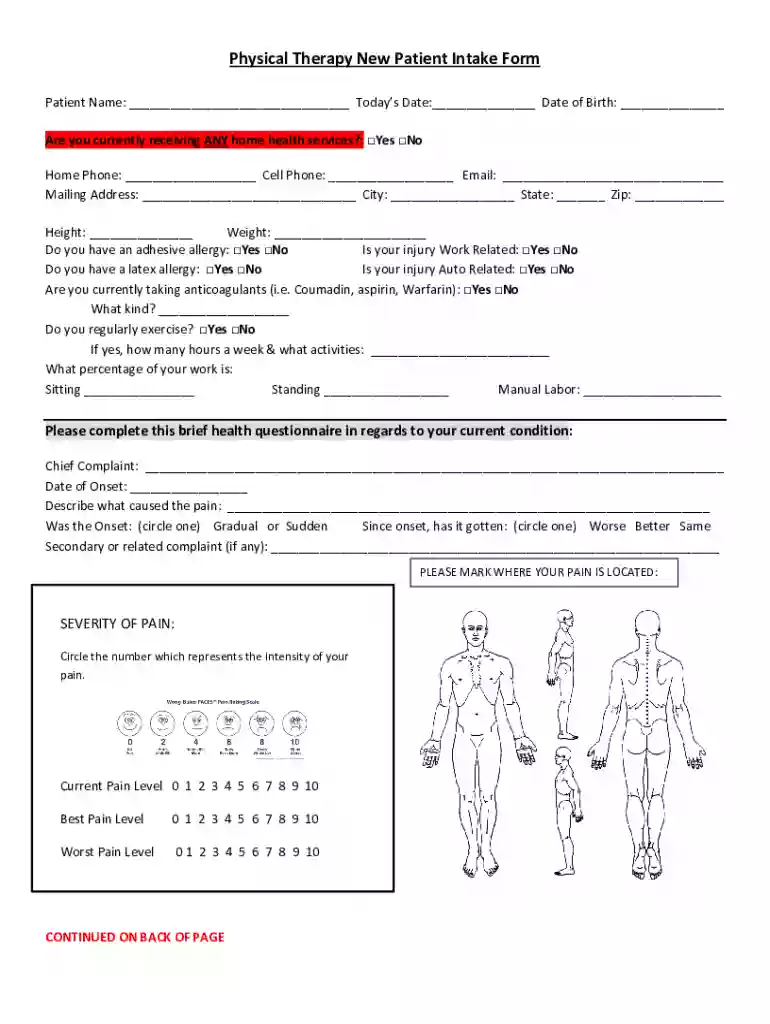
The term "Date of IE: P T Patient Name" typically represents a component of a Physical Therapy New Patient Intake Form. It serves as a placeholder for essential patient appointment or intake details, including the date of initial evaluation (IE), patient treatment (P T), and the patient's name. This structured information facilitates accurate tracking and management of patient data, ensuring that healthcare providers have a complete record to reference during treatment planning.
To effectively utilize the "Date of IE: P T Patient Name" section, clinicians should ensure the accuracy and completeness of every element. Recording the correct date of the initial evaluation and the patient's full name is crucial for maintaining comprehensive medical records. Adhering to consistent naming and dating conventions helps in aligning patient files, reducing the possibility of errors, and allowing for seamless integration into digital health systems.
Each of these elements contributes to a holistic view of the patient's medical journey, supporting better care outcomes and streamlined administrative processes.
This form section is primarily used by healthcare professionals in physical therapy or rehabilitation settings. Its users include:


The "Date of IE: P T Patient Name," as part of patient intake forms, must comply with privacy laws such as the Health Insurance Portability and Accountability Act (HIPAA) in the United States. It is essential that all entered data is handled securely and with consent, ensuring patient confidentiality and integrity of medical records.
To complete this section effectively, practitioners should have access to:
Different states in the U.S. may have specific regulations regarding patient intake forms. Providers should:
Digital completion of the "Date of IE: P T Patient Name" makes it compatible with various healthcare management systems and applications like DocHub. This ensures:
This compatibility enhances productivity and facilitates better patient care coordination.
We've got more versions of the Date of IE: P T Patient Name form. Select the right Date of IE: P T Patient Name version from the list and start editing it straight away!
At DocHub, your data security is our priority. We follow HIPAA, SOC2, GDPR, and other standards, so you can work on your documents with confidence.


