




01. Edit your t1 document pdf online
Type text, add images, blackout confidential details, add comments, highlights and more.

Type text, add images, blackout confidential details, add comments, highlights and more.

Draw your signature, type it, upload its image, or use your mobile device as a signature pad.

Send t1 document template via email, link, or fax. You can also download it, export it or print it out.
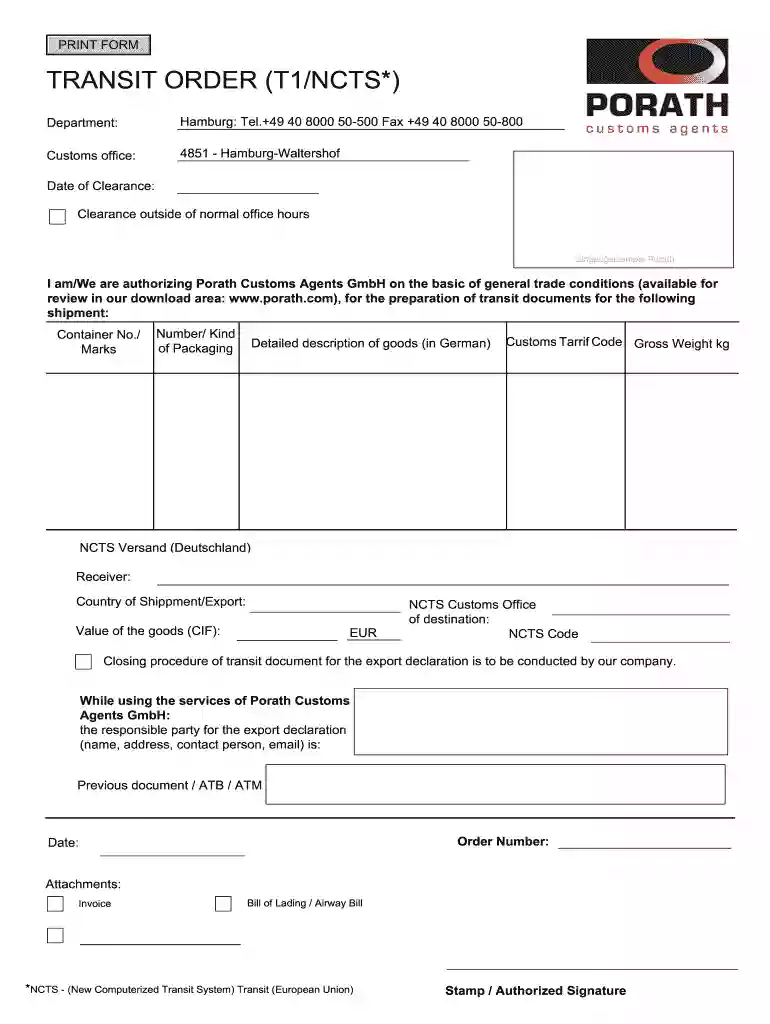
The customs order T1 NCTS form is a vital document used in the international transportation of goods and clearing customs for shipments entering or departing the European Union. Specifically designed for transit operations, it allows goods to move under a customs procedure that alleviates immediate duty payment while ensuring compliance with customs regulations. The T1 form is especially relevant in scenarios involving non-EU destinations where the final destination of the goods may not be immediately clear.
The T1 NCTS form generally includes critical details such as:
Understanding this form is crucial for businesses involved in import/export activities, particularly those dealing with goods transiting through multiple jurisdictions.
Completing the customs order T1 NCTS form requires specific attention to detail to ensure compliance with regulatory standards. The following steps outline the process:
Gather Required Information
Fill Out the Form
Indicate Transit Information
Sign and Date the Form
Submit the Form
Following these steps ensures compliance with customs requirements and smooth processing of goods across borders.
Understanding the key elements of the customs order T1 NCTS form is essential for effective use and compliance. The following elements are central to the form:
These elements work together to form a comprehensive document that satisfies both regulatory compliance and shipping logistics.
Practical scenarios illustrate how the customs order T1 NCTS form operates in real-world situations. Here are a few examples:
International Business Transaction: A U.S.-based electronics company ships a batch of devices to a distributor in Germany. The company fills out the T1 NCTS form to ensure the devices can transit through customs without immediate duties, allowing for their sale within the EU market.
Art Exhibition: An art gallery is preparing to showcase artworks in a European exhibit. Using the T1 NCTS form, the gallery can transport artworks across borders without paying upfront duties, facilitating the temporary movement required for exhibition purposes.
Commercial Samples: A fabric manufacturer sends samples to potential clients in France. By using the T1 NCTS form, the company can move these samples without incurring taxes, as the goods are not intended for sale.
Each scenario highlights the utility of the T1 form across various sectors, showcasing how it supports international trade while ensuring compliance with customs regulations.
A clear understanding of terms related to the customs order T1 NCTS form enhances compliance and clarity in customs processes. Key terms include:
NCTS (New Computerized Transit System): A system used by customs authorities in the EU to manage and monitor the transit of goods under customs control.
Customs Tariff Code: A numeric code used to classify products for customs duties and regulations.
Customs Declaration: A document submitted to customs authorities declaring the information regarding goods being imported or exported.
Electronic Customs Services: Digital platforms that allow for the submission and processing of customs documentation electronically, improving efficiency and accuracy.
Understanding these terms aids businesses in navigating customs regulations and ensures proper compliance with legal standards.
At DocHub, your data security is our priority. We follow HIPAA, SOC2, GDPR, and other standards, so you can work on your documents with confidence.
Dec 1, 2025 customs val- uation in order to comply with the Committees 1 directive. The staff report also included a valuation standard with two.Read more
This supplement provides guidance for UK Customs and traders, complementing the European Commission Transit Manual by offering UK-specificRead more


