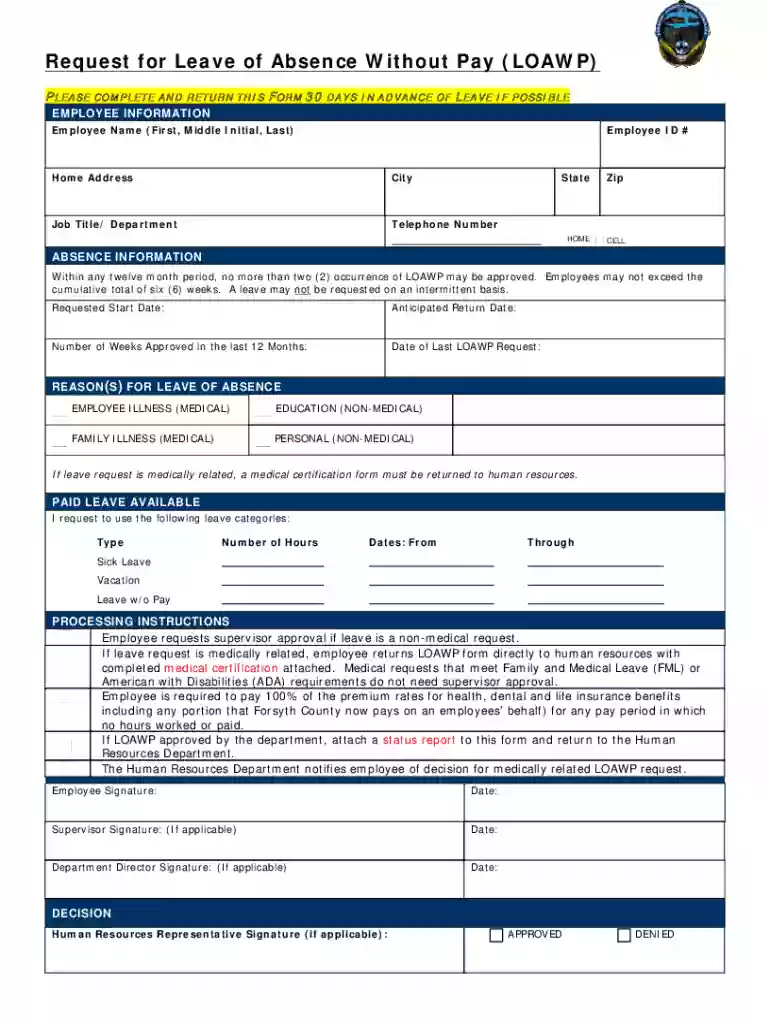
Request for Leave of Absence Without Pay (LOAWP) 2025

Get Form
Request for Leave of Absence Without Pay (LOAWP) Preview on Page 1

Here's how it works

01. Edit your form online
Type text, add images, blackout confidential details, add comments, highlights and more.

02. Sign it in a few clicks
Draw your signature, type it, upload its image, or use your mobile device as a signature pad.

03. Share your form with others
Send it via email, link, or fax. You can also download it, export it or print it out.

How to use or fill out Request for Leave of Absence Without Pay (LOAWP) with DocHub

Form edit decoration
9.5
Ease of Setup
DocHub User Ratings on G2
9.0
Ease of Use
DocHub User Ratings on G2
  1. Click ‘Get Form’ to open the Request for Leave of Absence Without Pay (LOAWP) in our editor.
  2. Begin by filling out the Employee Information section. Enter your full name, employee ID, home address, job title/department, and contact numbers.
  3. In the Absence Information section, specify your requested start date and anticipated return date. Note that you can only request a maximum of six weeks within a twelve-month period.
  4. Select the reason for your leave from the provided options: employee illness, education, family illness, or personal reasons. If applicable, remember to attach any required medical certification.
  5. Indicate any paid leave you wish to utilize by filling in the type and number of hours for sick leave or vacation. Specify the dates for each leave type.
  6. After completing all sections, review your entries for accuracy before signing and dating the form. If necessary, seek supervisor approval based on your leave type.

Start using our platform today to easily complete your LOAWP form online for free!

See more Request for Leave of Absence Without Pay (LOAWP) versions

We've got more versions of the Request for Leave of Absence Without Pay (LOAWP) form. Select the right Request for Leave of Absence Without Pay (LOAWP) version from the list and start editing it straight away!
Versions Form popularity Fillable & printable
2017 4.3 Satisfied (42 Votes)
2011 4 Satisfied (23 Votes)
be ready to get more

Complete this form in 5 minutes or less

Get form

Got questions?

We have answers to the most popular questions from our customers. If you can't find an answer to your question, please contact us.
Contact us
Employees may request unpaid leave for various reasons such as study, career breaks, caring for non-dependents, or healthcare appointments. In these cases, the decision to grant the leave is entirely at the employers discretion.
Employers have the discretion to grant LWOP for various reasons. Below are some of the most common situations where employees request unpaid leave: Extended holidays Employees may request LWOP when they have exhausted their annual leave but wish to extend their time away.
Requesting Time Off from Work Laws Generally speaking, it is up to you as the employer to decide whether employees are offered paid and/or unpaid time off. However, there are certain situations where a company is legally required to abide by the employment laws, at a state or federal level, to authorize time off.
Unpaid leave is referred to in the Act only in terms of what the employer is entitled to do when an employees sick leave or annual leave has been exhausted the employer may then allow (or require) the employee to take unpaid leave.
Unpaid leave Its up to their employer whether to agree to it. The worker can explain the reason for their request. The worker and employer should try to come to an agreement together. Workers should check their contract to see if it covers unpaid leave and how to request it.

People also ask

Unpaid leave is difficult. Youre usually supposed to use all your paid leave first before tapping into unpaid. And if its just few days, a lot of HRs will tell you to just not report it. Saves them a headache. But yeah unpaid is basically for exceptional circumstances only.
Even if a business does not offer unpaid time off, employees will be able to claim unpaid leave through the Family and Medical Leave Act (FMLA). First passed in 1993, this law provides certain employees up to 12 weeks of unpaid, job-protected leave a year, with preserved medical benefits.

Related links