
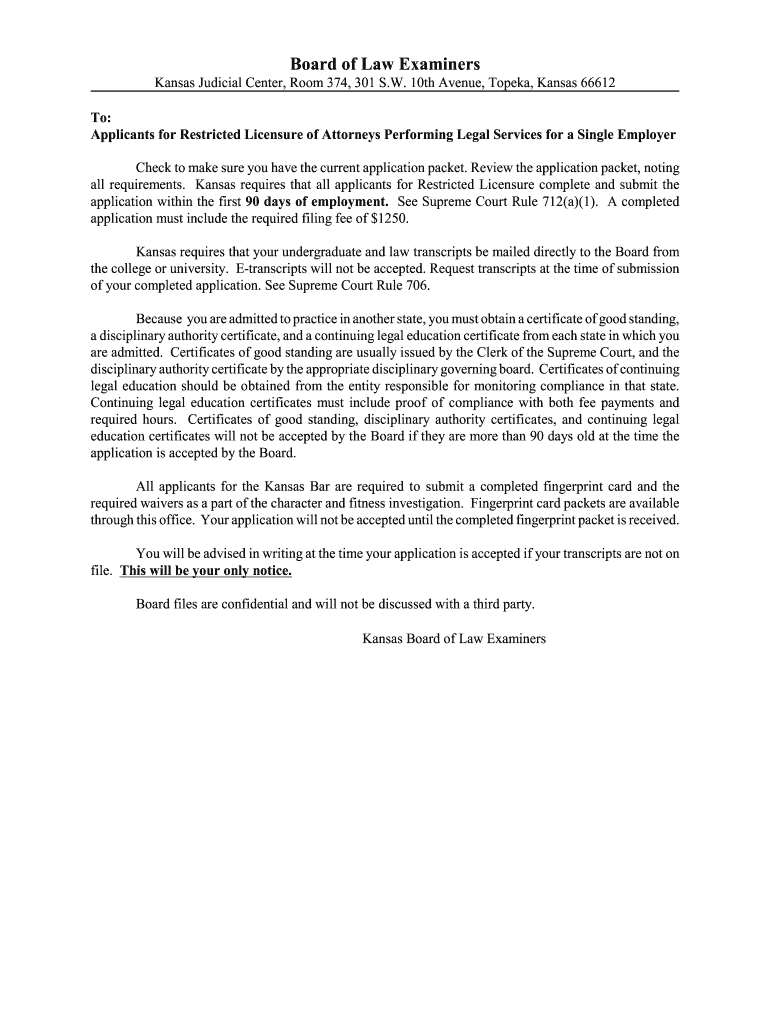







Definition and Meaning of Kansas Bar Licensure
Kansas bar licensure refers to the formal authorization granted by the Kansas Board of Law Examiners to practice law within the state. This credential signifies that an individual has met all required educational, ethical, and examination standards necessary for legal practice in Kansas. It involves the successful completion of the Kansas Bar Examination, submission of various documentation, and an evaluation of the applicant's character and fitness to practice law. Understanding this process helps guide future applicants through each required step, ensuring compliance with state-specific legal requirements.
How to Obtain Kansas Bar Licensure
Acquiring Kansas bar licensure involves a comprehensive process that includes several stages:
-
Educational Prerequisites: Applicants must hold a Juris Doctor (J.D.) degree from a law school accredited by the American Bar Association.
-
Registering for the Bar Exam: Candidates must apply to take the Kansas Bar Examination by completing and submitting the required application forms along with the corresponding fees by the deadline.
-
Submission of Required Documents: This includes official transcripts, certificates of good standing if applicable, and a fingerprint card for a background check. These documents ensure the confirmation of the applicant's legal education and professional history.
-
Character and Fitness Evaluation: This part of the process involves providing affidavits and certifications from reputable individuals who vouch for the applicant's ethical standards and fitness for legal practice.
-
Exam Completion: Applicants are required to pass the Kansas Bar Examination, which tests knowledge of federal and state law, ethics, and practical skills.
-
Final Approval: After passing the examination and successfully completing all other requirements, the applicant receives confirmation of licensure from the Kansas Board of Law Examiners.
Steps to Complete the Kansas Bar Licensure
Obtaining licensure includes a series of well-defined steps, each critical to achieving authorization to practice:
-
Application Preparation and Submission: Prepare the required documentation, including educational and character references, and submit the completed application before the deadline.
-
Study and Exam Preparation: Engage with preparatory materials, practice tests, and study groups. Reviewing the Multi-State Professional Responsibility Exam (MPRE) is also advised.
-
Take the Kansas Bar Examination: Attend the scheduled examination which is held over two days covering both multi-state and state-specific components.
-
Await Results and Complete Practicing Legal Ethics Exam: After passing the bar exam, complete any additional requirements such as the Practicing Legal Ethics Exam.
-
License Issuance: Upon successful completion of all these steps, applicants either receive their bar license or instructions on any further necessary actions.
Importance of Kansas Bar Licensure
Kansas bar licensure is critical for ensuring that only qualified individuals are granted the privilege to practice law within the state. It serves multiple functions:
-
Establishing Professional Standards: Ensures attorneys have the minimum required knowledge and ethical grounding to represent clients effectively.
-
Public Protection: Guards against unqualified individuals offering legal services, maintaining the integrity of legal services in Kansas.
-
Legal Accountability: Provides clients with assurance that practitioners are accountable to the Kansas Judicial Branch, which enforces standards of ethical practice.
Who Typically Uses the Kansas Bar Licensure
Typically, individuals who have completed their law degree and are seeking to practice law in Kansas are the primary users of the Kansas bar licensure process. This group includes:
-
Recent Law Graduates: Those who have recently completed their legal education and need to be admitted to the bar to begin practicing law.
-
Experienced Attorneys Relocating to Kansas: Lawyers licensed in other states may apply to take the Kansas Bar Examination or seek admission by reciprocity if they meet specific criteria.
-
Corporate Legal Departments: In-house legal teams who require their attorneys to be licensed in Kansas for operations that involve state-specific legal concerns.


Important Terms Related to Kansas Bar Licensure
Understanding the terminology associated with the Kansas bar licensure process is essential for applicants:
-
Juris Doctor (J.D.): Graduate degree in law required as a prerequisite for bar admission.
-
Bar Examination: A rigorous test that evaluates an applicant's understanding of legal principles and state-specific legislation.
-
Character and Fitness Evaluation: A process that investigates the moral aptitude and integrity of applicants wishing to practice law.
-
Reciprocity: The acceptance of out-of-state attorneys based on their existing licensure and experience without needing to retake the bar exam in Kansas.
State-Specific Rules for the Kansas Bar Licensure
Kansas implements specific legal requirements and procedures unique to its jurisdiction:
-
Eligibility Based on Education: Kansas mandates that applicants must be graduates from an ABA-accredited law school.
-
Examination Specifics: The bar exam in Kansas includes the Uniform Bar Examination (UBE), which consists of the Multistate Bar Exam (MBE), the Multistate Essay Exam (MEE), and the Multistate Performance Test (MPT).
-
Reciprocity and Admission on Motion: Kansas allows attorneys from certain states to be admitted without examination if their previous state of licensure agrees to similar reciprocity terms.
Required Documents for Kansas Bar Licensure
Applicants must gather and submit several key documents as part of their licensure application:
-
Official Transcripts: Confirming the completion of law school education from an accredited institution.
-
Certificates of Good Standing: Needed for applicants who are already licensed in another jurisdiction.
-
Fingerprint Card: Required for conducting a background check as part of the character and fitness evaluation.
-
Affidavits: Must include statements from personal and professional references affirming the applicant's suitability to practice law.
Complete and accurate submission of these documents is crucial for the timely processing of a licensure application.




