







Definition & Meaning
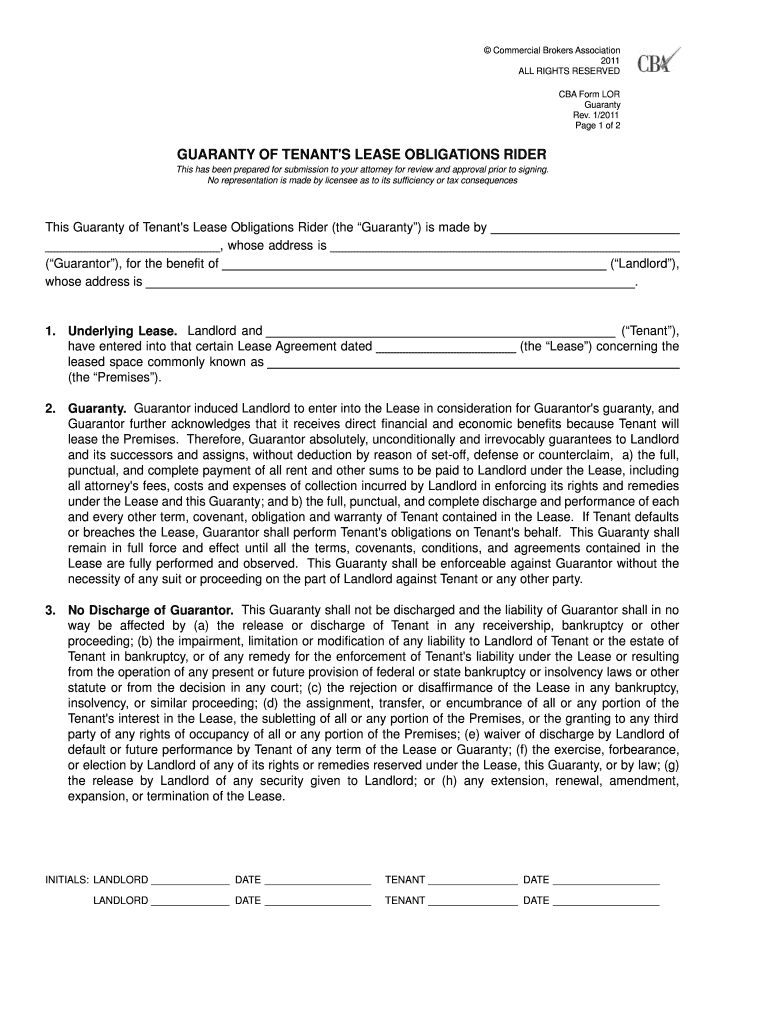
A Form LOR Guaranty of Tenant's Lease Obligations Rider is a supplementary document attached to a lease agreement, where a Guarantor agrees to fulfill the tenant's lease obligations should the tenant fail to do so. This form is a legal assurance for landlords, providing them with a secondary source of accountability if the tenant defaults, whether through non-payment or other breaches of the lease. It is a crucial part of landlord-tenant relationships, often used to reduce the financial risk associated with rental agreements.
How to Use the Form LOR Guaranty of Tenant's Lease Obligations Rider
To effectively use the Form LOR Guaranty, both the landlord and prospective tenant must first agree on the necessity of a guarantor. The guarantor should be a trustworthy and financially stable individual or entity willing to assume responsibility. After drafting the main lease agreement, the guaranty rider is added as an appendix. Ensure that all parties—the landlord, tenant, and guarantor—sign the document. This ensures transparency and mutual understanding of each party's responsibilities. Reviewing the entire form with a legal advisor is advisable to ensure all clauses meet legal standards and that all involved parties comprehend their obligations.
Steps to Complete the Form LOR Guaranty of Tenant's Lease Obligations Rider
-
Gather Required Information: Collect details about the tenant, landlord, and guarantor, including contact information and identification numbers.
-
Detail Responsibilities: Clearly outline the responsibilities of the guarantor, specifying the financial and performance obligations for which they are accountable.
-
Include Legal Provisions: Ensure clauses are included that cover scenarios such as bankruptcy, lease amendments, or legal fees.
-
Signatures and Notarization: Obtain signatures from the tenant, landlord, and guarantor. If required by state law, have the document notarized to verify its authenticity.
-
Document Storage: Keep a copy securely stored—both digitally and physically—for reference and legal protection.
Key Elements of the Form LOR Guaranty of Tenant's Lease Obligations Rider
-
Guarantor Liability: Specifies that the guarantor's obligations are enforceable regardless of circumstances such as tenant bankruptcy or changes to the lease.
-
Payment and Performance Obligations: Details the scope of obligations guaranteed, including specific financial duties and general lease compliance.
-
Successor Binding: States that the agreement is binding on any successors or assigns of the landlord or tenant.
-
Attorney Fees: Provisions outlining costs responsibility in case of legal action associated with the lease or guaranty enforcement.
Who Typically Uses the Form LOR Guaranty of Tenant's Lease Obligations Rider
Landlords employ this form when renting out valuable properties, especially in situations where tenants lack a strong credit history or financial stability. College students or young professionals often require guarantors for their rentals. Additionally, corporate leases may utilize this form when a company is renting a commercial space, ensuring higher financial security for the landlord.


Important Terms Related to the Form LOR Guaranty of Tenant's Lease Obligations Rider
- Guarantor: The party agreeing to meet the obligations if the tenant fails.
- Lease Obligations: The commitments of the tenant under the lease agreement, including rent payments and property maintenance.
- Rider: An appendix to an existing lease agreement, modifying or adding terms without altering the original lease.
- Binding Nature: The aspect of the agreement that applies to successors of the involved parties.
Legal Use of the Form LOR Guaranty of Tenant's Lease Obligations Rider
In the United States, the legal use of this document ensures that landlords have recourse if tenants fail to meet their lease obligations. It functions under contract law principles, where the guarantor legally consents to back the tenant. In disputes, it provides judicial weight by outlining explicit expectations and obligations, reducing ambiguity in enforcement cases.
State-Specific Rules for the Form LOR Guaranty of Tenant's Lease Obligations Rider
State laws can affect how guaranty forms are drafted or enforced. For instance, some states may have specific notarization requirements, while others might mandate disclosures about tenant and guarantor financial health. It is essential for landlords and guarantors to understand the particular rules of the state in which the property is located to ensure compliance with local regulations and standards.
Examples of Using the Form LOR Guaranty of Tenant's Lease Obligations Rider
Consider a young professional with minimal credit history attempting to lease an apartment in a competitive housing market. The landlord might require a parent or guardian to sign the Form LOR Guaranty, thereby increasing the security of lease fulfillment. Similarly, a start-up company seeking to lease office space might use this form to convince landlords of their payment and responsibility assurances, with an investor or financial backer acting as the guarantor.


