
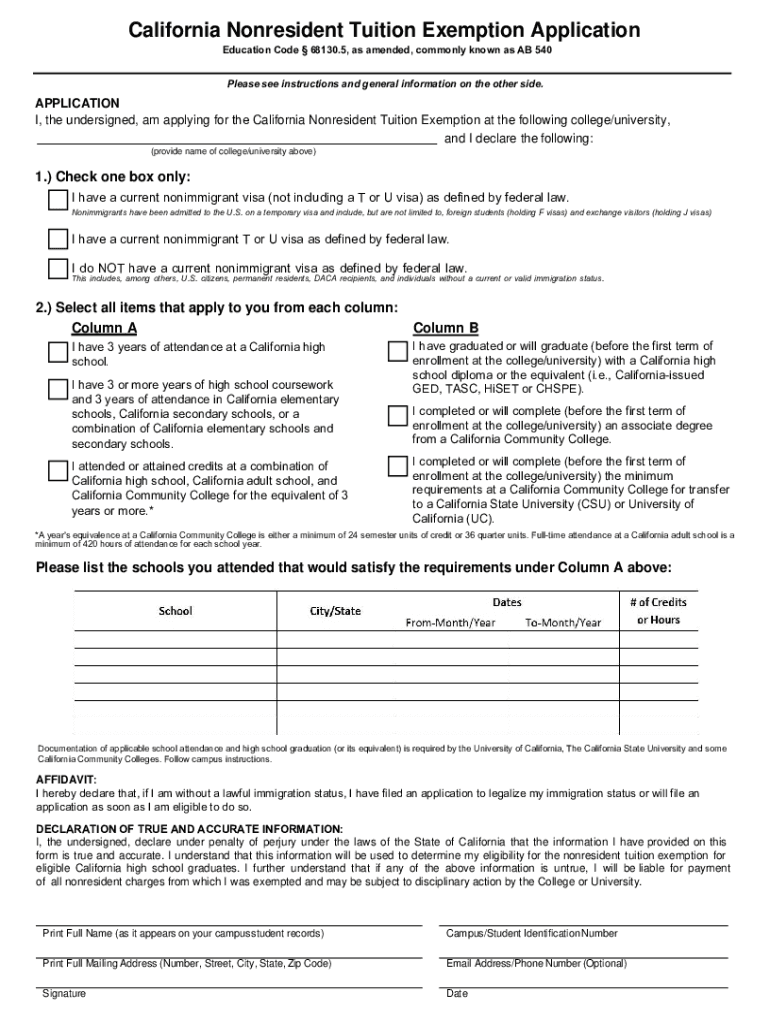







Definition and Meaning of the AB 540 and AB 2000 California Nonresident Tuition Exemption
The AB 540 and AB 2000 California Nonresident Tuition Exemption, commonly referred to as AB 540, is a legislative provision in the California Education Code that allows eligible students who meet specific requirements to pay in-state tuition rates at public colleges and universities in California, despite not being officially recognized as residents. Initially enacted under Assembly Bill 540, and later expanded by AB 2000, this exemption is particularly significant for undocumented students and U.S. citizens who have attended California high schools. Qualification criteria include attending a California high school for three or more years and fulfilling either graduation or transfer requirements. The exemption aims to alleviate financial barriers for students who have established a prolonged academic history within the state but lack a formal residency status.
Eligibility Criteria for AB 540 and AB 2000
Eligibility is a central component of the AB 540 and AB 2000 exemptions. Applicants must satisfy several key requirements to qualify for nonresident tuition exemption:
- High School Attendance: Must have attended a California high school for a minimum of three years.
- Graduation or Equivalent: Successful graduation from a California high school or attainment of the equivalent such as a GED.
- Higher Education Enrollment: Enrollment in an accredited California public college or university is necessary.
- Immigration Status: As this policy particularly benefits non-residents, having a valid non-immigrant visa typically disqualifies individuals, making legal or undocumented residency pertinent factors.


Steps to Complete the AB 540 and AB 2000 Tuition Exemption
Completing the AB 540 and AB 2000 Exemption involves several defined steps to ensure submission accuracy and eligibility verification:
- Gather Required Documentation: Include proof of high school attendance and graduation, such as transcripts or GED certificates.
- Application Completion: Fill out the designated sections such as personal details, school history, and the affirmative affidavit concerning the accuracy of the provided information.
- Submission Format: Determine whether electronic, mail, or in-person submission is necessary as per institution-specific guidelines.
- Verification Process: After submission, the application will undergo a review to affirm eligibility, necessitating patience for approval communication.
Key Elements and Features of the Exemption
The AB 540 and AB 2000 exemptions encompass several critical features that applicants should note:
- Affidavit Submission: An affidavit asserting an application for legal residency or intent to do so when eligible is mandatory.
- Non-discrimination Clause: The application must be processed without bias to ensure equitable access for all applicant demographics.
- In-state Tuition Benefit: Successful applications translate to significant cost reductions from nonresident to in-state tuition rates, altering affordability perspectives.
State-Specific Rules and Legal Use
California-specific guidelines govern the application of the AB 540 and AB 2000 exemptions:
- Residency Code Compliance: The exemption is compliant with Education Code § 68130.5, emphasizing statewide adherence.
- Legal Binding Nature: Applicants must accurately represent their status, and institutions have a mandate to verify compliance.
How to Obtain the AB 540 and AB 2000 Exemption
Securing the AB 540 and AB 2000 exemption involves procedural adherence and attention to regulatory requirements. Begin by consulting your chosen institution’s admissions or registrar’s office for specific instructions and submit the required documentation alongside the appropriate forms. Approval times may vary based on institutional processing speeds and application volume.
Important Terms Related to the Exemption
Understanding the terminology pertinent to the AB 540 and AB 2000 exemption strengthens application accuracy. Key terms include:
- Residency Classification: The basis for tuition determination, separate from general immigration status.
- Affidavit of Intent: A statement of desire or application for legal immigration status.
- Nonresident Tuition: Higher fees charged to students who do not qualify for resident rates without an exemption.
Examples Of Application: Real-World Scenarios
The application of the AB 540 and AB 2000 exemptions extends across diverse student groups:
- Undocumented Students: Those meeting the criteria can sidestep financial burdens hindering higher education access.
- U.S. Citizens in Transition: Students returning from abroad under non-citizen status, yet qualifying due to their California high school tenure, benefit notably.
- DACA Recipients: Deferred Action for Childhood Arrivals (DACA) participants using the exemption to facilitate education without residency contention.
Through understanding its facets, utility, and procedural requirements, applicants can more adeptly navigate the intricacies of the AB 540 and AB 2000 California Nonresident Tuition Exemption, optimizing financial access and educational advancement.