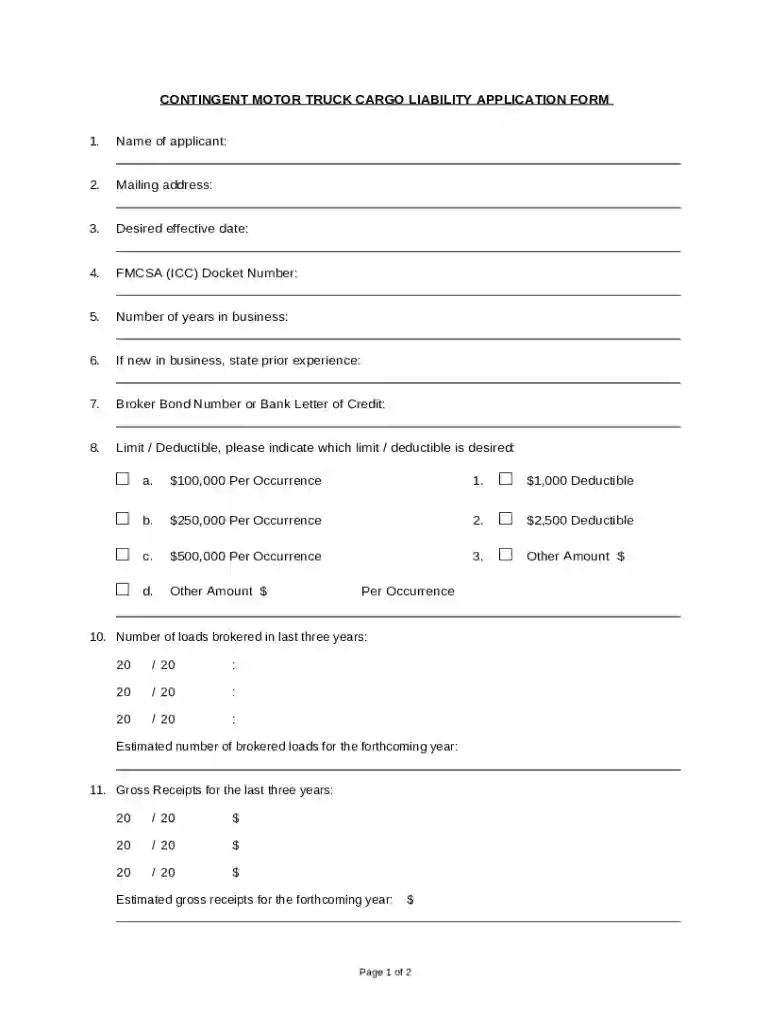
CONTINGENT MOTOR TRUCK CARGO LIABILITY APPLICATION FORM 2026

Get Form
CONTINGENT MOTOR TRUCK CARGO LIABILITY APPLICATION FORM Preview on Page 1

Here's how it works

01. Edit your form online
Type text, add images, blackout confidential details, add comments, highlights and more.

02. Sign it in a few clicks
Draw your signature, type it, upload its image, or use your mobile device as a signature pad.

03. Share your form with others
Send it via email, link, or fax. You can also download it, export it or print it out.

Definition & Meaning

The Contingent Motor Truck Cargo Liability Application Form is designed for businesses seeking insurance coverage for cargo liability. This form collects essential data from applicants to assess risk levels and determine appropriate insurance coverage. By securing contingent cargo liability insurance, businesses protect themselves from potential financial losses arising from damaged or lost cargo during transport. The form ensures all applicants provide accurate and comprehensive details of their operations, revealing their exposure to risk factors associated with motor truck cargo transport.

How to Use the Contingent Motor Truck Cargo Liability Application Form

To use the form effectively, applicants must first gather relevant business information which includes business operations details, commodities transported, and past claims history. Begin by filling out sections requiring business identification and contact information. Carefully evaluate the coverage limits required by your operation to ensure your insurance needs are met. Use the space allocated for additional comments to clarify complex scenarios. Remember, providing accurate and detailed responses is critical to avoid delays or misstatements that could affect coverage outcomes.

Steps to Complete the Contingent Motor Truck Cargo Liability Application Form

  1. Business Information: Enter the business name, contact information, and federal EIN number. This foundational data sets the stage for verifying the applicant’s identity and tracking correspondence.
  2. Operational Details: Detail the types of vehicles used, routes taken, and specific commodities transported. Highlight seasonal changes in operational patterns if any.
  3. Coverage Limits and Deductibles: Clearly state the desired insurance coverage limits and deductible amounts. Engage with your insurance advisor to make informed decisions about these figures.
  4. Claims History: Provide a transparent account of any past claims related to cargo liability. Include the nature of incidents, amounts paid, and corrective measures implemented to prevent recurrence.
  5. Signature and Date: End the form by affirming all information provided is accurate with a signature and date. This section certifies the authenticity of the responses, a crucial step in the application.

Key Elements of the Contingent Motor Truck Cargo Liability Application Form

  • Applicant Details: Essential personal or corporate identifiers involving business name, contacts, and federal tax identifiers.
  • Coverage Specifications: Define desired liability limits and deductible levels, considering the scope and scale of your operations.
  • Business Operations: Explicitly describe business activities, including the nature of cargo and geographical operation zones.
  • Past Legal and Claims History: Disclose historical claims data and the effectiveness of remedial actions taken to mitigate future risks.

Legal Use of the Contingent Motor Truck Cargo Liability Application Form

The completion and submission of this form adhere to legal norms that ensure compliance with state-specific insurance regulations. Applicants must ensure that all information is truthful and exact, as misrepresentations can lead to denied claims or policy voidance. The form also arranges a legal contract binding applicants to the conditions and coverage they declare and underwrite. Familiarize yourself with relevant state and federal regulations that may impact your application.

Required Documents

Applicants should prepare to submit supplementary documents to support their application. These include:

  • Proof of Business Registration: This verifies legitimacy and operational standing.
  • Financial Statements: These documents depict business solvency and risk exposure.
  • Fleet Information and Driver Registrations: Ensure certification and compliance with state commercial transport regulations.

Penalties for Non-Compliance

Failing to accurately fill out or submit this form can result in several penalties, including:

  • Claim Denials: Inaccurate information can invalidate insurance claims.
  • Policy Cancellation: Misrepresentation of facts can lead to policy revocation.
  • Financial Liabilities: Without proper coverage, businesses may face significant out-of-pocket expenses for cargo losses or damages.

State-Specific Rules for the Contingent Motor Truck Cargo Liability Application Form

State regulations can influence the eligibility and requirements for cargo liability insurance. Variations may include:

  • Different Coverage Requirements: States may mandate minimum liability limits depending on regional risk assessments.
  • Operational Permits: Specific permits might be necessary for transporting goods through various jurisdictions.
  • Reporting Mandates: States could require periodic updates on specific operational details or insurance coverage levels.

Understanding these state-specific regulations is critical for businesses to ensure full compliance and optimize their insurance protection strategies.

See more CONTINGENT MOTOR TRUCK CARGO LIABILITY APPLICATION FORM versions

We've got more versions of the CONTINGENT MOTOR TRUCK CARGO LIABILITY APPLICATION FORM form. Select the right CONTINGENT MOTOR TRUCK CARGO LIABILITY APPLICATION FORM version from the list and start editing it straight away!
Versions Form popularity Fillable & printable
2021 4.6 Satisfied (58 Votes)
be ready to get more

Complete this form in 5 minutes or less

Get form

Got questions?

We have answers to the most popular questions from our customers. If you can't find an answer to your question, please contact us.
Contact us
Which source of liability would a trucker be liable for under a Motor Carrier Coverage Form? Cargo damage from overturn. The Motor Carrier Coverage Form provides Trailer Interchange Coverage, which protects against physical damage such as comprehensive and/or collision coverage.
Cargo legal liability is a type of insurance designed for carriers, such as ship, truck, and train operators, who transport goods. This kind of policy is purchased through a contract of carriage and determines the extent to which the carrier is responsible for loss or damaged goods in transit.
Contingent Liability coverage provides a layer of protection by providing defense to the Motor Carrier when a qualified Independent Contractor attempts to collect Workers Compensation benefits as an employee.
Cargo liability limits refer to the maximum amount of insurance coverage (i.e., the amount of money) that an insurer will provide for the loss or damage of goods being transported.
A cargo owners liability risk stems from the possibility of being exposed to a claim for property damage (including loss of use) and/or bodily injury liability from: A third party with the resultant defense-related costs. Pollution of/from the cargo where you as a cargo owner are legally or contractually liable.

Security and compliance

At DocHub, your data security is our priority. We follow HIPAA, SOC2, GDPR, and other standards, so you can work on your documents with confidence.

Learn more
ccpa2
pci-dss
gdpr-compliance
hipaa
soc-compliance
be ready to get more

Complete this form in 5 minutes or less

Get form

People also ask

Contingent cargo legal liability insurance defends the logistics service provider who does not present as a carrier. Contingent insurance steps in when the carriers cargo legal liability insurance fails to respond to the loss, and the logistics service provider is drawn into a claim.
Contingent cargo insurance can cost between $1,200-$2,500 per year for the minimum necessary limit of $100,000 per load. The higher the risk level of your goods, the more expensive they will be to insure.

Related links