




01. Edit your form online
Type text, add images, blackout confidential details, add comments, highlights and more.

Type text, add images, blackout confidential details, add comments, highlights and more.

Draw your signature, type it, upload its image, or use your mobile device as a signature pad.

Send it via email, link, or fax. You can also download it, export it or print it out.
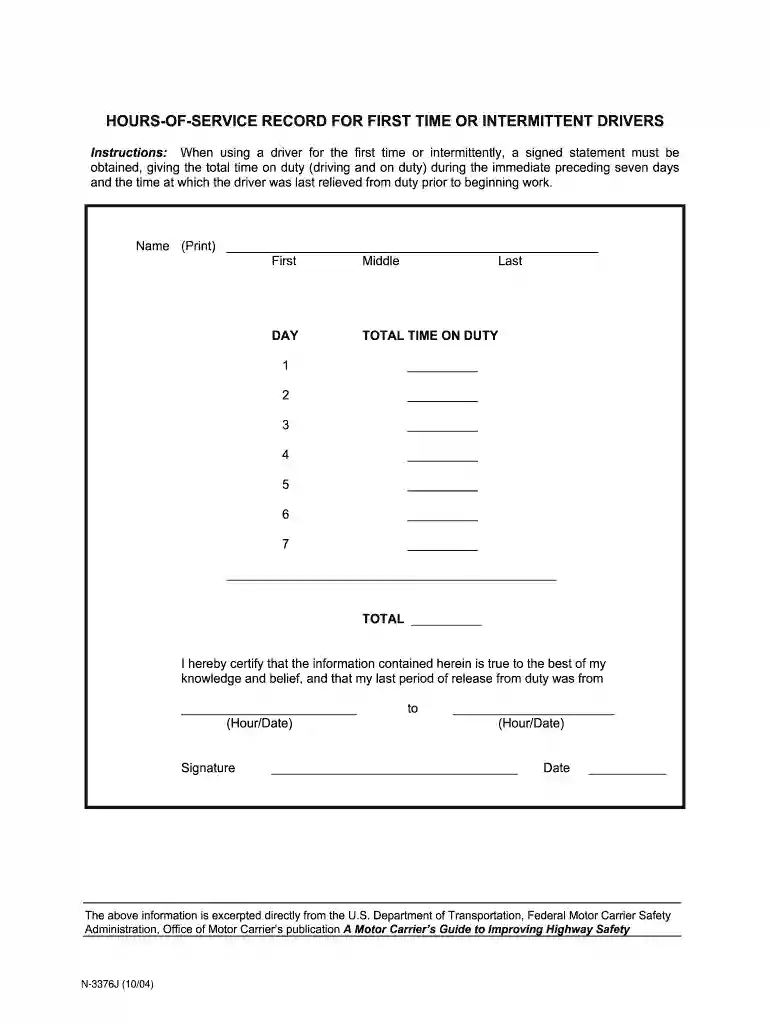
The Hours-of-Service Record for First-Time or Intermittent Drivers is a regulatory document used to track the working hours of drivers who are newly employed or drive sporadically. This record is designed to ensure compliance with federal regulations that limit the number of hours a driver can operate a vehicle, thereby promoting road safety and reducing driver fatigue. The record requires drivers to detail their total on-duty hours over the past seven days and note the last period off duty before commencing work.
The Hours-of-Service Record is crucial for maintaining regulatory compliance and ensuring the safety of both drivers and the public. Accurate records help to enforce guidelines that mitigate the risks associated with driver fatigue, such as impaired reaction times and decreased alertness. For first-time or intermittent drivers, this record is particularly important to establish a history of compliance.
Adhering to the guidelines outlined in the Hours-of-Service Record is a legal requirement under the Federal Motor Carrier Safety Administration (FMCSA) regulations. Non-compliance can lead to penalties for both the driver and their employer, such as fines and potential suspension of driving privileges. The record thus serves as a binding document that provides accountability and transparency regarding a driver's work schedule.
This document is primarily used by new or intermittent drivers in commercial vehicles, particularly those who operate under conditions governed by the FMCSA regulations. Employers in the trucking, delivery, and logistics industries frequently require these records to ensure their drivers are adhering to federal safety standards.


While the FMCSA provides overarching guidelines for hours-of-service, individual states may have additional or more restrictive provisions. Drivers should familiarize themselves with any state-specific requirements that may impact their logging procedures or permissible driving hours. Checking with state Department of Transportation offices can provide clarity on any variations.
Failing to maintain accurate hours-of-service records can result in significant consequences. Penalties might include:
Both digital and paper versions of the Hours-of-Service Record are available. The digital version streamlines the tracking process, allowing for real-time updates and easier error detection. However, drivers who prefer traditional methods or are in environments with limited digital access might opt for the paper form. Both formats require the same level of diligence in ensuring complete and accurate information logging.
We've got more versions of the HOURS-OF-SERVICE RECORD FOR FIRST TIME OR INTERMITTENT DRIVERS form. Select the right HOURS-OF-SERVICE RECORD FOR FIRST TIME OR INTERMITTENT DRIVERS version from the list and start editing it straight away!
| Versions | Form popularity | Fillable & printable |
|---|---|---|
| 2004 | 4.8 Satisfied (155 Votes) |
Many software solutions are available on the market for document editing and signing. DocHub is one of the most in-demand online solutions that comply with all security and compliance requirements and guarantees your electronically signed paperwork is legally enforceable. All you need to try it out is to sign up for an account, add your HOURS-OF-SERVICE RECORD FOR FIRST TIME OR INTERMITTENT DRIVERS, fill out the required information, and click Sign. Create your electronic signature by typing, drawing it, uploading its picture to your template, or scanning a unique QR code.
When you go for analog ways of completing your HOURS-OF-SERVICE RECORD FOR FIRST TIME OR INTERMITTENT DRIVERS, you can easily download your file for printing. Search DocHub’s Forms & Templates catalog to get the exact file template you need and open it for editing or download it on your gadget in the format of your liking. It is possible to complete your form electronically and put your handwritten signature on it after printing or eSign your file with DocHub.
At DocHub, your data security is our priority. We follow HIPAA, SOC2, GDPR, and other standards, so you can work on your documents with confidence.
Instructions: When using a driver for the first time or intermittently, a signed statement must be obtained, giving the total time on duty (driving and on duty)Read more
Instructions: When using a driver for the first time or intermittently, a signed statement must be obtained, giving the total time on duty (driving and onRead more
Such record shall indicate the date and hour of administration, name and quantity of controlled substances, name of the practitioner ordering the administrationRead more


