




01. Edit your united healthcare prior authorization form outpatient pdf online
Type text, add images, blackout confidential details, add comments, highlights and more.

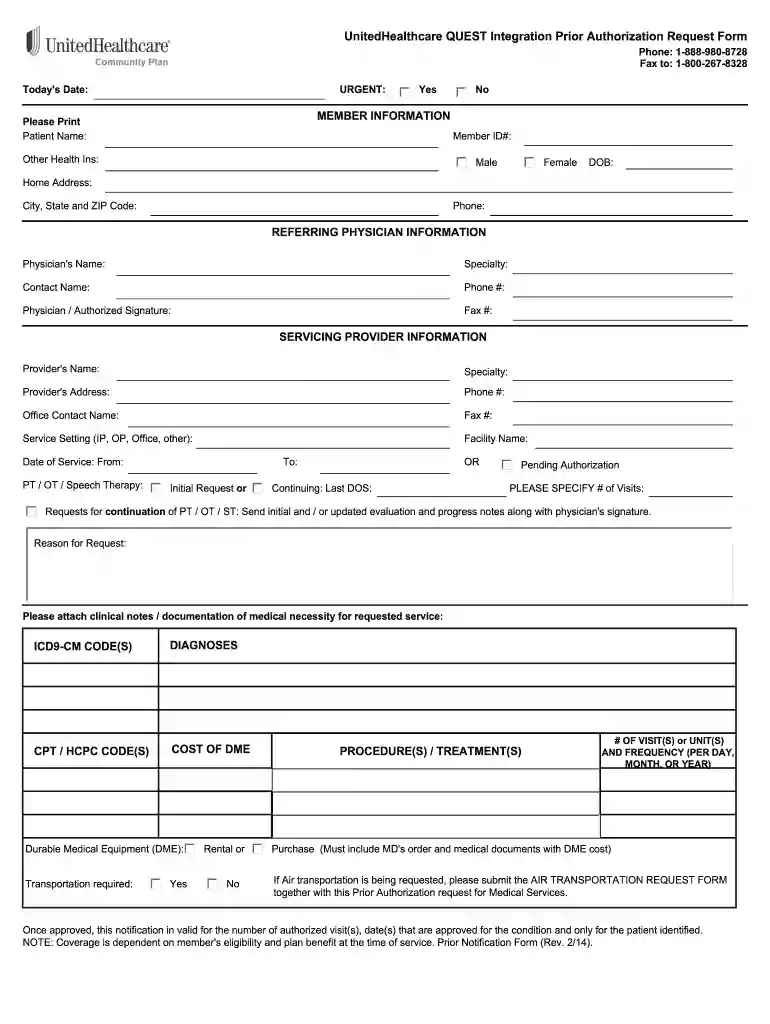
Type text, add images, blackout confidential details, add comments, highlights and more.

Draw your signature, type it, upload its image, or use your mobile device as a signature pad.

Send united healthcare prior authorization form via email, link, or fax. You can also download it, export it or print it out.
United Healthcare authorization forms are official documents used to request prior approval for specific medical services, procedures, or medications that may be covered under an individual's health insurance plan. These forms play a crucial role in ensuring that the care that a patient receives aligns with their health plan’s coverage guidelines and helps to manage healthcare costs. Authorization is typically required for services such as outpatient procedures, surgeries, physical therapy, and certain medications.
The process facilitates communication between healthcare providers and insurance companies, allowing providers to verify that a proposed treatment is medically necessary and covered by the patient’s insurance. By obtaining authorization, healthcare providers can minimize the risk of denied claims after services have been rendered. This proactive approach is essential for both patient satisfaction and financial management in the healthcare system.
Using the United Healthcare authorization forms involves a systematic approach to ensure all necessary information is captured effectively for the authorization process. Here’s a general guide:
Identify the Required Form: Depending on the service being requested, different forms may be used. Examples include the outpatient prior authorization form for outpatient procedures or the medical prior authorization form for more general requests.
Gather Necessary Information: Collect details about the patient, including member ID, insurance details, and specific information related to the service or medication in question.
Complete the Form: Accurately fill out the form with relevant information, such as:
Submit the Form: Forms can often be submitted electronically via the health plan's website or through fax, depending on the instructions provided.
Follow Up: After submission, it may be necessary to follow up with the insurance company to confirm that the authorization has been processed and to receive updates on any additional documentation needed.
Completing the United Healthcare authorization forms involves a series of steps to ensure thoroughness and accuracy:
Obtain the Correct Form: Access the appropriate form, such as the prior authorization form for physical therapy or a surgical procedure.
Personal Information Entry: Input all relevant patient information clearly:
Provider Information: Provide details about the referring physician and servicing provider. This typically includes:
Service Details: Clearly describe the requested service or treatment, including:
Attach Supporting Documentation: Including clinical notes, diagnostic imaging results, and treatment plans can support the request and increase the likelihood of approval.
Review & Submit: Double-check all entered information for completeness and accuracy before submitting the form as instructed—either electronically or via fax.
Familiarizing oneself with key terms associated with United Healthcare authorization forms is essential for navigating the authorization process:
Prior Authorization: A requirement that certain medical services, procedures, or medications receive approval from insurance before being provided.
CPT Codes: Codes that are used to describe medical services and procedures.
Clinical Documentation: Medical records or notes that support the necessity of the requested service.
NPI Number: A unique identification number for healthcare providers.
Member ID: A number assigned to each insured individual under a health plan.
Understanding these terms can help streamline the communication between healthcare providers and insurance companies and aid patients in ensuring their treatment is authorized under their plan.
Eligibility for requesting services through United Healthcare authorization forms typically depends on several factors:
Insurance Policy Type: The specific benefits provided under the member’s plan governance will determine if prior authorization is required.
Type of Service Requested: Certain high-cost or specialized services, such as surgeries or outpatient therapies, often require prior authorization.
Clinical Necessity: Authorization is generally granted based on documented medical necessity for the proposed treatment, evaluated according to established clinical guidelines.
Provider Status: Ensure that the healthcare provider is in-network as out-of-network services may have different authorization processes or criteria.
State Regulations: Some services may also be affected by state-specific regulations around healthcare services and insurance coverage.
Understanding these criteria enables both providers and patients to accurately navigate the prior authorization process and communicate more effectively with insurance providers.


United Healthcare provides a variety of authorization forms tailored for different services and needs. Here are several commonly used forms:
United Healthcare Prior Authorization Form for Outpatient Services: Required for medical services provided in an outpatient setting, such as outpatient surgery or therapy services.
United Healthcare Radiology Prior Authorization Form: Specifically used for radiological services like MRIs, CT scans, and X-rays.
United Healthcare DME Prior Authorization Form: Used to request approval for durable medical equipment, suitable for patients needing items like wheelchairs, oxygen tanks, or other assistive devices.
United Healthcare Medication Prior Authorization Form: This is critical for obtaining authorization for prescription medications that may have restrictions based on clinical criteria or formulary status.
Understanding these various forms allows healthcare providers to choose the correct documentation for each authorization request, thereby improving the likelihood of receiving timely approvals.
The legal use of United Healthcare authorization forms is substantial, impacting both healthcare providers and patients. These forms serve as binding agreements that confirm prior approval for certain treatments before they are administered. Here are key considerations:
Compliance with Insurance Policies: Using the authorization forms helps ensure that healthcare providers adhere to the guidelines set forth by United Healthcare and that patients are protected from unexpected costs due to service denials.
Documented Agreement: The forms provide a written record of what services have been approved by the insurer, which can be important in disputes or audits.
Protection Against Fraud: By requiring documented approval for services, these forms help reduce fraud within the healthcare system, ensuring only medically necessary services are billed to insurance.
Patient Consent: The authorization process typically includes patient consent, ensuring the patient's right to privacy and agreement to sharing their medical information with the insurance entity.
By understanding and adhering to the legal framework surrounding these forms, healthcare providers can maintain compliance while ensuring patients receive necessary care.
When addressing authorization requests, concrete examples help illustrate how the forms function in practice. Here are three scenarios:
Example One: Physical Therapy: A patient recovering from knee surgery may need physical therapy to regain mobility. The healthcare provider would complete the United Healthcare prior authorization form for physical therapy, detailing the medical necessity and including any relevant diagnostic imaging. Upon approval, the patient can proceed with therapy sessions without financial worry.
Example Two: Outpatient Surgery: A patient requiring gallbladder removal must undergo outpatient surgery. The surgeon submits the appropriate authorization form, confirming the need for the procedure based on the patient's symptoms and previous treatments. Once authorized, the surgery can be scheduled without complications related to insurance coverage.
Example Three: Prescription Medication: A physician prescribes a high-cost medication for a chronic condition. The office submits a medication prior authorization form, including clinical notes supporting the need for this specific drug versus alternatives. Authorization is granted, allowing the patient to fill the prescription without incurring out-of-pocket costs for a non-covered medication.
These examples highlight how effectively navigating the authorization process enables timely medical interventions, ultimately enhancing patient outcomes.
We've got more versions of the united healthcare prior authorization form outpatient pdf form. Select the right united healthcare prior authorization form outpatient pdf version from the list and start editing it straight away!
| Versions | Form popularity | Fillable & printable |
|---|---|---|
| 2014 | 4.8 Satisfied (141 Votes) |
At DocHub, your data security is our priority. We follow HIPAA, SOC2, GDPR, and other standards, so you can work on your documents with confidence.
United Healthcare Prior Authorization Form - Web use this tool to check requirements, enter requests, upload notes and images, and check status for priorRead more
INFORMATION WILL RESULT IN A DELAY IN YOUR REQUEST. UnitedHealthcare Community Plan. 11/28/11. Louisiana Prior Authorization Fax Request Form 877-271-6290.Read more
Form 3500 The United States (U.S.) FDA has made this test available under an emergency access mechanism called an Emergency Use Authorization (EUA).Read more


