







Definition and Meaning of a PIP Template
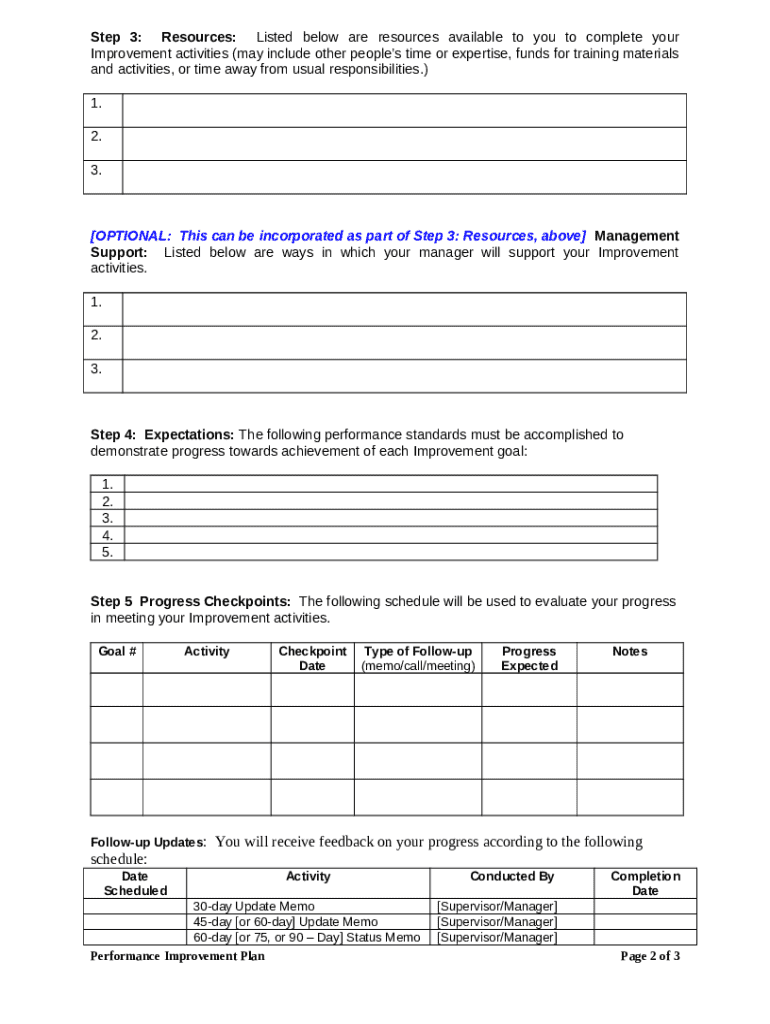
A Performance Improvement Plan (PIP) template is a structured document used by organizations to help employees improve their job performance. It serves as a guide outlining specific areas where an employee's performance does not meet the required standards, along with clear expectations and a timeline for improvement. PIP templates typically include sections for identifying performance issues, setting measurable goals, providing necessary resources, and detailing the support that management will offer. They play a crucial role in performance management, fostering clear communication between employees and their supervisors.
Steps to Complete the PIP Template
-
Identify Performance Issues: Begin by clearly documenting the specific behaviors or outcomes that are not meeting expectations. Provide examples to support the identified issues.
-
Set Improvement Goals: Outline measurable and achievable goals that the employee needs to meet. Ensure these goals are directly related to the performance issues and are realistic within the given timeframe.
-
Detail Required Resources and Support: Specify any resources, such as training or mentoring, that will be provided to the employee to help them achieve the set goals. Include any additional support from management or colleagues.
-
Establish a Timeline: Define a clear timeline for achieving the improvement goals. This should include key milestones and regular check-ins to assess progress.
-
Conclude with Employee and Manager Commitments: Both the employee and the supervisor should review and agree to the PIP, ensuring understanding and commitment from both parties.
How to Use the PIP Template
-
Customize to Fit Specific Needs: Adjust the template's language and structure to align with the organization's policies and the specific job role of the employee in question.
-
Incorporate Regular Feedback: Use the PIP as a living document, making updates based on ongoing feedback and progress during the review period.
-
Document Progress and Adjustments: Record the employee's progress towards the goals and make necessary adjustments to the plan as needed. This documentation can be valuable for future performance evaluations.
Why Should You Use a PIP Template
-
Promotes Accountability: A PIP template helps to establish clear expectations and accountability for the employee's performance.
-
Facilitates Professional Development: It provides a framework for professional growth, helping employees develop skills and competencies necessary to succeed in their roles.
-
Supports Constructive Feedback: Through a structured approach, supervisors can provide meaningful and constructive feedback, enhancing the employee's ability to improve.
Who Typically Uses the PIP Template
-
Human Resources Professionals: HR teams often oversee the PIP process, ensuring that the templates are used consistently and fairly across the organization.
-
Managers and Supervisors: These individuals directly utilize PIP templates to address specific performance issues with their team members.
-
Employees: While often the subject of a PIP, employees use the template as a roadmap to understand expectations and track their development over the PIP period.


Key Elements of the PIP Template
-
Performance Objectives: Clearly defined objectives that the employee is expected to achieve.
-
Action Plan: A step-by-step plan demonstrating how the employee can meet their objectives.
-
Evaluation Criteria: Standards against which the employee's progress will be measured.
-
Review Dates: Predetermined dates to review the employee's progress and make any necessary adjustments.
Legal Use of the PIP Template
-
Compliance with Labor Laws: Ensure that the PIP template adheres to applicable labor laws and regulations, including those related to employment discrimination and fair treatment.
-
Confidentiality Considerations: Maintain confidentiality of the information contained within the PIP to protect the privacy rights of the employee.
Important Terms Related to PIP Templates
-
Measurable Goals: Specific targets that can be quantitatively or qualitatively evaluated to determine improvement.
-
Performance Metrics: Standards or benchmarks used to assess the success of the employee in meeting PIP goals.
-
Feedback Loop: Process through which ongoing communication and evaluation occur between the employee and supervisor throughout the PIP period.
Examples of Using the PIP Template
In a corporate setting, a sales manager may use a PIP template to address an employee's failure to meet sales targets. The PIP could include goals such as increasing monthly sales by a specific percentage, attending sales training workshops, and performing weekly check-ins with the manager to discuss progress.
In an educational context, a university may implement a PIP for an instructor needing to improve lecture delivery. Goals could include observing a peer's lectures, receiving student feedback, and meeting with instructional coaches.
State-Specific Rules for the PIP Template
U.S. states may have varying rules and regulations regarding performance improvement plans, especially concerning employment laws and rights. Employers should consult local laws to ensure that PIP templates comply with state-specific requirements.
Digital vs. Paper Version of the PIP Template
-
Digital Version: Allows for easy access, editing, and sharing among stakeholders. Facilitates real-time updates and collaboration.
-
Paper Version: May be preferable for traditional work environments or when digital access is limited, though it can lack the flexibility and efficiency of digital formats.
Each format has its advantages, and organizations should choose based on their operational needs and technological capabilities.




