



01. Edit your form 6 divorce online
Type text, add images, blackout confidential details, add comments, highlights and more.

Type text, add images, blackout confidential details, add comments, highlights and more.

Draw your signature, type it, upload its image, or use your mobile device as a signature pad.

Send ohio form 6 via email, link, or fax. You can also download it, export it or print it out.
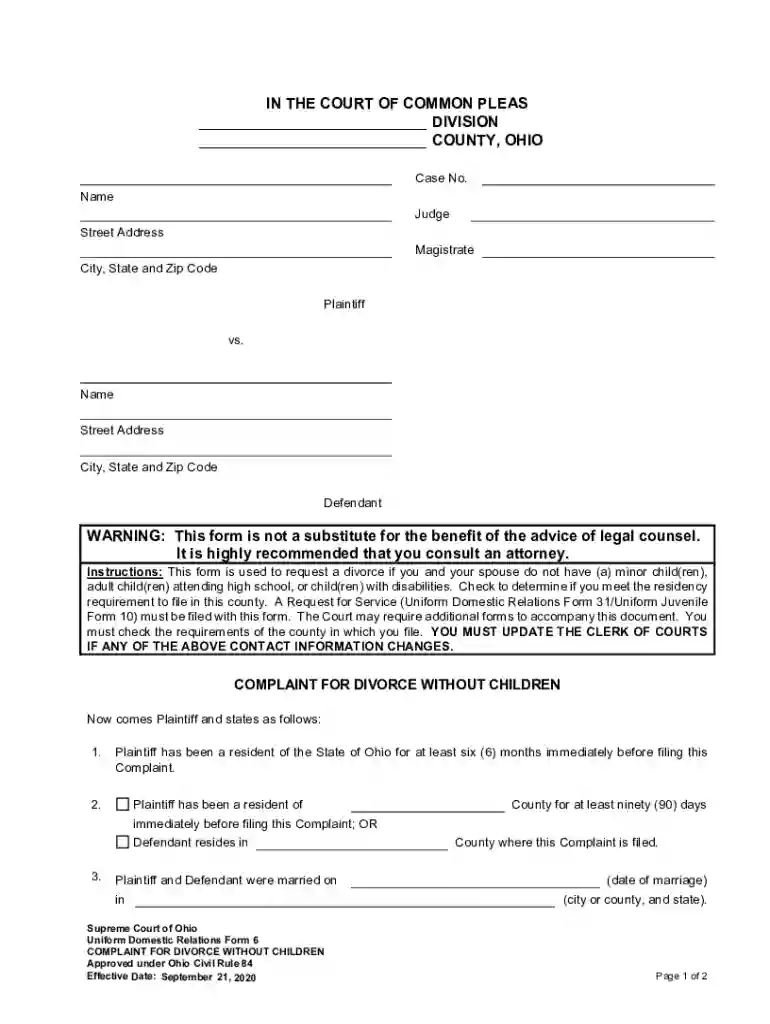
The Uniform Domestic Relations Form 6, often referred to as the "Complaint for Divorce Without Children," is a legal document used in Ohio's Court of Common Pleas. It is intended for spouses seeking a divorce when there are no children involved. The form outlines necessary details, such as the parties' identifying information, marriage details, and residency requirements. It also requires statements regarding grounds for divorce and requests concerning financial matters like property division and spousal support.
Personal Information: Begin by entering your full name, current address, and contact information. Include similar information for your spouse.
Marriage Details: Specify the date and location of the marriage. Confirm that there are no children from this marriage, thus confirming the form's suitability.
Residency Confirmation: Ohio requires one of the parties to have been a resident for at least six months preceding the filing. Detail your residency to affirm eligibility.
Grounds for Divorce: Clearly state and provide plausible reasons that justify the divorce, such as incompatibility or other recognized grounds under Ohio law.
Financial and Property Distribution: Outline any requests for division of property or debts and mention if spousal support is being sought.
Verification and Signatures: Review the completed form to ensure accuracy and complete the verification section with your dated signature.
In the legal system, the Uniform Domestic Relations Form 6 is used to formally begin divorce proceedings. It provides the court with a framework to assess the necessity and validity of the divorce request, ensuring that all legal grounds and state-specific requirements are met. The form emphasizes legal accuracy, often requiring the guidance of legal counsel to complete effectively.
This form is typically used by Ohio residents who are married and wish to legally separate without involving matters related to children. It suits couples who have mutually agreed to dissolve their marriage and have clear-cut issues concerning finances and property that require court intervention.

Ohio law governs the process and rules for using this form. Understanding state-specific legal prerequisites, like grounds for divorce, is crucial. Each county might have additional procedural rules, so it is advisable to consult local legal resources or professionals familiar with Ohio's family law.
Suppose a couple in Columbus, Ohio, decides to divorce and has no children. The husband has been an Ohio resident for seven months, making him eligible to file. They mutually agree on property division and neither seeks spousal support. This scenario exemplifies when and how this form is appropriately utilized.
When submitting the Uniform Domestic Relations Form 6, gather related documents that might support your case, such as marriage certificates, property deeds, or financial statements. These documents can substantiate claims regarding financial distribution or residency status.
Failing to properly complete or submit the Uniform Domestic Relations Form 6 can result in delays or dismissals of the divorce proceedings. Misrepresentations or omissions may have legal repercussions, potentially affecting the outcome of spousal support or property settlements.
We've got more versions of the form 6 divorce form. Select the right form 6 divorce version from the list and start editing it straight away!
At DocHub, your data security is our priority. We follow HIPAA, SOC2, GDPR, and other standards, so you can work on your documents with confidence.
by K Doe 2018 Some federal courts determine that the exception only divests them of hearing actions for divorce, alimony, or child custody. Others concludeRead more
by C No Cited by 1 Uniform Domestic Relations Form 6. COMPLAINT FOR DIVORCE WITHOUT CHILDREN. Approved under Ohio Civil Rule 84. Page 1 of 2. IN THE COURT OF COMMON PLEASRead more
Jun 27, 2013 It argued that the court should agree with Plaintiff and the United States and not dismiss the complaint. 6 UNITED STATES v. WINDSOR SCALIA


