




01. Edit your interbank giro application form online
Type text, add images, blackout confidential details, add comments, highlights and more.

Type text, add images, blackout confidential details, add comments, highlights and more.

Draw your signature, type it, upload its image, or use your mobile device as a signature pad.

Send interbank giro form via email, link, or fax. You can also download it, export it or print it out.
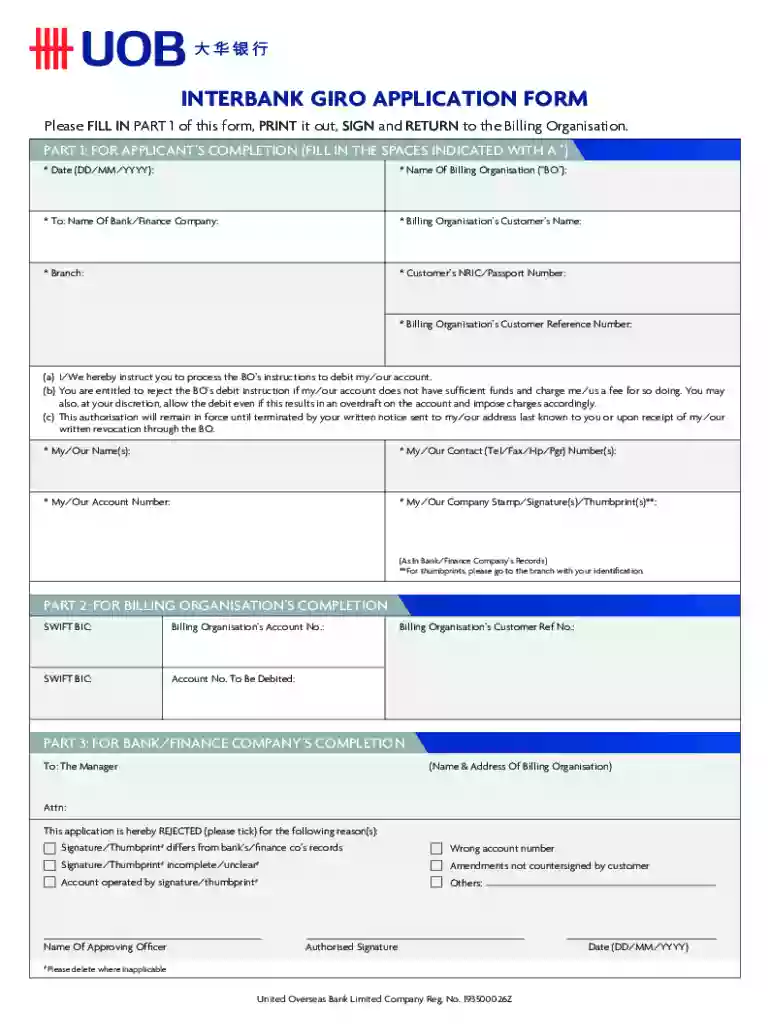
The "UOB Interbank GIRO Form" is a financial document used to authorize electronic funds transfers between bank accounts. Specifically, it facilitates periodic or one-time payments, typically from an individual or business to a billing organization, such as a utility company, educational institution, or other services. This form is essential for setting up GIRO payment instructions, allowing for automated transactions that help streamline billing processes and minimize manual intervention.
Understanding the usage of the UOB Interbank GIRO Form requires careful attention to specific procedures. The form typically contains sections that the applicant must fill out, including personal information, banking details, and the authorization for the billing organization to debit amounts from their account.
Understanding the essential components of the UOB Interbank GIRO Form is crucial to accurate completion and processing. Let's dive into the key elements typically included:
Entering correct information in each section ensures smooth transactions without processing delays. Double-check account numbers and spelling errors, as incorrect information is a common reason for processing failure.
This form serves a broad audience, each with unique needs for seamless banking transactions:



The legal framework surrounding the UOB Interbank GIRO Form ensures that both parties uphold their end of the agreement. Complying with regulations is crucial to avoid legal consequences and to facilitate smoother processing.
Accurate completion of the form is essential, and following a methodical approach helps reduce error potential:
While this document is primarily standard, variations could exist due to specific state laws within the United States:
Understanding the form's intricacies will ensure users can effectively utilize its capabilities, achieve efficient payment scheduling, and maintain compliance with applicable legal standards.
We've got more versions of the interbank giro application form form. Select the right interbank giro application form version from the list and start editing it straight away!
As outlined by eSignature laws, forms signed electronically have the same validity as traditionally approved ones. You can eSign almost any business and personal documentation. Four types of documents still require handwritten signatures only - wills and testamentary trusts, court orders and other court papers, state statutes governing divorce, adoption, or other family law, and notice of cancellation of utility services. If you follow the guidelines and utilize a trustworthy and compliant software solution, like DocHub, you can eSign your interbank giro application form online without printing it.
You can quickly fill out, edit, and even eSign your uob interbank giro application form utilizing DocHub. Create a new profile and start your free trial. After that, you can upload the document with the form and simply make all the needed edits. No need to print on paper or use a third-party application to sign it, as you can place your electronic signature on your document faster via DocHub.
At DocHub, your data security is our priority. We follow HIPAA, SOC2, GDPR, and other standards, so you can work on your documents with confidence.


