




01. Edit your form online
Type text, add images, blackout confidential details, add comments, highlights and more.

Type text, add images, blackout confidential details, add comments, highlights and more.

Draw your signature, type it, upload its image, or use your mobile device as a signature pad.

Send it via email, link, or fax. You can also download it, export it or print it out.
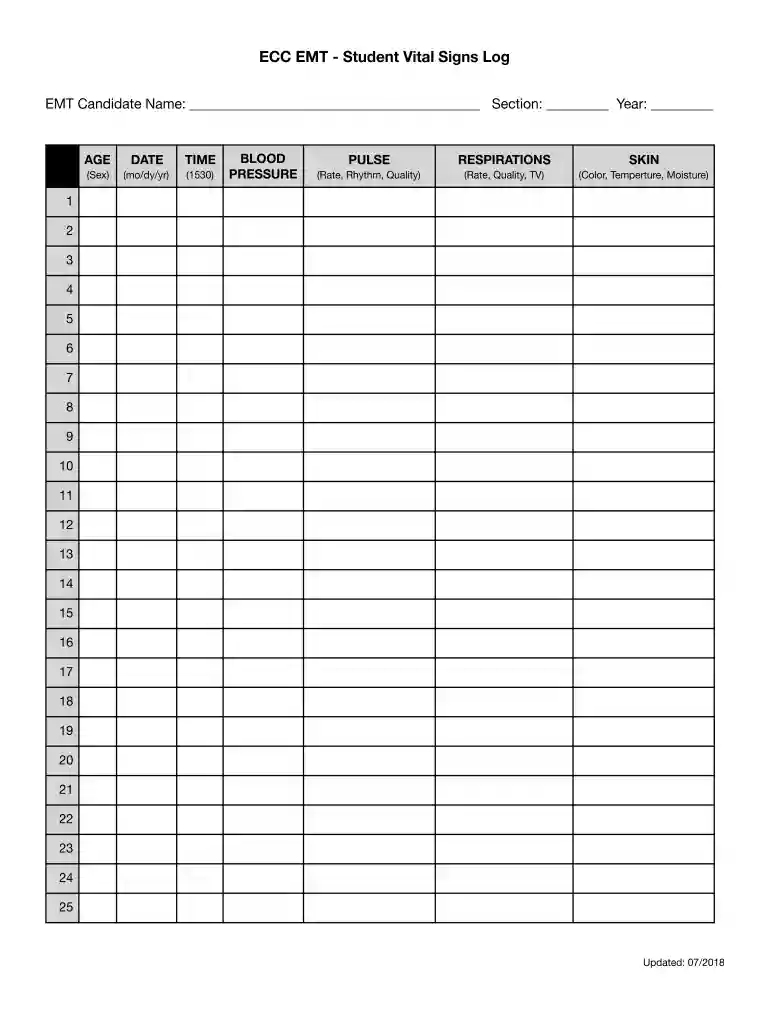
The Vital Signs Log is a structured document designed to record essential patient data crucial for monitoring health status, particularly for Emergency Medical Technician (EMT) students. It serves as a practical training tool for logging vital information such as age, time, blood pressure, pulse, respirations, and skin condition. By systematically arranging these entries, it helps medical trainees develop the necessary skills to effectively assess and monitor patient conditions in real-life scenarios. This log not only facilitates efficient information organization but also contributes to accurate patient care documentation.
Using the Vital Signs Log involves several systematic steps to ensure accurate and thorough data recording.
Completing the Vital Signs Log requires adherence to a sequence of actions ensuring comprehensive data capture.
The primary users of the Vital Signs Log are EMT candidates and educators within medical training programs. It is a crucial educational tool enabling students to practice real-world applications of their learning. Instructors utilize the log in assessment scenarios, evaluating trainee competence in taking and interpreting vital signs. Additionally, practicing paramedics and other healthcare providers may use it for skill refinement and continuous professional development purposes.


The document comprises several vital elements that guide its utility:
Training sessions in medical schools often incorporate case studies to simulate real-life scenarios. For instance, during a mock emergency drill, students use the Vital Signs Log to monitor a simulated patient who presents symptoms of dehydration. They regularly record changes in vital signs, such as an increased pulse and lowered blood pressure, illustrating how practical learning is facilitated through the log. Furthermore, clinical simulations demonstrate how accurate documentation supports diagnosis and treatment plans.
While traditionally maintained as a paper document, digital advancements have enabled Vital Signs Log integration into various software platforms. Systems like DocHub facilitate creating interactive templates, allowing logs to be filled out and shared electronically, enhancing accessibility and reducing paper waste. Digital versions support real-time updates and integration into Electronic Health Record (EHR) systems, aligning with modern medical digital transformation initiatives.
In the U.S., compliance with legal and regulatory standards is crucial when utilizing tools like the Vital Signs Log. Each state may have specific guidelines or additional documentation requirements, especially relevant in professional licensure examinations. Adherence to confidentiality laws such as HIPAA is imperative when handling and sharing patient information. Understanding these rules ensures proper usage and legal compliance while protecting patient privacy and maintaining professional integrity.
We've got more versions of the VITAL SIGNS LOG form. Select the right VITAL SIGNS LOG version from the list and start editing it straight away!
| Versions | Form popularity | Fillable & printable |
|---|---|---|
| 2018 | 4.7 Satisfied (31 Votes) |
At DocHub, your data security is our priority. We follow HIPAA, SOC2, GDPR, and other standards, so you can work on your documents with confidence.


