




01. Edit your dss intake form online
Type text, add images, blackout confidential details, add comments, highlights and more.

Type text, add images, blackout confidential details, add comments, highlights and more.

Draw your signature, type it, upload its image, or use your mobile device as a signature pad.

Send nc 1402 via email, link, or fax. You can also download it, export it or print it out.
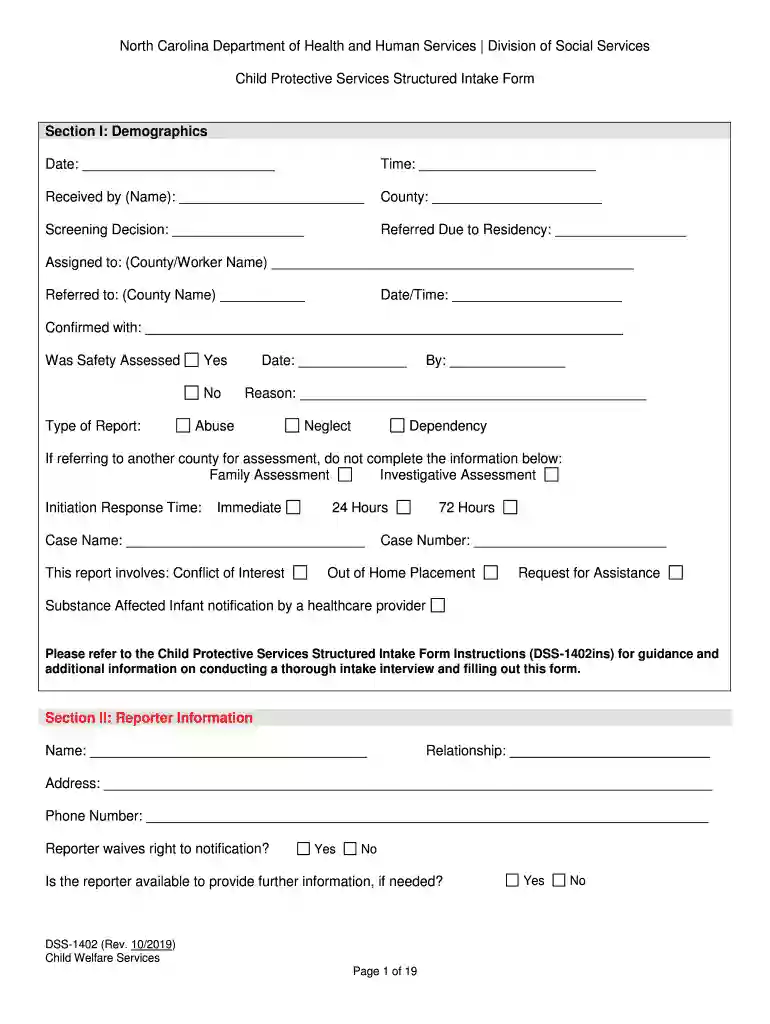
The NC intake form, officially known as the Child Protective Services Structured Intake Form, is a crucial document used within the North Carolina Department of Health and Human Services. This form is pivotal in recording comprehensive details about cases concerning child maltreatment. It serves as a structured guide to ensure thorough documentation of various aspects, including the demographics of involved parties, the reporter’s information, and specifics about the alleged maltreatment. Its primary aim is to facilitate systematic assessments of potential child welfare concerns, ensuring that all relevant data is collected in an organized manner.
Real-world applications of this form often involve social workers and child protective service agents, who use it as the first step in the intervention process. The form ensures uniformity and thoroughness in information gathering, reducing the risk of oversight and improving the quality of the protective services provided.
Completing the NC intake form is a meticulous process involving several steps to capture all relevant child protection details accurately:
Collect Demographic Information: Begin by gathering basic details such as the child's name, age, and address. This section ensures that the identity of the child is clearly documented.
Provide Reporter Details: Document the information of the reporter, including their relationship to the child and contact information. Anonymity options may be available depending on circumstances.
Detail Maltreatment Information: Note specifics about the alleged abuse or neglect, including type, frequency, and any historical context to provide a full picture of the situation.
Assess Family Strengths and Safety Factors: Evaluate and record any observed strengths within the family that may aid in resolving potential issues and note any factors contributing to the child’s safety or risk.
Include Health and Insurance Information: It’s important to fill in details about the child’s physical and mental health status, alongside their health insurance coverage, to plan required support services.
Finalize with Required Signatures: Ensure all necessary parties review the completed form and provide signatures where needed, validating the document for official use.
Each step must be diligently followed to ensure every critical aspect of the child's case is covered, paving the way for accurate and effective intervention measures.
The NC intake form can be accessed through a variety of official channels:
North Carolina Department of Health and Human Services: The form is available on their official website as a downloadable PDF, providing easy access for social workers and authorized personnel.
Local Child Protective Services Offices: Hard copies of the form can be obtained in person, which is ideal for immediate use when technology access is limited.
Request via Mail: For those unable to access online or physical offices, requests can be made to receive the form through mail, though this may be less convenient for urgent cases.
Understanding how to obtain the form is essential for timely intervention in child protection cases, ensuring that authorized personnel can quickly engage with the required documentation.
Several critical elements within the NC intake form ensure comprehensive data collection:
Demographic Details: Includes basic information like name, age, and contact information of the child and family members.
Maltreatment Reports: Documents types of abuse or neglect, providing evidence for further investigation.
Family Dynamics and Strengths: Evaluates the family environment and existing support structures that might mitigate risk factors.
Safety Assessments: Safety factors are documented to outline immediate and potential risks associated with the child's environment.
These elements collectively form a narrative that helps agencies understand the child’s situation fully, aiding in the design of effective intervention strategies.
North Carolina has specific legal and procedural guidelines governing the use of the intake form:
Mandated Reporters: Certain professionals, such as teachers and healthcare providers, are legally required to report suspicions of abuse using this form.
Confidentiality Protocols: The information recorded is subject to strict confidentiality rules intended to protect the privacy of the child and the reporting individual.
Follow-up Protocols: After submission of the form, there are state-regulated procedures dictating how quickly investigations must commence to ensure child safety.
Understanding these rules ensures compliance and enhances the efficiency and effectiveness of the child protection process.
The NC intake form is not just a procedural document; it carries significant legal weight:
Documentation for Legal Proceedings: The form can be used as evidence in court to substantiate claims of maltreatment.
Compliance with Statutory Requirements: Its completion and submission are often necessary to fulfill certain state mandates regarding child protection.
Role in Custody Hearings: Information from the intake form can influence custody decisions, shaping judicial outcomes based on reported evidence.
These aspects illustrate the form's critical role in legal contexts, emphasizing the seriousness of accuracy and thoroughness in completion.
To contextualize the application of the NC intake form, consider these scenarios:
School Teachers Reporting: A teacher observes signs of neglect and uses the form to officially report the case to child protective services, initiating a timely intervention.
Healthcare Professionals: A pediatrician notes suspicious injuries that suggest abuse and submits the form as part of a mandatory reporting obligation.
Social Worker Interventions: A social worker conducts a home visit, completing the form to reflect observed conditions and family interactions that pose potential risks to the child.
These examples showcase the form's versatility and essential role in a variety of professional settings where child welfare is a concern.
Both digital and paper versions of the NC intake form offer unique advantages depending on the context of use:
Digital Version: Provides ease of access, editing, and submission, suitable for work environments with robust digital infrastructure.
Paper Version: Useful in field settings where technology may not be readily accessible, ensuring that documentation can proceed without delay.
Both versions require adherence to confidentiality and security protocols, ensuring that sensitive information is protected across different formats. Understanding the advantages of each helps in optimizing efficiency depending on situational constraints.
We've got more versions of the dss intake form form. Select the right dss intake form version from the list and start editing it straight away!
| Versions | Form popularity | Fillable & printable |
|---|---|---|
| 2019 | 4.8 Satisfied (71 Votes) |
Managing your forms with DocHub this way is extremely easy once you have downloaded its extension for Google Chrome. Go to the Chrome Web Store and set up DocHub - Sign PDF from Gmail to obtain it. Give our tool access to your Google account, and then open an email with the nc intake form attached and point to the file with your cursor - the DocHub extension button will automatically appear there. Click on it to open your document in our editor. Make any required modifications, fill out the blanks, and click Sign to create your legally-binding eSignature.
You may complete and sign your child protective services intake form online, even on a tight deadline. All you need to access top-notch editing tools on any device is a DocHub account, that you can register within a couple of moments. When you register, add your file or find what you are looking for in our catalog, complete it using the editing tools you want, and put your electronic signature on it at the end.
At DocHub, your data security is our priority. We follow HIPAA, SOC2, GDPR, and other standards, so you can work on your documents with confidence.
This manual explains MELDASMAGIC64 installation and connection methods centered on the NC. Card. By installing this NC Card in a personal computer expansionRead more
Appendix 2-2 Sample Intake Form. UNC SOG Logo. UNC School of Government 400 South Road Knapp-Sanders Building, CB 3330. Chapel Hill, NC 27599-3330. T: 919.966.Read more
NC Department of Health and Human Services 2001 Mail Service Center Raleigh, NC 27699-2000. Customer Service Center: 1-800-662-7030. Visit RelayNC forRead more


