




01. Edit your form online
Type text, add images, blackout confidential details, add comments, highlights and more.

Type text, add images, blackout confidential details, add comments, highlights and more.

Draw your signature, type it, upload its image, or use your mobile device as a signature pad.

Send it via email, link, or fax. You can also download it, export it or print it out.
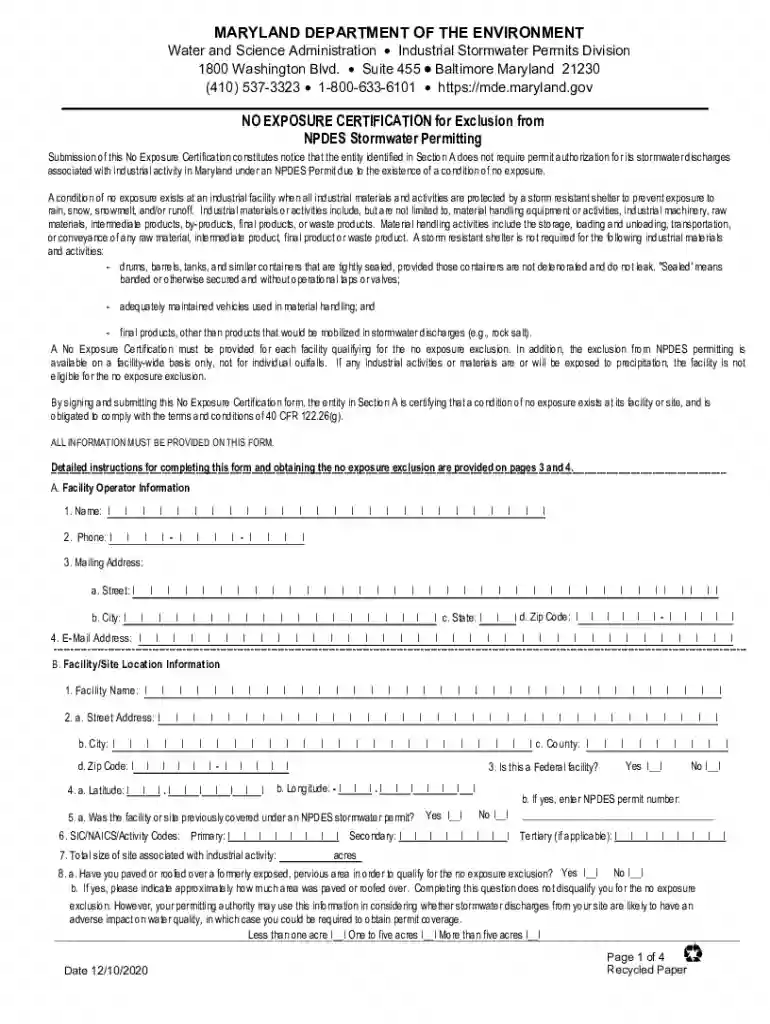
The EPA No Exposure Certification, commonly referred to as the No Exposure Cert, is a form used by industrial facilities to declare that their operations prevent any exposure of industrial activities or materials to precipitation. This condition helps facilities avoid contamination of stormwater and is integral for facilities seeking exclusion from the NPDES stormwater permitting requirements. The term "no exposure" signifies that all potential sources of pollution are sheltered, ensuring no contribution to stormwater pollution.
Understanding the nuances of the No Exposure Cert is crucial for facilities to determine if they meet the requirements for certification. Failure to correctly interpret the definition can lead to non-compliance and the need for an NPDES permit.
The No Exposure Cert requires detailed facility information to assess eligibility for permit exclusion. Key elements include:
These elements form the core of the certification, ensuring that the facility's operational setup aligns with no exposure conditions. Misreported information could mislead regulatory assessments and result in penalties if discovered through site inspections.
Obtaining the No Exposure Cert involves preparing comprehensive documentation that verifies no exposure conditions. Facilities must:
Different states may have additional requirements, and understanding these nuances is essential for compliance. Some states provide a streamlined process through online portals, which can expedite certification issuance.
Completing the No Exposure Cert involves several precise steps:
Attention to detail in filling out the form and ensuring documentation integrity is crucial for successful submission and compliance.
Obtaining the No Exposure Cert provides significant benefits for an industrial facility, including:
These advantages make the No Exposure Cert attractive for facilities looking to efficiently manage environmental compliance while reducing administrative workload.
Each state may have its own regulatory framework and nuances concerning the No Exposure Cert. Understanding state-specific rules is necessary for accurate compliance:
Facilities should consult state environmental agencies or legal experts to ensure they meet localized mandates, avoiding penalties due to non-compliance with state-specific rules.
Familiarity with relevant terms enhances understanding and communication regarding the No Exposure Cert:
These terms form the language of stormwater regulation and are frequently referenced in certification contexts.
The process for submitting the No Exposure Cert can vary based on technological capabilities and state protocols:
Knowing preferred submission methods can save time and ensure compliance with regulatory timelines.
Non-compliance with the No Exposure Cert requirements can result in significant penalties:
Ensuring compliance with the certification process helps mitigate these risks and promotes sustainable environmental practices across industrial sectors.
We've got more versions of the EPA No Exposure Cert form. Select the right EPA No Exposure Cert version from the list and start editing it straight away!
At DocHub, your data security is our priority. We follow HIPAA, SOC2, GDPR, and other standards, so you can work on your documents with confidence.
EPA guidelines that were used in the development of this assessment include the following: Guidelines for Developmental Toxicity Risk Assessment (U.S. EPA, 1991)Read more
Mar 1, 2026 The conditional no exposure exclusion applies to 10 of the 11 categories of stormwater discharges from regulated industrial activities.Read more
A No Exposure Certification is only available to those facilities covered under General Permit No. 1 that meet all applicable criteria. To qualify for a NoRead more


