




01. Edit your form online
Type text, add images, blackout confidential details, add comments, highlights and more.

Type text, add images, blackout confidential details, add comments, highlights and more.

Draw your signature, type it, upload its image, or use your mobile device as a signature pad.

Send it via email, link, or fax. You can also download it, export it or print it out.
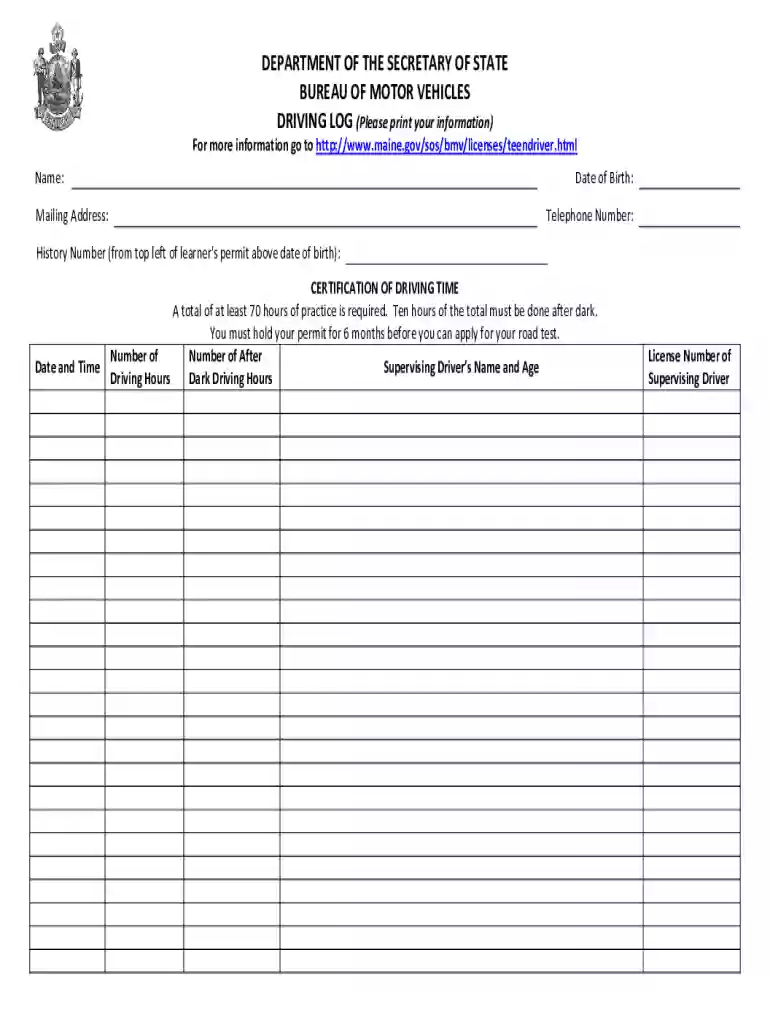
The Bureau of Motor Vehicles Driving Log is a crucial document required by many U.S. states for individuals learning to drive. It serves as an official record to track and verify the practice hours logged by a learner driver. This log typically requires new drivers to document specific amounts of driving time, including various conditions such as day and night driving. Certification by a parent or guardian is often necessary to ensure the accuracy and authenticity of the entries. Falsification of information within this log is legally punishable, highlighting its importance in the process of obtaining a driving license.
To effectively use the Bureau of Motor Vehicles Driving Log, learners should keep the document easily accessible during practice sessions. Each entry must include the date, number of hours driven, conditions of driving (day or night), and may also capture details such as weather or type of roads driven on. Consistent and accurate completion of the log is vital for acquiring the necessary experience needed for a road test. At the end of the required period, the log must be reviewed and signed by a parent or guardian.
Completing the Bureau of Motor Vehicles Driving Log involves specific steps:
Key elements within the Driving Log include:
Each element is crucial for meeting the statutory requirements and verifying eligibility for taking the driver’s test.
The driving log serves as an official document with legal implications. Accurate and truthful entries are critical, as falsifying information can result in legal penalties or disqualification from the driver’s permit process. It's important to adhere to your state's specific guidelines regarding the log and certification process to ensure compliance.
Different states in the U.S. have varying requirements regarding the driving log:
Understanding and adhering to state-specific requirements is crucial for a smooth transition from learner’s permit to a full driving license.
Familiarize yourself with essential terms:
Knowing these terms can aid in understanding the log’s requirements and ensure compliance.
Failing to accurately complete the Bureau of Motor Vehicles Driving Log may lead to substantial repercussions:
Maintaining a detailed and truthful log is not just beneficial but necessary to avoid these consequences.
We've got more versions of the Bureau of Motor Vehicles Driving Log form. Select the right Bureau of Motor Vehicles Driving Log version from the list and start editing it straight away!
At DocHub, your data security is our priority. We follow HIPAA, SOC2, GDPR, and other standards, so you can work on your documents with confidence.
You must hold your permit for 6 months before you can apply for your road test. Date and Time. Number of. Driving Hours. Number of After. Dark Driving Hours.Read more
Study the Driver Handbook. Download the official handbook from the state DMV site. Focus on traffic laws, road signs, and safe-driving tips.Read more
I hereby swear or affirm that I am the parent or lawfully appointed guardian of the applicant and I DocHub that. has completed 40 hours of guided practice,Read more


