




01. Edit your unregistered vehicle permit qld price online
Type text, add images, blackout confidential details, add comments, highlights and more.

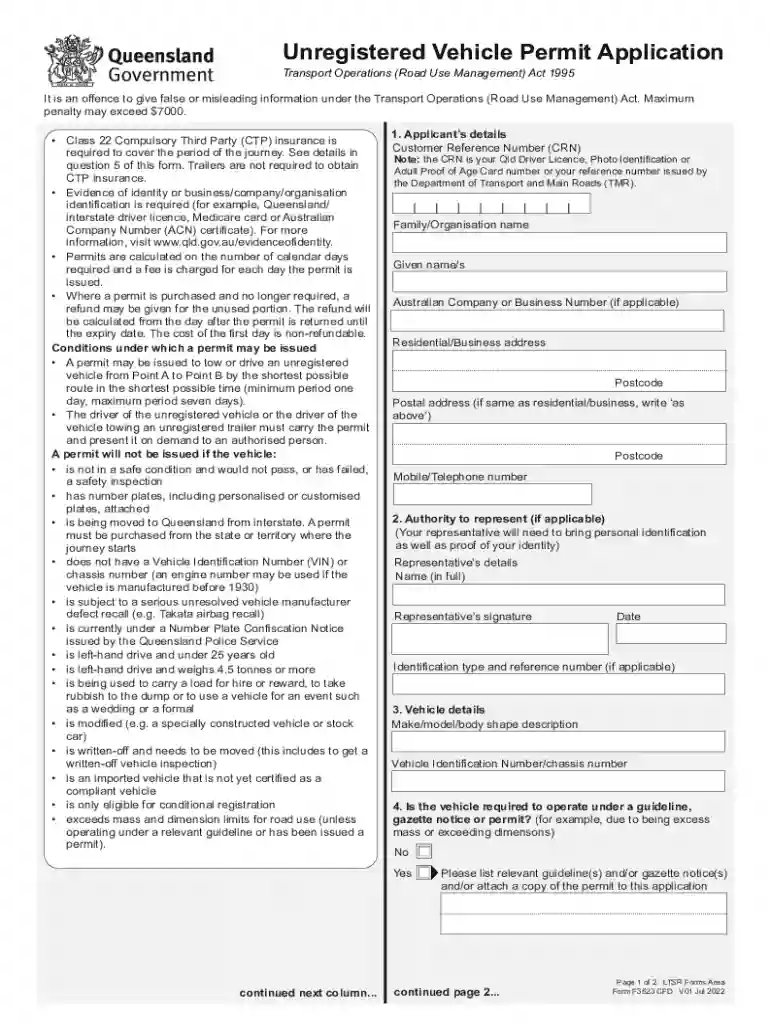
Type text, add images, blackout confidential details, add comments, highlights and more.

Draw your signature, type it, upload its image, or use your mobile device as a signature pad.

Send unregistered vehicle permit qld via email, link, or fax. You can also download it, export it or print it out.
The Unregistered Vehicle Permit (UVP) form is a document sanctioned under the Transport Operations (Road Use Management) Act 1995. It is designed to facilitate the legal operation of vehicles on public roads that are not currently registered. This form is essential for those who need to operate a vehicle temporarily, allowing it to be driven without a current registration. Applicants must have a valid reason for the permit, such as travelling for a vehicle inspection, repair, or relocation. Understanding this document's purpose ensures compliance with transportation regulations while avoiding legal complications.
Gather Required Information: Start by collecting necessary details, including personal identification such as a driver's license, vehicle information like make, model, and VIN, and intended use details.
Fill Out Applicant Information: Enter your personal details accurately, including full name, contact information, and identification number.
Provide Vehicle Details: Accurately record all vehicle-specific information, including the vehicle type, make, model, year, and identification number. Precise data avoids potential delays or issues in processing.
Specify Journey Details: Clearly outline the journey's specifics for which the permit is needed, including origin, destination, and purpose. This is crucial to justify the permit's need.
Review and Sign: After completing the form, review all sections to ensure accuracy and completeness. Sign the form where indicated to confirm the information provided.
Submit and Pay Fees: Follow instructions for submission, which may include mailing, online, or in-person options. Be sure to pay any applicable fees to process the permit.
Eligibility for an unregistered vehicle permit generally requires that the applicant meets specific conditions. The vehicle must be deemed roadworthy and intended for legitimate purposes like transportation to a mechanic or regulatory inspection location. Applicants must hold a valid driver's license and need to substantiate the purpose of the permit through documentation. Meeting these eligibility criteria is vital; failure to do so may result in denial of the permit application, potentially leading to legal ramifications if the vehicle is used without authorization.


The permit’s legal use is strictly for scenarios specified on the form; deviating from these can result in fines or the suspension of driving privileges. Each state may have unique rules regarding how long the permit remains valid and any additional conditions accompanying it. For instance, Queensland permits differ slightly in terms of allowed travel distances and purposes. Understanding these state-specific regulations ensures adherence to local laws and prevent unnecessary penalties.
Understanding these terms will clarify the application process and ensure all steps are completed accurately.
Each use case illustrates a unique situation where permits are legally essential to operate the vehicle on public roads.
While the UVP serves a specific function, understanding other forms of temporary vehicle registration and permits can broaden available options. Each state may offer variants or alternatives tailored to different vehicle types, such as those for agricultural machines or oversized loads. Exploring these variants can provide additional pathways to legally operate vehicles when the standard unregistered vehicle permit does not meet specific needs.
We've got more versions of the unregistered vehicle permit qld price form. Select the right unregistered vehicle permit qld price version from the list and start editing it straight away!
At DocHub, your data security is our priority. We follow HIPAA, SOC2, GDPR, and other standards, so you can work on your documents with confidence.
by B Walker Smith 2024 Cited by 1 This Article is brought to you for free and open access by the Journals at University of Michigan Law School. Scholarship Repository.Read more
It is illegal to operate an OHV on public lands. OHV Act Rules, Fines, Accident Form. Safety Requirements for Operators and/or Passengers Under 18.Read more
by L Crabtree Cited by 33 This Manual was funded by the Western Australian Department of Housing, the City of Port Phillip, the City of Sydney, Inner Melbourne ActionRead more


