







Definition & Purpose of the Statement of Claim Request Form
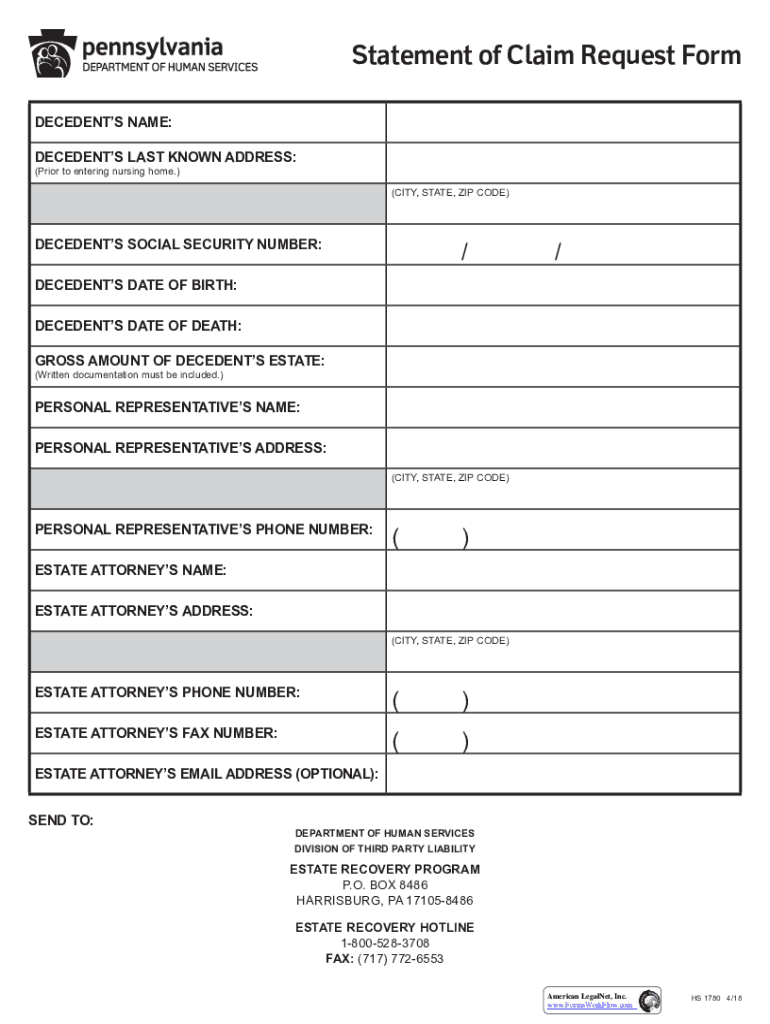
The Statement of Claim Request Form is a legal document used primarily to report the details of a decedent's estate, including pertinent personal information and estate representative details, to the Department of Human Services as part of the Estate Recovery Program. This form is critical for notifying relevant authorities about the assets and liabilities involved in an estate's settlement, ensuring compliance with legal obligations and facilitating the recovery of state-provided benefits.
- Estate Recovery Program: In the United States, this program mandates the reimbursement of Medicaid benefits from the estates of deceased individuals who were Medicaid recipients.
- Personal Information: Includes the decedent's name, date of death, Social Security number, and last known address.
- Estate Representative: Typically, this is the person responsible for administering the estate, such as an executor or administrator.
How to Use the Statement of Claim Request Form
To effectively use the Statement of Claim Request Form, the estate representative should follow these steps:
- Gather Necessary Information: Collect all required personal data about the decedent and details about the estate.
- Consult Legal Counsel: Depending on the complexity of the estate, it might be prudent to seek legal advice to ensure the correctness and completeness of the form.
- Complete the Form Accurately: Fill out all sections, adhering to the guidelines provided by the Department of Human Services.
- Submit the Form: The completed form should be submitted according to the prescribed method, whether online, by mail, or in person.
Practical Example
- Example Scenario: Jane Doe, an executor, needs to file the Statement of Claim to report the estate details of her deceased uncle, highlighting liabilities like outstanding Medicaid claims.
Steps to Complete the Statement of Claim Request Form
Completing the Statement of Claim Request Form requires attention to detail and accuracy. Here is a step-by-step guide:
- Enter Decedent Information: Provide all relevant identification details about the deceased, including legal name, date of birth, and Social Security number.
- List Estate Assets and Liabilities: Detail any property, financial accounts, and debts associated with the estate.
- Authentication and Signature: The estate representative must sign the form, verifying the accuracy of the provided information.
- Review and Correct Errors: Before submission, carefully review all entries for accuracy and completeness to avoid delays.
Important Terms Related to the Statement of Claim Request Form
Understanding key terminology is essential for correctly completing the Statement of Claim Request Form:
- Decedent: The deceased person whose estate is being managed.
- Executor: Individual named in the will to administer the estate.
- Administrator: Court-appointed individual to manage the estate if no will exists.
- Medicaid Claim: Potential reimbursement obligation to the state for Medicaid benefits received by the decedent during their lifetime.
Submission Methods for the Statement of Claim Request Form
The submission process for the Statement of Claim Request Form can vary by location and method:
- Online: Some states allow digital submission through secure portals. This method often includes instant confirmation and can be more efficient.
- Mail: Traditional paper submission via postal service remains a common method. It requires ensuring all necessary documents are included before sending.
- In-Person: Submission directly at a Department of Human Services office, which can provide the advantage of immediate processing and feedback.
Edge Cases
- Missing Information: Submitting incomplete forms can lead to processing delays or rejections. It is crucial to double-check for completeness.
- State Variations: Different states might have unique requirements or additional documentation that must accompany the form.
Who Typically Uses the Statement of Claim Request Form
The primary users of the Statement of Claim Request Form include:
- Estate Representatives: Executors or administrators handling the affairs of the deceased.
- Attorneys: Legal practitioners assisting with estate planning and execution.
- Family Members: Relatives who might need to interact with the estate for legal or administrative reasons.


Legal Use of the Statement of Claim Request Form
The proper legal use of this form is dictated by state regulations:
- Verification: All provided information must be truthful and verifiable, often requiring supporting documentation.
- Compliance: Adhering to submission deadlines is crucial to avoid legal complications or penalties.
- Confidentiality: Personal and financial details on the form should be protected as per privacy laws.
Penalties for Non-Compliance
Failing to correctly file the Statement of Claim Request Form can lead to significant repercussions:
- Financial Penalties: Fines might be levied for late or inaccurate submission.
- Legal Action: Persistent non-compliance can result in court proceedings against the estate representative.
- Delayed Estate Settlements: Incomplete processing may hinder the timely distribution of the decedent's assets.
State-Specific Rules for the Statement of Claim Request Form
Each state may have distinct requirements for filing the Statement of Claim Request Form:
- Regulatory Bodies: Engage with local Department of Human Services offices to understand jurisdiction-specific rules.
- Additional Documentation: Certain states might require extra forms or attestations to accompany the primary document.
In summary, the Statement of Claim Request Form is a vital component of estate management within the United States, tied closely to legal and financial processes for recovering Medicaid and other state benefits. Understanding its components, usage, and compliance demands is crucial for estate representatives and their advisors.




