




01. Edit your ir330 form online
Type text, add images, blackout confidential details, add comments, highlights and more.

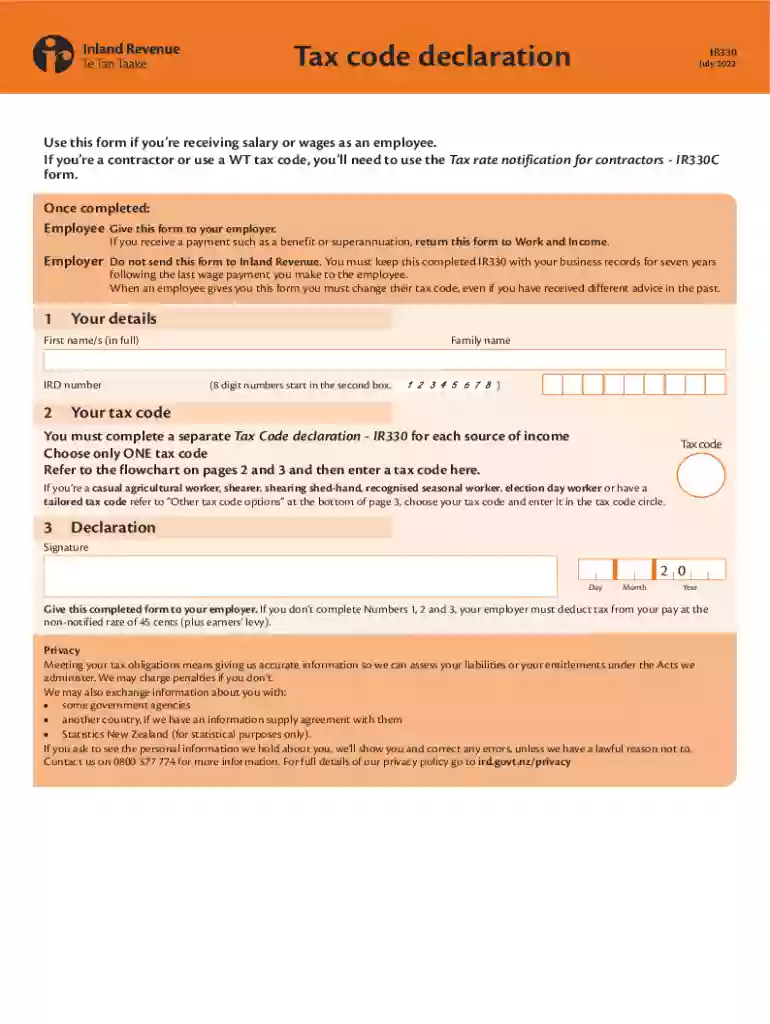
Type text, add images, blackout confidential details, add comments, highlights and more.

Draw your signature, type it, upload its image, or use your mobile device as a signature pad.

Send ird forms ir330 via email, link, or fax. You can also download it, export it or print it out.
The IR330 form is a Tax Code Declaration form used in New Zealand. This form is tailored for employees to declare their tax codes for income derived from salary or wages. It's a fundamental document that ensures individuals are taxed accurately based on their specific income situation.
The purpose of this form is to gather necessary information to apply the correct tax rate. Incorrect tax code declarations can lead to underpayment or overpayment of taxes, which may require adjustments in the future. New Zealand employers utilize the IR330 to determine the amount of tax to withhold from an employee's pay.
To use the IR330 effectively, you must understand the different sections of the form. This includes selecting the appropriate tax code that corresponds to your employment situation. The following steps outline how to complete the form:
By following these steps, employees can ensure they are taxed correctly, minimizing potential issues with the Inland Revenue Department.
Completing the IR330 involves several key steps that must be followed carefully:
Familiarizing yourself with the key terms associated with the IR330 will aid in a smooth completion process:
Understanding these terms will help avoid errors in tax code designation and ensure compliance with tax regulations.
The legal significance of the IR330 is rooted in its role in tax administration:
Employers must store these forms as part of their payroll records, aligning with legal record-keeping requirements mandated by the government.
The IR330 form comprises several critical sections and elements:
Comprehension and accurate filling of these elements are crucial to correctly formulating your tax obligations and responsibilities.
Different scenarios demonstrate the practical application of the IR330:
These examples pinpoint the versatility of the IR330 in adapting to varying employment and income situations.
While there is no fixed submission deadline for the IR330, it’s vital that employees complete and submit this form promptly upon starting a job or when their employment situation changes. Key timeframes to be mindful of include:
Timeliness in submission ensures proper tax deductions and keeps communication smooth between employee, employer, and the Inland Revenue Department.
We've got more versions of the ir330 form form. Select the right ir330 form version from the list and start editing it straight away!
At DocHub, your data security is our priority. We follow HIPAA, SOC2, GDPR, and other standards, so you can work on your documents with confidence.
The course is designed to get students familiarized with the art of the possible, emphasizing how diplomatic practice has evolved so far.Read more
by J Lai 2013 Cited by 235 FT-IR spectra were collected on an Avatar Nicolet FT-IR330 spectrometer. Raman spectrum characterizations were performed on Laser Raman, Renishaw inViaRead more


