




01. Edit your form online
Type text, add images, blackout confidential details, add comments, highlights and more.

Type text, add images, blackout confidential details, add comments, highlights and more.

Draw your signature, type it, upload its image, or use your mobile device as a signature pad.

Send it via email, link, or fax. You can also download it, export it or print it out.
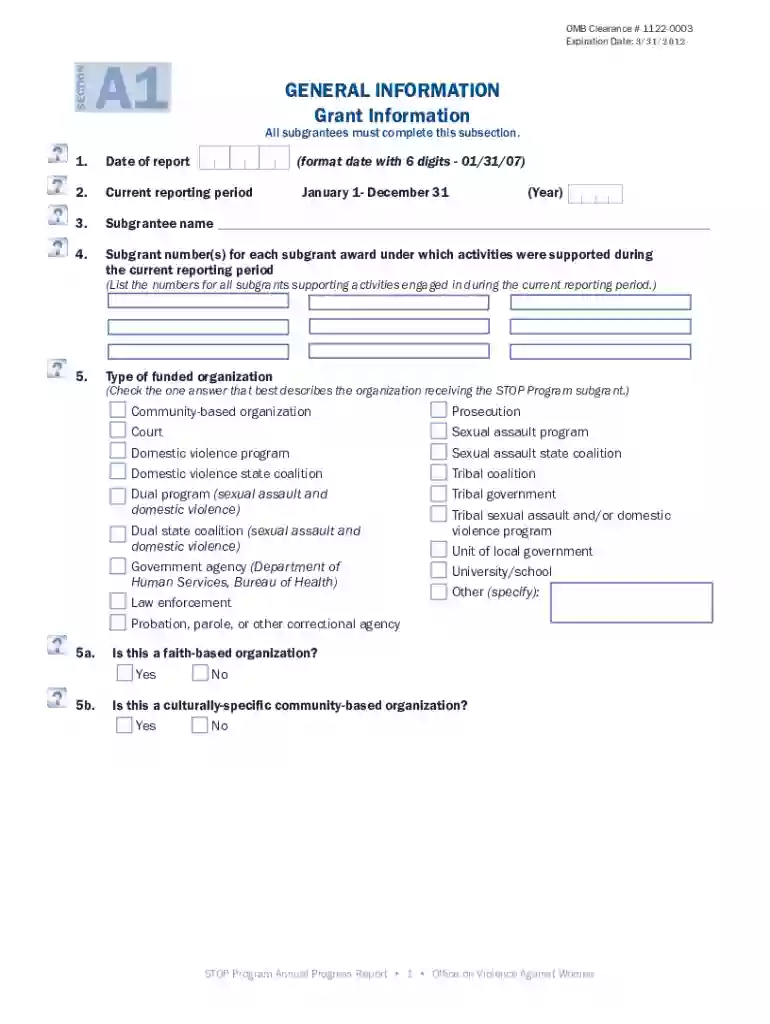
The Annual Progress Report for the STOP Violence Against Women Formula Grant Program serves as a comprehensive document managed by the U.S. Department of Justice's Office on Violence Against Women. It collects detailed data from subgrantees to assess the effectiveness and reach of funded programs. The report aims to improve services for victims of sexual assault, domestic violence, dating violence, and stalking.
Accurate completion of the report is crucial as it informs federal evaluations and policy adjustments. By providing precise data, subgrantees contribute to national efforts to enhance safety mechanisms for women facing violence.
The report can be accessed through official channels provided by the U.S. Department of Justice. Typically, it is distributed electronically to eligible entities involved in the STOP Violence Against Women Formula Grant Program, allowing them to download and complete necessary sections.
Official agency websites and dedicated grant management portals often host downloadable versions of this report. Subgrantees should ensure they retrieve the latest version to comply with current guidelines.
Organizations participating in the STOP Violence Against Women Program, including non-profits, advocacy groups, and state/local government agencies, are the primary entities completing this report. They coordinate efforts to provide comprehensive support services for impacted women.
By documenting progress, these organizations enhance public safety and community support infrastructure, making significant strides towards ending violence against women.
Completion of this report is a mandatory requirement for continued funding under the grant program. It serves both a legal and operational purpose by ensuring compliance with federal reporting standards and aiding in the formulation of targeted violence prevention strategies.
Failure to submit the report accurately and on time could result in funding revocations or future grant ineligibility, hindering programs that rely on federal assistance.
Reports can typically be submitted electronically through designated DOJ platforms, ensuring rapid transmission and receipt confirmation. Mail and in-person submissions may be available but are less common due to the efficiency of electronic processes.
Departments usually set specific annual deadlines for submission, with penalties for late submissions. It is crucial for subgrantees to be aware of these deadlines to maintain compliance and secure continued funding.
We've got more versions of the Annual Progress Report For STOP Violence Against Women Formula Grant Program form. Select the right Annual Progress Report For STOP Violence Against Women Formula Grant Program version from the list and start editing it straight away!
At DocHub, your data security is our priority. We follow HIPAA, SOC2, GDPR, and other standards, so you can work on your documents with confidence.
Subgrantees shall complete annual progress reports and submit them to the State, which shall review them and submit them to OVW or as otherwise directed.Read more
Brief Instructions: This form must be completed for all STOP Violence Against Women Formula Grant Program (STOP. Program) subgrants received.Read more
Oct 5, 2018 To provide protections for certain sports medicine professionals, to reauthorize Fed- eral aviation programs, to improve aircraft safetyRead more


