




01. Edit your form online
Type text, add images, blackout confidential details, add comments, highlights and more.

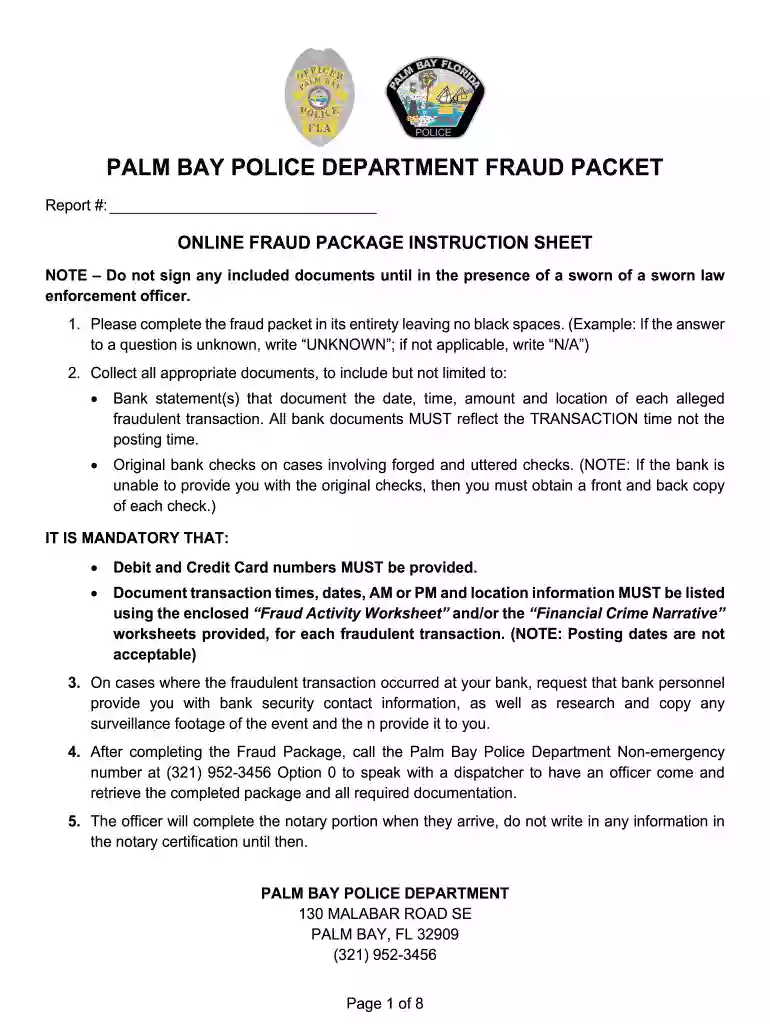
Type text, add images, blackout confidential details, add comments, highlights and more.

Draw your signature, type it, upload its image, or use your mobile device as a signature pad.

Send it via email, link, or fax. You can also download it, export it or print it out.
The Fraud Packet Online is a comprehensive collection of forms and instructions designed to assist victims of online fraud and identity theft. Its purpose is to facilitate the reporting and documentation process when individuals suspect fraudulent activities affecting their financial accounts or personal identity. This packet is typically provided by law enforcement agencies, such as the Palm Bay Police Department, and encompasses essential forms, detailed steps for gathering evidence, and protocols for legitimate dispute procedures. It acts as a pivotal tool for victims to officially document fraud incidents and initiate corrective actions.
Using the Fraud Packet Online requires meticulous attention to detail as it involves collecting and compiling evidence of the fraudulent activity. Here’s a structured approach to effectively utilizing the packet:
This step-by-step use ensures that all necessary protocols are followed, safeguarding the legitimacy and accuracy of the fraud claim.
Completing the Fraud Packet Online involves several specific steps that must be carried out methodically to ensure full compliance and accuracy:
Following this process precisely is crucial for the packet’s acceptance and subsequent action by law enforcement authorities.
Certain documentation is critical when dealing with fraud reports to substantiate the claims effectively:
These documents provide the necessary evidence to support the claims detailed in the fraud packet and are instrumental in the investigative process.
The legal use of the Fraud Packet Online is governed by strict protocols to ensure its effectiveness in combating fraud:
Utilizing the packet legally ensures that the victim’s rights are protected and that the documented evidence is admissible in any subsequent legal processes.
A well-structured fraud packet includes several pivotal elements designed to capture comprehensive information about the fraudulent activity:
These elements are integral to constructing a robust case report that law enforcement can reliably act upon.
The Fraud Packet Online is tailored to address several kinds of fraudulent activities that affect individuals:
This categorization allows the fraud packet to address a wide range of fraudulent scenarios, ensuring victims can report various types using the same comprehensive tool.
The Fraud Packet Online is commonly utilized by individuals who have been victims of identity theft or online financial fraud. It is particularly valuable for:
These groups significantly benefit from the structured and systematic approach the packet provides, enabling them to seek redress through official channels.


We've got more versions of the Fraud Packet Online form. Select the right Fraud Packet Online version from the list and start editing it straight away!
| Versions | Form popularity | Fillable & printable |
|---|---|---|
| 2020 | 4.4 Satisfied (30 Votes) |
Upload your Fraud Packet Online to DocHub (once you’ve set up an account for this). If you need to complete fields in it, use appropriate tools from the upper pane. For instance, add Signature Fields, assign each to a particular party, and click on Sign → Request signatures from others. Personalize your message for your recipients and click Send Request. You can also send your document by fax or as a Signing link instead of using email (you’ll find these options by navigating to the Menu → Send)
You can easily complete, modify, and even eSign your Fraud Packet Online using DocHub. Create a new account and start your free trial. After that, you may add the file with the form and easily make all the required edits. No need to print on paper or use a third-party application to sign it, as you can place your electronic signature on your document faster through DocHub.
At DocHub, your data security is our priority. We follow HIPAA, SOC2, GDPR, and other standards, so you can work on your documents with confidence.
Aug 8, 2006 Software necessary and used predominantly to create, maintain, transmit, or receive electronic health records. Software pack- ages may includeRead more
Once an investigation is completed and a claim is deemed to be fraudulent, NYS DOL immediately shuts down the fraudulent claim and no more benefits are paid.Read more
IC3 is the main intake form for a variety of complaints everything from cyber-enabled frauds and scams to cybercrime so file a report even if you are unsureRead more


