




01. Edit your form online
Type text, add images, blackout confidential details, add comments, highlights and more.

Type text, add images, blackout confidential details, add comments, highlights and more.

Draw your signature, type it, upload its image, or use your mobile device as a signature pad.

Send it via email, link, or fax. You can also download it, export it or print it out.
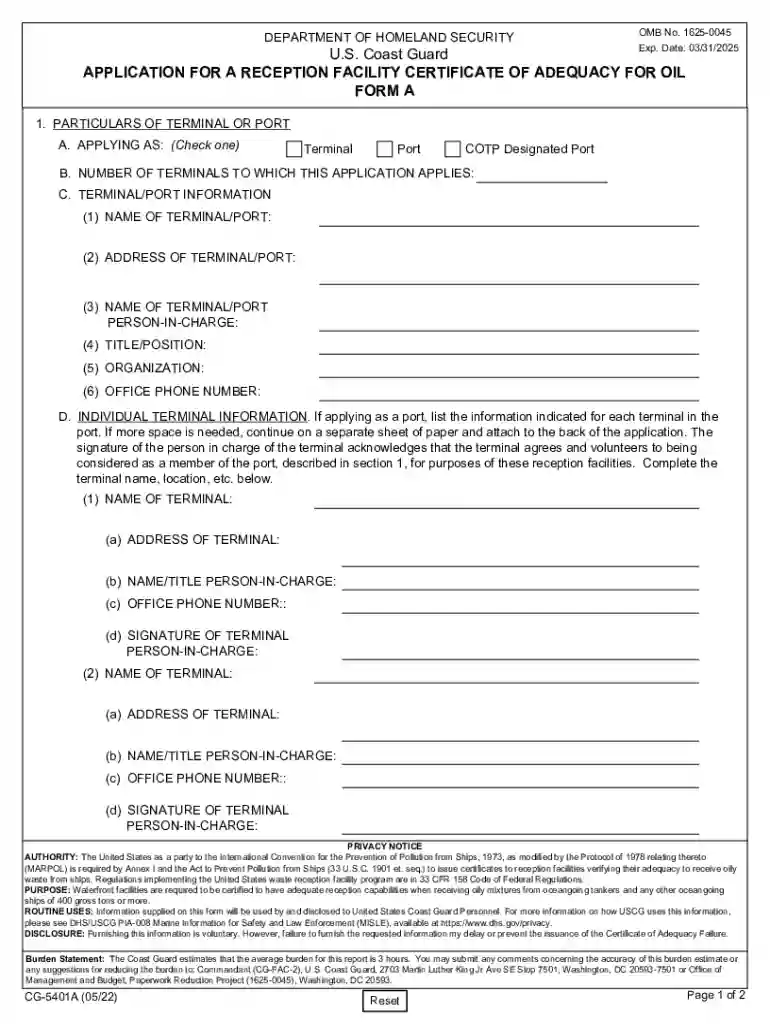
The Application for Certificate of Adequacy (COA) for Reception Facilities Form A is a critical document required by the United States and international maritime regulations. This form is used by port and terminal operators to certify that their facilities can adequately manage and process oily waste from ships. By adhering to this certification process, facilities demonstrate compliance with established environmental and safety standards, mainly aimed at preventing marine pollution.
Understanding the core components of the COA for Reception Facilities Form A is essential for proper completion. These elements typically include:
Filling out the COA for Reception Facilities Form A involves several steps:
Eligibility to apply for a Certificate of Adequacy requires that facilities meet specific standards:


The COA for Reception Facilities Form A is primarily utilized by:

Failing to obtain or correctly complete the COA for Reception Facilities Form A can result in:
Submitting this form often requires accompanying documentation such as:
Facilities can submit the COA for Reception Facilities Form A through several methods:
The COA for Reception Facilities Form A ensures legal compliance with maritime environmental standards. Correct usage includes:
The application process involves:
While both options are available, the choice between digital and paper submissions depends on:
By addressing each of these aspects with thorough explanations and practical scenarios, stakeholders can confidently navigate the COA application process, ensuring that their facilities remain compliant with essential environmental and safety standards.
We've got more versions of the Application for Certificate of Adequacy (COA) for Reception Facilities Form A form. Select the right Application for Certificate of Adequacy (COA) for Reception Facilities Form A version from the list and start editing it straight away!
At DocHub, your data security is our priority. We follow HIPAA, SOC2, GDPR, and other standards, so you can work on your documents with confidence.
Applicants for a Certificate of Adequacy required by 158.135(a) or (b) must apply to the COTP of the Zone in which the port or terminal is located using FormRead more
Oct 5, 2018 To provide protections for certain sports medicine professionals, to reauthorize Fed- eral aviation programs, to improve aircraft safetyRead more


