Definition & Meaning
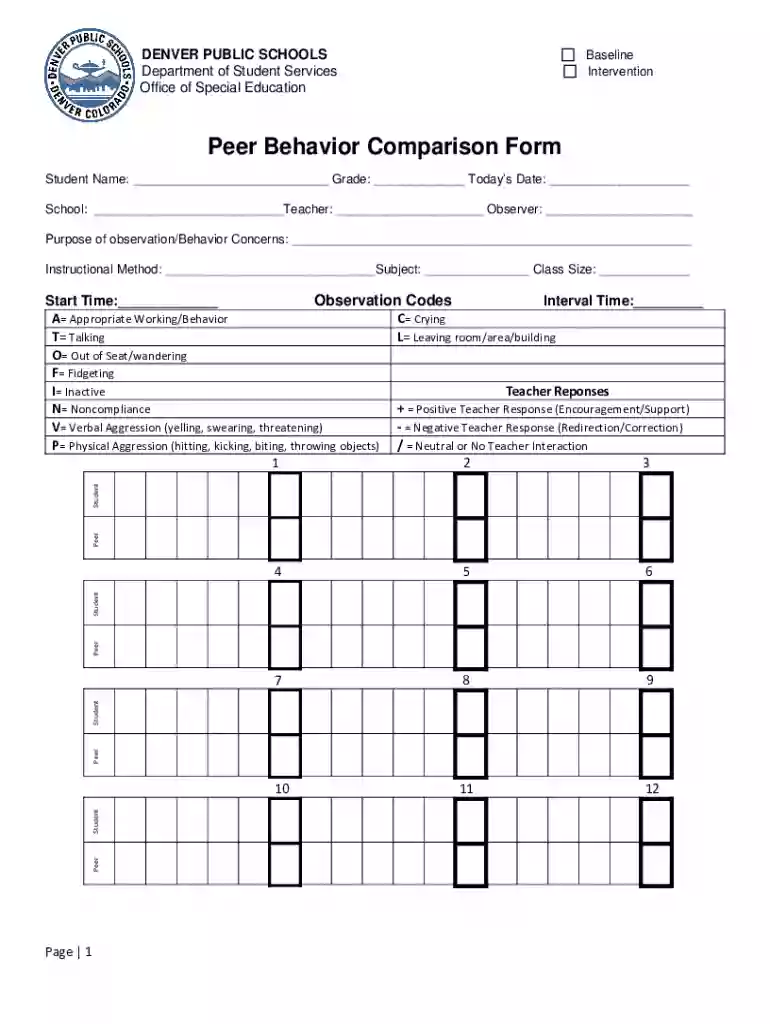
The Peer Comparison Observation Form is a tool used in the educational setting to monitor and assess student behaviors during classroom activities. This form is vital for educators, particularly those in special education, to gain insights into student interactions and behaviors compared to their peers. It typically includes detailed sections for recording specific observations, helping teachers make informed decisions about student needs and interventions.
Purpose and Usefulness
- Observation: Facilitates structured observation of students, allowing for systematic recording of interactions and behaviors.
- Comparison: Assists in comparing individual student behaviors to peers, highlighting areas needing attention or support.
- Documentation: Provides documentation for meetings with parents, special education teams, or for official assessments.
How to Use the Peer Comparison Observation Form
Using the Peer Comparison Observation Form involves several steps to ensure accurate and useful data collection.
- Preparation: Review the form and understand each section before starting observations. Ensure clarity on the behaviors to be observed and recorded.
- Observation: During classroom activities, the observer should discreetly note behaviors, focusing on both individual actions and interactions with peers.
- Coding: Use the coding system provided on the form to categorize behaviors efficiently. This often involves marking observed behaviors against preset categories.
- Analysis: After completing observations, analyze the noted behaviors in comparison to peers to identify patterns or specific needs.
- Reporting: Compile the data into a report which can be shared with educators and stakeholders to develop or adjust educational strategies.
Key Elements of the Peer Comparison Observation Form
The Peer Comparison Observation Form includes several critical sections that support the evaluation process:
- Identification Fields: Areas for student and observer details to ensure accurate tracking.
- Behavior Coding System: A defined set of codes representing various behaviors and interactions.
- Peer Interaction Section: Dedicated space for noting specific peer-related behaviors and interactions.
- Observer Comments: Space for detailed notes and observations, providing context beyond the coding system.
Common Examples of Sections
- Student Information: Name, age, grade, and other identifying details.
- Behavior Categories: Categories that may include communication, social interaction, attention, and participation.
- Observer Notes: Personal observations and insights beyond the coding checklist offer deeper understanding.
Who Typically Uses the Peer Comparison Observation Form
The Peer Comparison Observation Form is primarily used by educators and professionals within the schooling system.

- Special Education Teachers: Utilize the form to track and support special education students.
- School Psychologists: Work with the form to assess student needs and contribute to special education assessments.
- General Educators: May use the form to identify students who might benefit from additional support or services.
Professional Contexts
- Assessment Meetings: Used in meetings to discuss student progress and needs.
- Intervention Planning: Helps in developing tailored interventions or support plans.
Steps to Complete the Peer Comparison Observation Form
Completing the form requires attention to detail and a systematic approach:
- Initial Setup: Fill out the student and observer information at the top of the form. Prepare any additional materials needed for coding behaviors.
- Engage in Observation: Observe the student over a specified period. Note behaviors using the coding system and add detailed notes for context.
- Analysis and Review: Once observation is complete, review and analyze the data. Compare against peer behaviors to identify any significant patterns or outliers.
- Document Findings: Write a detailed report compiling all observations and analyses, which can be used for further discussions or planning.
Legal Use of the Peer Comparison Observation Form
Using the Peer Comparison Observation Form involves adherence to specific legal and ethical guidelines:
- Confidentiality: All data collected should be kept confidential and handled according to privacy laws such as the Family Educational Rights and Privacy Act (FERPA).
- Consent: In certain cases, parental consent might be necessary before conducting observations, particularly if data is used outside standard educational assessments.
- Compliance: Ensure compliance with both federal and state educational laws and regulations.
Privacy Considerations
- Data Storage: Secure storage of all forms and observations to prevent unauthorized access.
- Sharing Data: Restricted sharing; data should only be shared with authorized personnel.
Important Terms Related to the Peer Comparison Observation Form
Understanding specific terms related to the form can enhance its effective use:
- Behavior Coding: The process of assigning standardized codes to observed behaviors for effective categorization.
- Peer Interactions: Observations focusing on how the student engages with classmates can include communication and collaborative actions.
- IEP (Individualized Education Program): A plan tailored to the needs of a student with disabilities, which can be informed by data from the observation form.
Software Compatibility
Although the Peer Comparison Observation Form is primarily paper-based, it can also be adapted to digital platforms for added ease.
- Digital Platforms: Incorporate the form into platforms like DocHub, enabling online editing and sharing.
- Integration: Use alongside educational management software for more comprehensive data management.
Benefits of Digital Versions
- Accessibility: Easy access and sharing among educators and stakeholders.
- Efficiency: Digital editing and storage reduce physical paperwork.
Examples of Using the Peer Comparison Observation Form
Real-world applications of the form can vary based on student needs and educational contexts:
- Case Study: A sample case where a student showing withdrawn behavior was observed over several weeks. The data gathered highlighted a lack of peer interaction, prompting targeted social skills interventions.
- Scenario: In a class focusing on group projects, the form revealed which students consistently demonstrated leadership qualities, informing team assignments and leadership development programs.
- Comparison Insight: Comparison with peers revealed a student with persistent distractions, leading to an evaluation for attention-related interventions.