




01. Edit your philippines trademark application form online
Type text, add images, blackout confidential details, add comments, highlights and more.

Type text, add images, blackout confidential details, add comments, highlights and more.

Draw your signature, type it, upload its image, or use your mobile device as a signature pad.

Send it via email, link, or fax. You can also download it, export it or print it out.
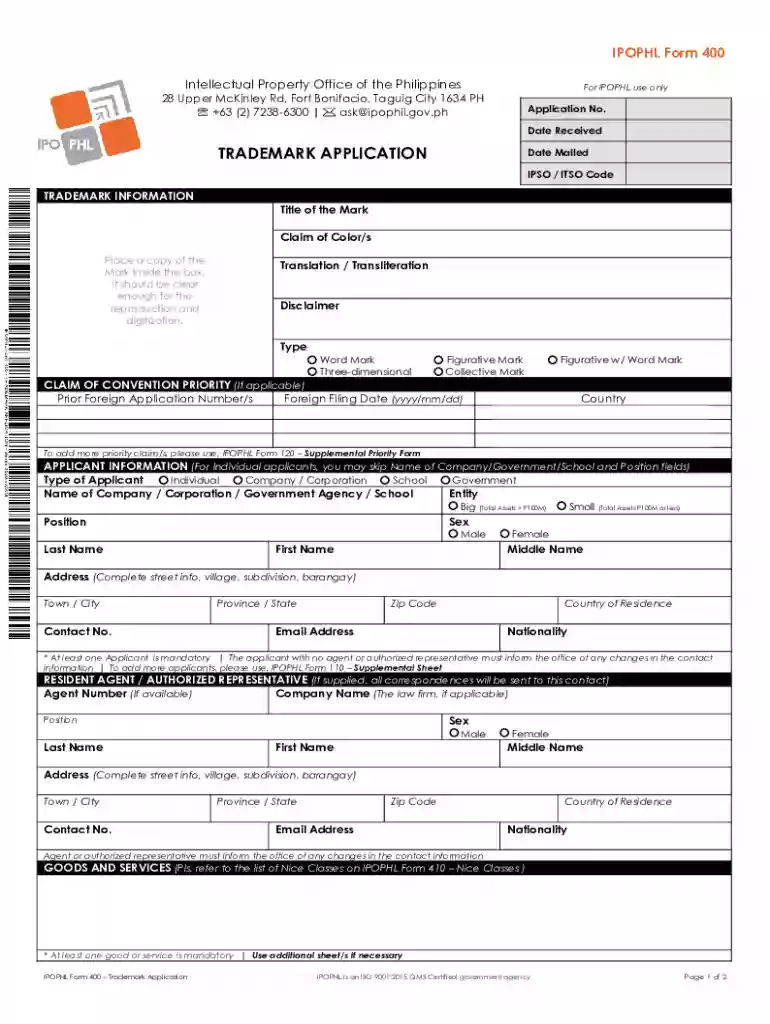
The IPOPHL Form 400 is a formal document used for trademark application processing with the Intellectual Property Office of the Philippines (IPOPHL). This form is essential for businesses or individuals seeking to register their trademarks, ensuring legal protection for their unique symbols, logos, or brand identifiers. Utilizing this form facilitates trademark protection, builds brand identity, and prevents unauthorized use by others. The registration process includes providing comprehensive details about the trademark and its intended use, which are crucial for the application’s approval.
Acquiring the IPOPHL Form 400 can be accomplished efficiently online to cater to the needs of applicants from the United States. To begin, visit the official IPOPHL website, where the form is available for download in a fillable PDF format. This digital availability ensures easy access and the ability to complete the form using document editing tools like DocHub, which supports a wide array of file formats. The convenience of online access reduces the time and effort required to commence the trademark registration process.
Filling out the IPOPHL Form 400 requires careful attention to detail to ensure the application is processed without delays. Here is a step-by-step guide to completing the form:
Trademark Information: Begin by entering the name and representation of your trademark. Include any distinctly identifying features like colors or design elements if applicable.
Applicant Details: Provide accurate personal or business information, depending on whether the applicant is an individual or an organization. This includes names, addresses, and contact details.
Authorized Representatives: If someone will act on your behalf, such as an attorney or representative, their full details and authorization need to be documented.
Goods/Services Classification: Classify the goods or services associated with the trademark according to the Nice Classification system, which categorizes products and services into different classes.
Declaration of Use: Confirm the goods or services will be introduced in the market soon after registration, adhering to legal requirements.
Completing this process accurately is vital for ensuring your application meets IPOPHL's requirements.
Understanding specific terminology within the IPOPHL Form 400 can simplify the completion and submission process.
Familiarity with these terms can help clarify the requirements and streamline the completion process.
The legal use of the IPOPHL Form 400 is governed by various intellectual property laws which mandate adherence to specific standards. This form is used to establish a legal claim over a trademark and prevent misuse or infringement by others. Businesses and individuals protect their brand equity and reputation by legally securing their trademarks. The application outcomes are subject to thorough evaluation against the set criteria, underscoring the importance of accurate and complete submissions.
The IPOPHL Form 400 includes several critical elements that determine the effectiveness of the trademark application:
These elements collectively ensure the application aligns with the necessary legal requirements, increasing the likelihood of successful trademark registration.
Submitting the IPOPHL Form 400 can be done through various channels to accommodate different preferences. Options include:
Online Submission: Filing it directly on the IPOPHL website is the most convenient and fast method, eliminating mailing time and providing immediate confirmation of receipt.
Mail: If preferred, the completed form can be mailed to the IPOPHL office, though processing may be slower than online submissions.
Choosing the appropriate submission method is crucial for efficient and timely application processing, especially when under strict deadlines.
To apply for a trademark using the IPOPHL Form 400, applicants must meet specific eligibility criteria:
Meeting these criteria ensures the application is processed swiftly, and the trademark is legally recognized.


The application process for the IPOPHL Form 400 involves specific stages that applicants should anticipate:
Understanding this process helps applicants prepare and manage their expectations regarding the timeframe for obtaining trademark registration.
Various business entities may find trademark registration via IPOPHL Form 400 particularly beneficial:
These businesses often gain significant legal advantages and market differentiation through proper trademark registration.
We've got more versions of the philippines trademark application form form. Select the right philippines trademark application form version from the list and start editing it straight away!
Sure, a typed name is accepted as a valid electronic signature when you create it on your document utilizing a compliant solution like DocHub. Simply add your IPOPHLFillable Form 400PDFTrademark to our editor, click Sign in the top tool pane → Create your signature → Type your name in the appropriate tab, and decide how it will appear on your document.
You may get and edit your IPOPHLFillable Form 400PDFTrademark online by using DocHub. Its straightforward yet feature-rich design enables you to begin effective work immediately after you sign up your account. Create your account and add your file, then our user interface will guide you via our stress-free form completion experience.
At DocHub, your data security is our priority. We follow HIPAA, SOC2, GDPR, and other standards, so you can work on your documents with confidence.


